Stock Analysis · F.N.B. Corp (FNB)
Overview
F.N.B. Corp is a regional bank holding company headquartered in Pennsylvania. Through First National Bank, it provides traditional banking services such as deposits, commercial and consumer loans, treasury management, and payment services, along with wealth management and insurance offerings. Its footprint is concentrated in Pennsylvania, Ohio, Maryland, West Virginia, North Carolina, South Carolina, Virginia, and the Washington, D.C. area, giving it a meaningful presence in the Mid-Atlantic and Southeast.
Like most banks, F.N.B. makes most of its money from the spread between what it earns on loans and securities and what it pays on deposits and other funding. Based on recent annual reporting, revenue is mainly organized this way:
- Net interest income: approximately 70% to 75% of total revenue. This is the core banking business: commercial real estate loans, commercial and industrial lending, consumer loans, residential mortgages, and income from investment securities, minus interest paid on deposits and borrowings.
- Wealth management and insurance: approximately 10% to 12%. This includes trust, investment advisory, brokerage-related services, retirement services, and insurance commissions.
- Service charges and bank fees: approximately 7% to 9%. These are fees from deposit accounts, treasury management, overdrafts, and other customer banking services.
- Capital markets, card, and other noninterest income: approximately 8% to 10%. This includes merchant services, debit and credit card fees, mortgage banking, swap fees, and other specialized banking revenues.
One notable pattern in recent years is that total revenue has expanded strongly, but funding costs also rose sharply as higher interest rates increased interest expense. Even so, the company has remained solidly profitable, which matters for a bank navigating a more expensive funding environment.
Key Figures
| Metric | Value | Sector ⓘ |
|---|---|---|
| Date | Oct 03, 2026 | |
| Context | ||
| Sector | Financial Services | |
| Industry | Banks - Regional | |
| Market Cap ⓘ | $6.13B | |
| Beta ⓘ | 0.86 | |
Value (Cheapness) | ||
| P/E Ratio ⓘ | 10.24 | 12.60 |
| P/B Ratio ⓘ | 0.90 | 1.23 |
| FCF Yield ⓘ | 10.15% | 10.16% |
| Dividend Yield ⓘ | 2.83% | 2.96% |
| EBIT / EV ⓘ | N/A | 7.77% |
| PEG ⓘ | 1.05 | |
Growth (Business expansion) | ||
| Revenue Growth ⓘ | 6.80% | 9.50% |
| RPS Growth (5Y CAGR) ⓘ | 15.89% | 12.10% |
| EPS Growth (5Y CAGR) ⓘ | -13.87% | -9.45% |
| BVPS Growth (5Y CAGR) ⓘ | 4.62% | 5.01% |
| Margin Growth (5Y Trend) ⓘ | -12.84% | -4.07% |
| FCF Growth (5Y CAGR) ⓘ | -5.53% | 4.96% |
| DPS Growth (5Y CAGR) ⓘ | -1.32% | 8.79% |
Quality (Business durability) | ||
| ROIC (Latest) ⓘ | N/A | 9.60% |
| ROE (Latest) ⓘ | 8.97% | 13.84% |
| ROA (Latest) ⓘ | 1.20% | 1.53% |
| ROIC (5Y Median) ⓘ | 5.54% | 7.86% |
| ROE (5Y Median) ⓘ | 8.14% | 12.20% |
| ROA (5Y Median) ⓘ | 1.05% | 1.29% |
| Net Debt / EBIT (Latest) ⓘ | N/A | 0.91 |
| Net Debt / EBIT (5Y Median) ⓘ | 2.12 | 0.74 |
| Net Debt / EBITDA (Latest) ⓘ | 5.82 | 0.97 |
| Operating Margin (Latest) ⓘ | N/A | 22.12% |
| Operating Margin (5Y Median) ⓘ | 26.22% | 24.39% |
| Debt to Equity (Latest) ⓘ | 72.69% | 60.37% |
| Profit Margin (Latest) ⓘ | 34.62% | 26.62% |
| Free Cash Flow (Latest) ⓘ | $622.00M | |
Momentum (Price trend) | ||
| 3Y Return ⓘ | +79.02% | +89.23% |
| 12M Return (excl. last month) ⓘ | +11.03% | +17.35% |
| 6M Return ⓘ | +3.51% | +10.00% |
| Price vs. 200-Day MA ⓘ | -2.39% | +3.73% |
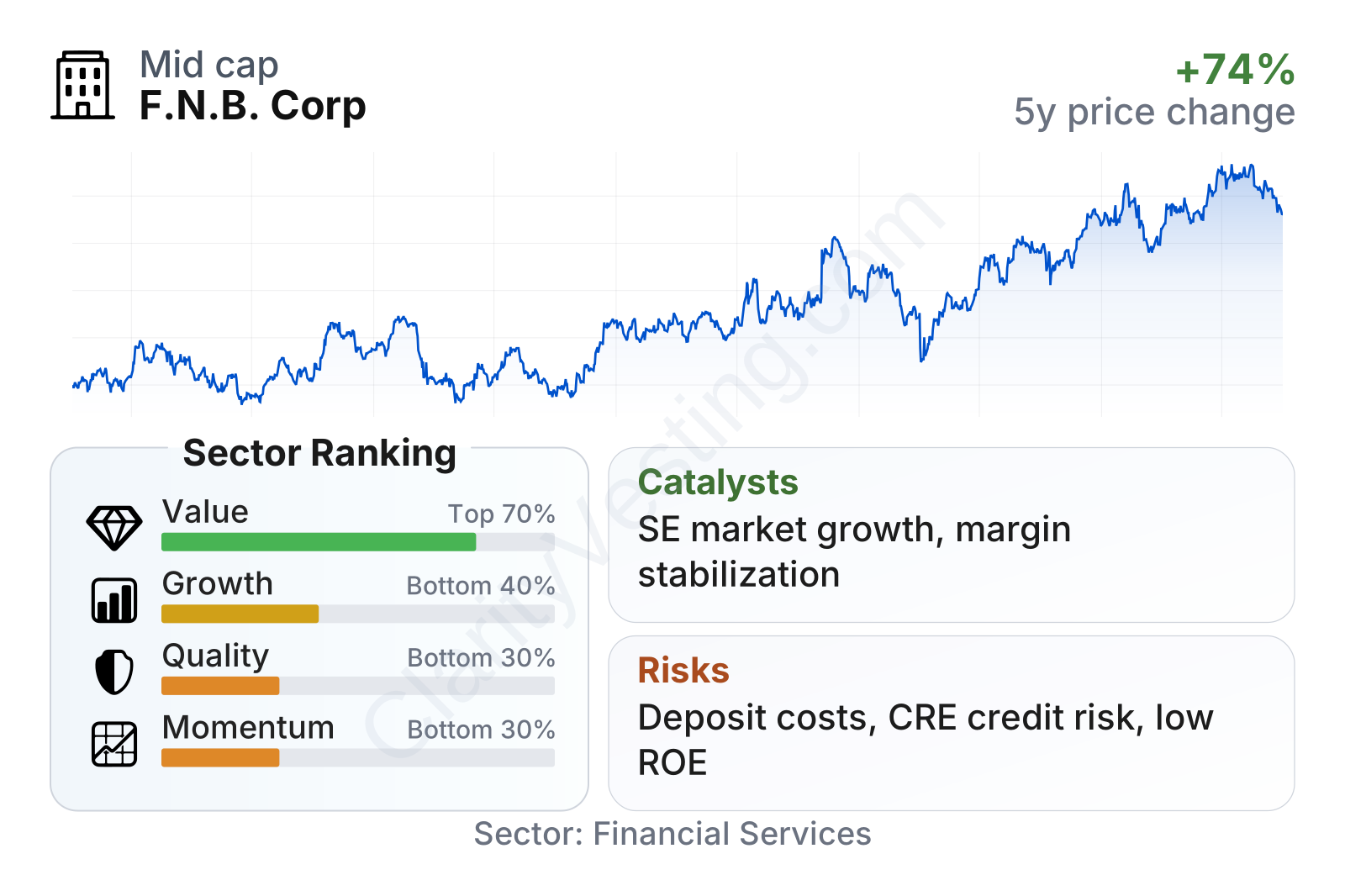
F.N.B. sits in the mid-sized regional bank group, with a market value of roughly $6 billion and a beta below 1, which suggests the stock has not been unusually volatile compared with the broader market. On valuation, the shares trade below the sector median on both earnings and book value multiples, while the dividend yield is close to the sector norm.
The more mixed picture appears in operating quality and growth. Revenue has been growing, and the long-term increase in revenue per share is better than the sector median, but earnings growth over five years has been weaker and profitability metrics rank below many peers. Momentum is also softer than the sector median, which usually means the market still sees open questions around returns and execution rather than awarding a premium multiple.
Growth
F.N.B. operates in a mature industry, so the growth case is not about explosive expansion. It is more about gaining deposits, expanding loans in attractive regional markets, and selling more services to existing customers. The company’s geographic mix gives it exposure to faster-growing Southeastern and Mid-Atlantic markets, especially around Charlotte, Raleigh, and the Washington region. That matters because regional banks often grow by following population shifts, new business formation, and commercial real estate development in expanding metros.
Its strategy also makes practical sense for long-term growth. Management has continued to emphasize commercial banking, treasury management, wealth management, and digital capabilities rather than relying only on branch expansion. For a regional bank, that combination is important: commercial relationships can deepen deposit ties, treasury services improve customer stickiness, and wealth management adds fee income that is less dependent on interest rates.
Earnings per share have not moved in a straight line, but the broader pattern shows the bank remains consistently profitable. After improving from 2021 through 2023, earnings eased in 2024 and then recovered in 2025. That kind of uneven path is common for banks when interest rates change quickly, because deposit pricing and asset yields do not adjust at the same speed.
Book value per share has trended upward over the past several years, which is a useful signal for a bank. It suggests the company has continued to build capital over time even while distributing dividends. For long-term analysis, steady growth in book value is often more important than one strong quarter because it reflects the bank’s ability to compound its balance sheet and absorb shocks.
A current catalyst is the possibility of better earnings efficiency if funding pressure continues to stabilize. When deposit costs stop rising as fast, regional banks can see margin improvement without needing unusually strong loan growth. Another favorable factor is F.N.B.’s broad business mix beyond plain lending, since fee businesses can help soften the impact of rate swings. Recent company communications have also highlighted continued loan production and customer acquisition in expansion markets, which supports the idea of gradual share gains rather than one-off growth.
Risks
This article is for informational purposes only and does not constitute financial advice. Some content is AI-generated. See Disclaimer


