Stock Analysis · Farmers And Merchants Bank of Long Beach (FMBL)
Overview
Farmers & Merchants Bancorp is the parent company of Farmers & Merchants Bank of Long Beach, a long-established California regional bank. It focuses on traditional banking rather than investment banking or high-growth fintech activities. Its business is centered on gathering deposits from customers and lending that money out, while also earning fees from related banking services. The bank operates mainly in Southern California and serves businesses, professionals, families, and property owners.
Like most regional banks, its revenue mix is led by interest income. The largest source is the spread between what the bank earns on loans and securities and what it pays on deposits and other funding. Non-interest income is a smaller part of the business and includes service charges, trust and investment-related fees, and other customer banking fees.
Based on its recent annual reporting, the revenue base can be described approximately as follows:
- Net interest income: about 75% to 85% of total revenue. This is the core banking engine and includes income from commercial real estate loans, residential mortgage loans, business loans, and the securities portfolio, after funding costs.
- Non-interest income: about 15% to 25% of total revenue. This generally includes deposit account fees, fiduciary and wealth-related services, and other service income.
The business model is simple to understand: attract stable deposits, lend conservatively, manage credit risk, and keep expenses under control. That model can work well over long periods, but for banks it is very sensitive to interest rates, funding costs, and loan quality.
The recent earnings flow shows a clear pattern: revenue weakened in 2023 and 2024 as interest expense rose sharply, which compressed profit, then improved in 2025 as earnings recovered. That matters because it suggests the recent pressure came more from the rate environment and deposit costs than from a collapse in the franchise itself.
Key Figures
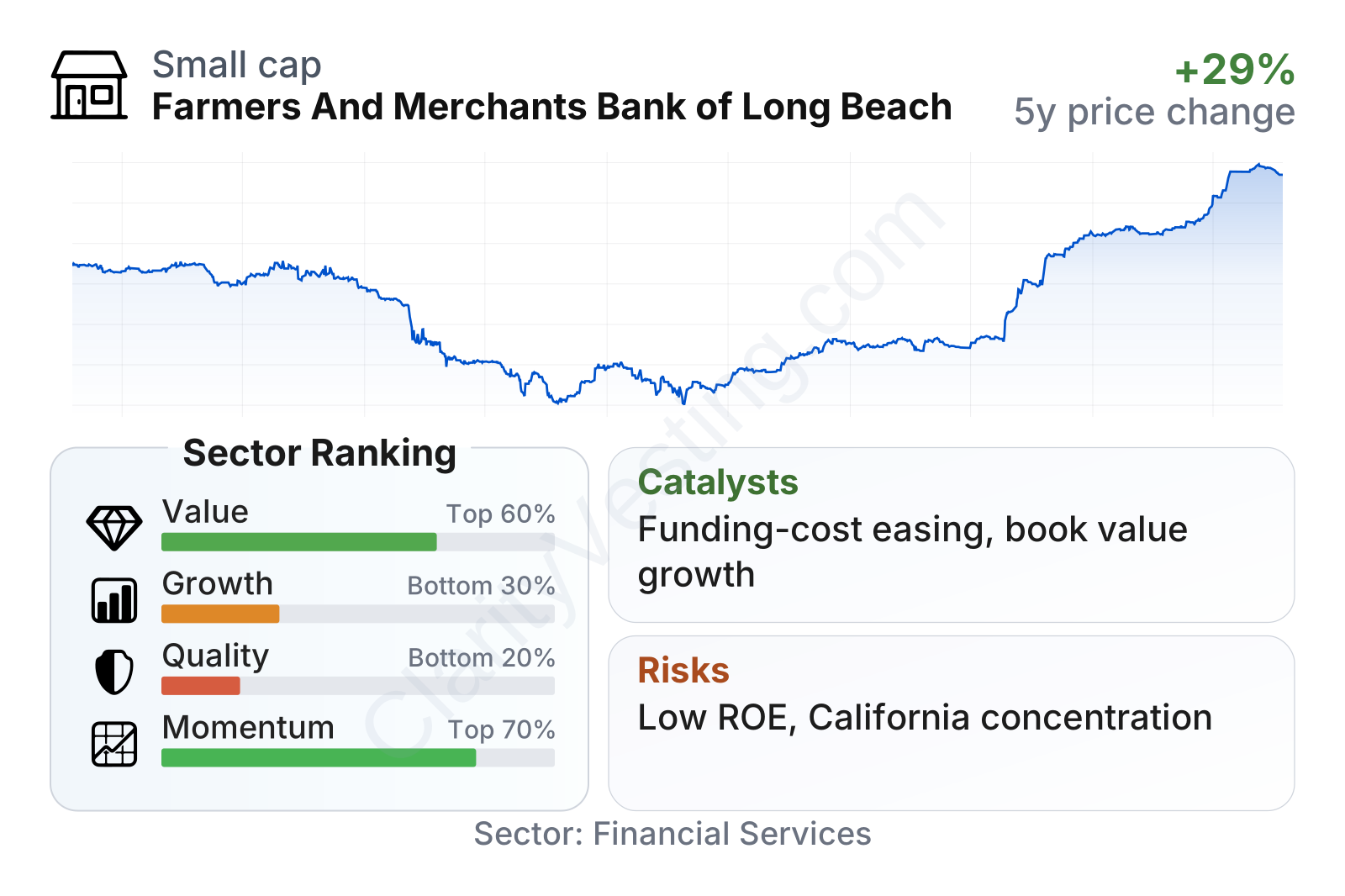
The stock has been unusually volatile for a bank that otherwise looks conservative on the surface. After a steep decline during the regional banking stress period, the share price later rebounded strongly and recently moved well above prior levels. That recovery indicates improving confidence, but it also means the easy rerating from the lows has already happened.
| Metric | Value | Sector ⓘ |
|---|---|---|
| Date | Oct 17, 2026 | |
| Context | ||
| Sector | Financial Services | |
| Industry | Banks - Regional | |
| Market Cap ⓘ | $1.17B | |
| Beta ⓘ | 0.23 | |
Value (Cheapness) | ||
| P/E Ratio ⓘ | 13.80 | 12.26 |
| P/B Ratio ⓘ | 0.72 | 1.23 |
| FCF Yield ⓘ | N/A | 10.40% |
| Dividend Yield ⓘ | 0.58% | 3.02% |
| EBIT / EV ⓘ | N/A | 8.14% |
| PEG ⓘ | N/A | |
Growth (Business expansion) | ||
| Revenue Growth ⓘ | 50.20% | 9.35% |
| RPS Growth (5Y CAGR) ⓘ | -1.59% | 12.19% |
| EPS Growth (5Y CAGR) ⓘ | -19.62% | -9.53% |
| BVPS Growth (5Y CAGR) ⓘ | 7.48% | 4.99% |
| Margin Growth (5Y Trend) ⓘ | N/A | -3.86% |
| FCF Growth (5Y CAGR) ⓘ | -10.82% | 4.81% |
| DPS Growth (5Y CAGR) ⓘ | 1.91% | 8.79% |
Quality (Business durability) | ||
| ROIC (Latest) ⓘ | N/A | 9.49% |
| ROE (Latest) ⓘ | 6.01% | 13.90% |
| ROA (Latest) ⓘ | 0.78% | 1.55% |
| ROIC (5Y Median) ⓘ | N/A | 7.86% |
| ROE (5Y Median) ⓘ | 5.25% | 12.17% |
| ROA (5Y Median) ⓘ | 0.58% | 1.30% |
| Net Debt / EBIT (Latest) ⓘ | N/A | 0.96 |
| Net Debt / EBIT (5Y Median) ⓘ | N/A | 0.73 |
| Net Debt / EBITDA (Latest) ⓘ | N/A | 0.92 |
| Operating Margin (Latest) ⓘ | N/A | 22.30% |
| Operating Margin (5Y Median) ⓘ | N/A | 24.63% |
| Debt to Equity (Latest) ⓘ | N/A | 58.56% |
| Profit Margin (Latest) ⓘ | 28.11% | 26.57% |
| Free Cash Flow (Latest) ⓘ | N/A | |
Momentum (Price trend) | ||
| 3Y Return ⓘ | +137.10% | +88.33% |
| 12M Return (excl. last month) ⓘ | +44.38% | +19.38% |
| 6M Return ⓘ | +17.78% | +4.75% |
| Price vs. 200-Day MA ⓘ | +9.89% | +3.50% |
On the latest snapshot, valuation looks mixed but not stretched: the earnings multiple is close to the sector norm, while the price-to-book ratio remains clearly below the sector median. The more important takeaway is that profitability and growth quality are weaker than many peers. Revenue growth recently improved sharply, but longer-term trends in earnings and revenue per share are still soft. Momentum has been strong, while quality metrics such as return on equity and return on assets remain below industry medians. The bank is also relatively low-volatility, with a beta far below the broader market.
Growth
Banking is not a fast-growth sector in the way software or semiconductor markets can be, but it remains essential and can expand steadily in attractive local economies. Southern California is still a large banking market with meaningful demand for commercial real estate lending, business banking, treasury services, and wealth-related offerings. That gives F&M Bank a reasonable long-term operating backdrop, especially if it can deepen relationships in its existing footprint rather than chase aggressive expansion.
The company’s strategy appears rooted in relationship banking and balance-sheet discipline. For a long-term view, that approach makes sense if management can protect deposits, maintain credit quality, and gradually rebuild profitability as the interest-rate environment normalizes. The strongest growth path is likely not rapid branch expansion, but better net interest margin performance, measured loan growth, and higher fee income from existing customers.
Earnings per share show how much profitability was hit after 2022. Results fell sharply through 2024 before beginning to recover. That pattern supports the idea that the bank is in a rebuilding phase rather than in a clean multi-year earnings expansion. For long-term analysis, the key question is whether the recovery continues toward earlier profit levels, not just whether it bounced from a weak base.
Book value per share has moved upward over time and accelerated recently. That is an encouraging sign for a bank because book value represents the underlying capital base supporting the franchise. Even with weaker earnings, the company has continued to build shareholder equity per share over the longer run, which partly explains why the stock still trades below many peers on a price-to-book basis.
A meaningful catalyst is the possibility of further normalization in funding costs. If deposit pricing pressure eases faster than asset yields decline, profitability can improve without the bank needing extraordinary balance-sheet growth. Another opportunity is the bank’s niche strength in high-value California markets, where customer relationships and local reputation can matter more than scale alone. Recent company reporting also points to improved earnings compared with the trough period, which supports the case for a continuing operational recovery if credit costs remain controlled.
Risks
This article is for informational purposes only and does not constitute financial advice. Some content is AI-generated. See Disclaimer


