Stock Analysis · First Mid Illinois Bancshares Inc (FMBH)
Overview
First Mid Illinois Bancshares is a regional financial company centered on community banking. It operates primarily through First Mid Bank & Trust and serves individuals, businesses, farms, and local institutions across the Midwest, with a strong presence in Illinois and nearby states. Its model is broader than a plain-vanilla bank: alongside deposits and loans, it also has insurance, wealth management, and agribusiness-related services. That mix matters because it gives the company more than one way to earn money and helps reduce its dependence on any single product line.
The largest revenue source is still traditional banking. In its most recent annual mix, net interest income represented the clear majority of total revenue, with noninterest income providing a meaningful second leg. Based on the company’s recent annual reporting, an approximate ranking of revenue sources looks like this:
- Net interest income after provision for credit losses: approximately 73% of total revenue. This is the spread between what the bank earns on loans and securities and what it pays on deposits and other funding, after accounting for credit-loss provisioning.
- Insurance commissions and fee income: approximately 12%. This comes from property, casualty, employee benefits, and related insurance brokerage activities.
- Wealth management revenue: approximately 5%. This includes trust, investment management, retirement-plan, and related advisory services.
- Service charges, card fees, and other deposit-related fees: approximately 4%. These are routine account and transaction fees tied to banking services.
- Mortgage banking, gains on sales, and other noninterest income: approximately 6% combined. This smaller bucket can fluctuate more from year to year depending on housing activity, market conditions, and one-time items.
That overall structure makes First Mid a diversified regional bank rather than a pure lender. It remains heavily exposed to core banking economics, but the insurance and wealth segments add recurring fee income that can soften the impact of changes in interest rates.
The business has expanded revenue meaningfully over the last several years, and net income has also trended higher overall. At the same time, operating costs and funding expenses have risen, which is important because it shows that growth has not come without pressure on efficiency.
Key Figures
| Metric | Value | Sector ⓘ |
|---|---|---|
| Date | Oct 17, 2026 | |
| Context | ||
| Sector | Financial Services | |
| Industry | Banks - Regional | |
| Market Cap ⓘ | $1.30B | |
| Beta ⓘ | 0.80 | |
Value (Cheapness) | ||
| P/E Ratio ⓘ | 12.09 | 12.26 |
| P/B Ratio ⓘ | 1.19 | 1.23 |
| FCF Yield ⓘ | 9.53% | 10.40% |
| Dividend Yield ⓘ | 2.05% | 3.02% |
| EBIT / EV ⓘ | 5.00% | 8.14% |
| PEG ⓘ | 1.27 | |
Growth (Business expansion) | ||
| Revenue Growth ⓘ | 26.00% | 9.35% |
| RPS Growth (5Y CAGR) ⓘ | 8.70% | 12.19% |
| EPS Growth (5Y CAGR) ⓘ | -11.35% | -9.53% |
| BVPS Growth (5Y CAGR) ⓘ | 3.13% | 4.99% |
| Margin Growth (5Y Trend) ⓘ | -1.64% | -3.86% |
| FCF Growth (5Y CAGR) ⓘ | 17.13% | 4.81% |
| DPS Growth (5Y CAGR) ⓘ | 4.41% | 8.79% |
Quality (Business durability) | ||
| ROIC (Latest) ⓘ | 4.26% | 9.49% |
| ROE (Latest) ⓘ | 9.86% | 13.90% |
| ROA (Latest) ⓘ | 1.18% | 1.55% |
| ROIC (5Y Median) ⓘ | 7.80% | 7.86% |
| ROE (5Y Median) ⓘ | 9.67% | 12.17% |
| ROA (5Y Median) ⓘ | 1.04% | 1.30% |
| Net Debt / EBIT (Latest) ⓘ | 4.18 | 0.96 |
| Net Debt / EBIT (5Y Median) ⓘ | 4.29 | 0.73 |
| Net Debt / EBITDA (Latest) ⓘ | 3.25 | 0.92 |
| Operating Margin (Latest) ⓘ | 16.19% | 22.30% |
| Operating Margin (5Y Median) ⓘ | 26.75% | 24.63% |
| Debt to Equity (Latest) ⓘ | 55.55% | 58.56% |
| Profit Margin (Latest) ⓘ | 26.85% | 26.57% |
| Free Cash Flow (Latest) ⓘ | $123.51M | |
Momentum (Price trend) | ||
| 3Y Return ⓘ | +96.46% | +88.33% |
| 12M Return (excl. last month) ⓘ | +32.74% | +19.38% |
| 6M Return ⓘ | +14.63% | +4.75% |
| Price vs. 200-Day MA ⓘ | +9.14% | +3.50% |
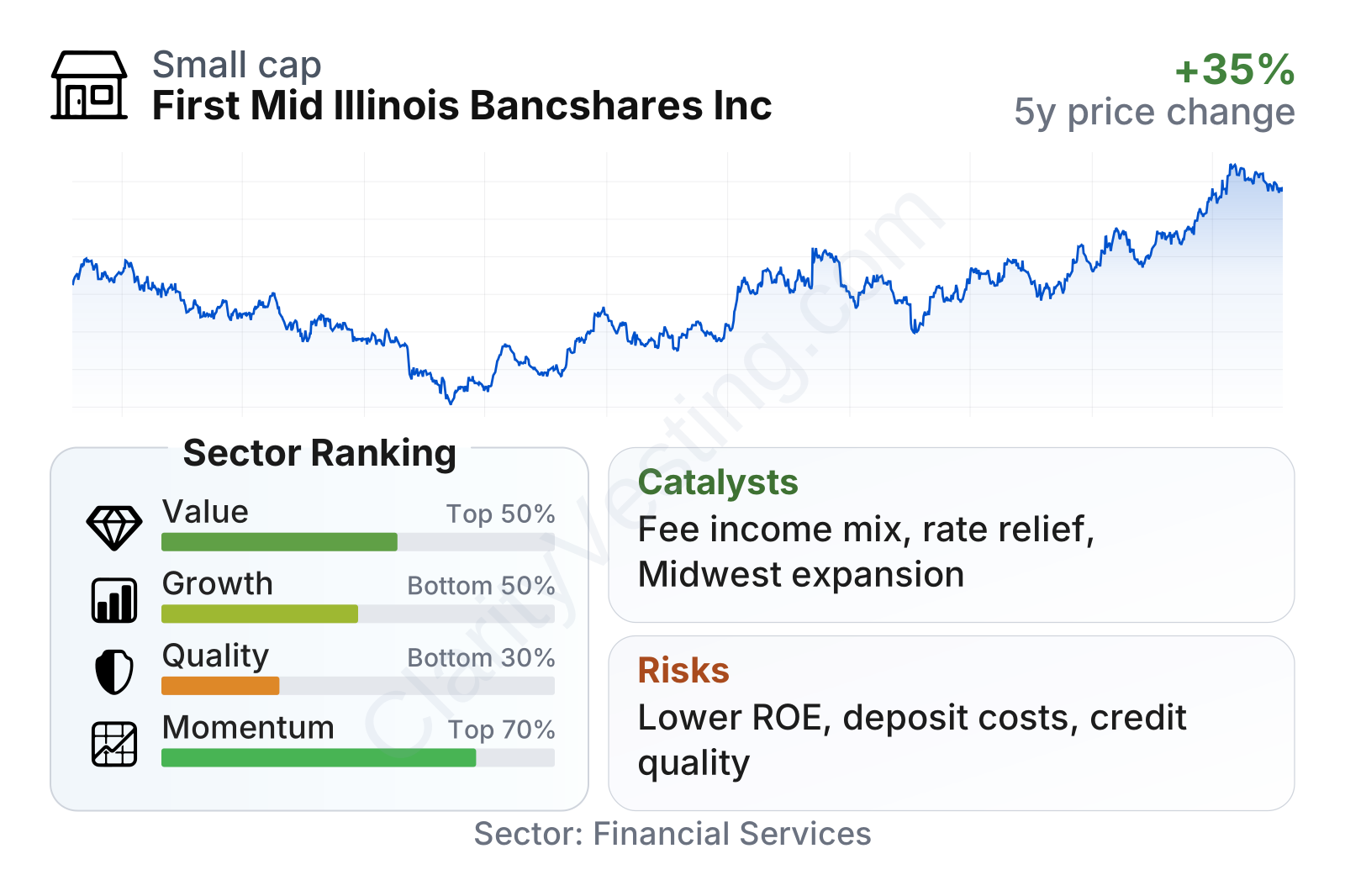
First Mid sits in the middle of the pack on valuation, with earnings and book-based multiples close to or slightly below sector medians. The more notable contrast is between decent recent revenue momentum and weaker profitability measures. Growth ranks in the lower half of the sector over a longer period, quality metrics are in the lower tier, while recent share-price momentum has been better than many regional-bank peers. The company is also a mid-sized regional bank with a below-market beta, which fits its community-bank profile.
The stock-price history shows a familiar regional-bank pattern: weakness during the 2023 banking stress period, followed by a strong recovery through 2024, 2025, and into 2026. That rebound suggests market confidence has improved, but it also means part of the easy recovery from the earlier selloff has already happened.
Growth
Regional banking is not a high-growth industry in the same way as software or biotech, but it remains a necessary part of the economy. Long-term growth tends to come from population shifts, local business formation, loan demand, market-share gains, and acquisitions. First Mid’s footprint in community and rural markets gives it exposure to commercial lending, agricultural banking, and relationship-driven business that can be durable over time. Its insurance and wealth operations also fit well with that customer base, creating cross-selling opportunities beyond loans and deposits.
The company’s strategy appears coherent for a regional bank: deepen relationships in local markets, use acquisitions selectively, and build fee income alongside spread-based banking revenue. That approach can work well when executed carefully because it makes the business less dependent on one interest-rate cycle. A useful point in First Mid’s favor is that fee businesses such as insurance and wealth management can continue producing revenue even when lending margins become less favorable.
Earnings per share have not followed a straight upward line over the full period. There was a softening from 2021 through 2024 before improvement in 2025, showing that growth has been uneven rather than consistently compounding each year. That pattern is common in banking, where profit can be affected by deposit costs, credit provisions, and acquisition integration. It also explains why the company’s five-year earnings growth record looks weaker than its recent revenue growth.
Book value per share, a closely watched measure for banks, has generally moved upward over time despite some fluctuations. That is encouraging because it suggests the company has continued to build capital value per share over the cycle, even if the pace has not been especially fast compared with many peers.
A major catalyst for future growth is the path of interest rates and deposit pricing. If funding costs stabilize or decline while loan yields remain healthy, earnings can improve without the company needing dramatic balance-sheet expansion. Another catalyst is continued development of insurance and wealth management, which can support revenue growth with less balance-sheet risk than lending. In addition, any well-executed small or mid-sized acquisition in its existing markets could add scale and customer relationships relatively quickly, which has been a traditional growth tool for regional banks.
Recent company reporting and investor materials point to continued focus on commercial banking, agricultural relationships, and fee-based businesses. That does not create a single transformative opportunity, but it does support a steady expansion framework that fits the company’s size and market position.
Risks
This article is for informational purposes only and does not constitute financial advice. Some content is AI-generated. See Disclaimer


