Stock Analysis · Fluor Corporation (FLR)
Overview
Fluor Corporation is a large engineering, procurement, and construction company that helps clients design, build, modernize, and maintain complex industrial and infrastructure projects. Its work spans energy, chemicals, mining, metals, life sciences, advanced manufacturing, transportation, government services, and nuclear-related activities. In simple terms, Fluor is a project execution specialist hired when customers need large, technically demanding facilities delivered over many years.
The company reports revenue mainly through business segments rather than by narrow product lines. Based on recent annual reporting, the largest revenue sources come from Energy Solutions and Urban Solutions, with Mission Solutions much smaller by revenue but strategically important because it includes government and nuclear work. Revenue mix can vary year to year depending on project timing and contract awards, but a reasonable recent approximation is:
- Energy Solutions: about 45% to 50% — engineering and construction for oil and gas, chemicals, petrochemicals, terminals, fuels, and related energy infrastructure.
- Urban Solutions: about 40% to 45% — mining and metals, advanced technologies, life sciences, manufacturing, infrastructure, and other industrial facilities.
- Mission Solutions: about 10% to 15% — U.S. government services, nuclear cleanup, operations support, and other public-sector work.
That mix matters because Fluor is no longer only tied to traditional fossil-fuel projects. The company has been repositioning toward higher-value areas such as data centers and advanced manufacturing, life sciences, mining tied to electrification, and nuclear services, while still keeping a meaningful presence in conventional energy and chemicals.
Over the last several years, revenue recovered from the post-pandemic period and operating performance improved through 2024, but 2025 brought a noticeable setback. The business remains very large in absolute revenue, yet profitability is still uneven because project execution issues or contract charges can have an outsized effect in this industry.
The long view shows a thin-margin business where small changes in execution can dramatically affect earnings. Revenue has stayed in the mid-teens of billions of dollars, but profit has swung from losses to strong gains and back again, showing why contract quality and cost control matter more here than simple sales growth.
Key Figures
| Metric | Value | Sector ⓘ |
|---|---|---|
| Date | Oct 24, 2026 | |
| Context | ||
| Sector | Industrials | |
| Industry | Engineering & Construction | |
| Market Cap ⓘ | $6.04B | |
| Beta ⓘ | 1.28 | |
Value (Cheapness) | ||
| P/E Ratio ⓘ | N/A | 22.29 |
| P/B Ratio ⓘ | 2.53 | 1.98 |
| FCF Yield ⓘ | -5.46% | 6.26% |
| Dividend Yield ⓘ | N/A | 1.92% |
| EBIT / EV ⓘ | -1.97% | 4.83% |
| PEG ⓘ | 1.10 | |
Growth (Business expansion) | ||
| Revenue Growth ⓘ | 8.80% | 9.30% |
| RPS Growth (5Y CAGR) ⓘ | -3.22% | 7.76% |
| EPS Growth (5Y CAGR) ⓘ | 7.89% | -13.17% |
| BVPS Growth (5Y CAGR) ⓘ | 20.53% | 6.13% |
| Margin Growth (5Y Trend) ⓘ | -0.21% | 0.74% |
| FCF Growth (5Y CAGR) ⓘ | N/A | 10.79% |
| DPS Growth (5Y CAGR) ⓘ | N/A | 9.41% |
Quality (Business durability) | ||
| ROIC (Latest) ⓘ | -0.53% | 10.75% |
| ROA (Latest) ⓘ | -21.01% | 5.41% |
| ROIC (5Y Median) ⓘ | 3.13% | 9.37% |
| ROA (5Y Median) ⓘ | 2.01% | 4.95% |
| Net Debt / EBIT (Latest) ⓘ | N/A | 2.04 |
| Net Debt / EBIT (5Y Median) ⓘ | -3.63 | 2.27 |
| Net Debt / EBITDA (Latest) ⓘ | N/A | 1.39 |
| Net Debt / Assets ⓘ | -24.56% | 19.27% |
| EBITDA / Interest ⓘ | N/A | 9.58 |
| Operating Margin (Latest) ⓘ | -0.65% | 10.49% |
| Operating Margin (5Y Median) ⓘ | 2.20% | 10.30% |
| Debt to Equity (Latest) ⓘ | 39.91% | 64.82% |
| Profit Margin (Latest) ⓘ | -12.85% | 6.67% |
| Free Cash Flow (Latest) ⓘ | -$330.00M | |
Momentum (Price trend) | ||
| 3Y Return ⓘ | +33.71% | +67.77% |
| 12M Return (excl. last month) ⓘ | +22.74% | +12.05% |
| 6M Return ⓘ | -1.55% | 0.00% |
| Price vs. 200-Day MA ⓘ | -5.87% | +0.67% |
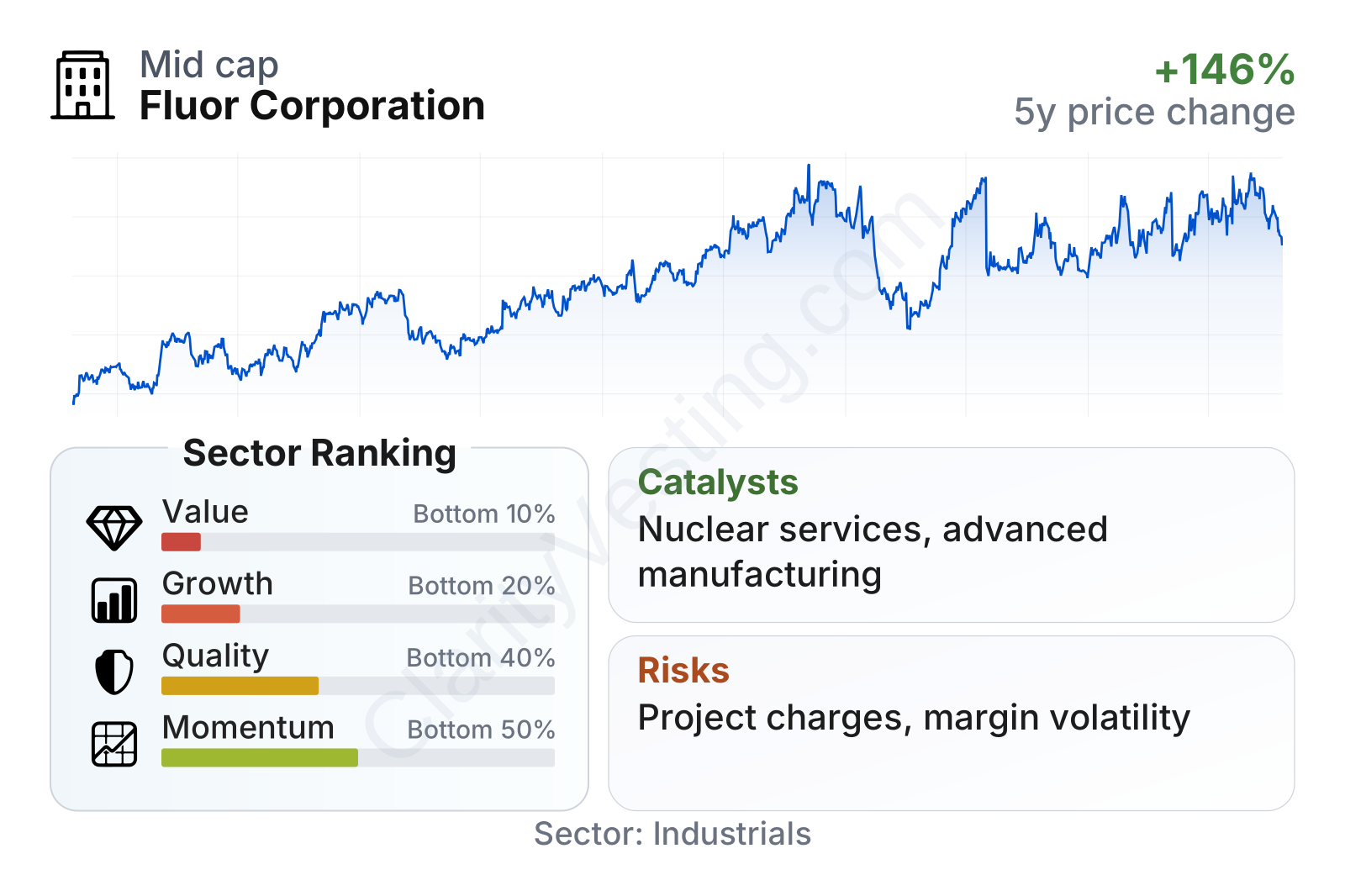
Fluor is a mid-sized industrial company with a stock that has been volatile but generally much stronger than it was a few years ago. The recent profile is mixed. Momentum has improved, and leverage looks better than the industry median, but value, growth, and quality rankings sit in the weaker part of the sector. The most important takeaway is that balance-sheet risk appears more manageable than in the past, while profitability and cash generation remain the areas that still need the most consistency.
Growth
Fluor operates in end markets that have real long-term demand behind them. Governments and corporations continue to spend on power, grid support, mining capacity, semiconductor and advanced manufacturing facilities, life sciences plants, and nuclear-related services. Those are all areas where large-scale engineering expertise is difficult to replace. This means the company is exposed to sectors that should keep producing major projects over many years, even if quarterly timing remains uneven.
The company’s strategy also makes industrial sense. Management has been emphasizing contract discipline, focusing more on reimbursable or better-protected work, and expanding in markets where technical complexity is high enough to support better economics than commodity-like construction work. Its stake in NuScale had once given Fluor exposure to small modular reactor development, and more broadly the company remains well positioned for nuclear services and government work through Mission Solutions.
Revenue growth has been positive in parts of the recent period, but the pattern is not smooth. After a strong rebound phase, growth turned more uneven, which is typical for a project-based contractor. This does not necessarily indicate weak demand on its own; it often reflects project starts, completions, and the accounting rhythm of large contracts. Still, the stop-and-start pattern means Fluor cannot yet be described as a steady compounder.
Cash generation tells a similar story. Free cash flow moved from positive to negative and back again over recent periods, with a strong spike followed by another reversal. For an engineering and construction business, that can happen because customer advances, working capital, and project milestones can swing sharply. Even so, long-term investors usually look for repeatable cash conversion, and that remains a work in progress.
Recent company updates point to opportunity in advanced manufacturing, mining and metals, LNG-related infrastructure, and government services. These markets are supported by reshoring, energy security, digital infrastructure growth, and large public-sector spending programs. If Fluor keeps winning projects in those categories while protecting margins better than in prior cycles, the growth setup becomes much more compelling than the backward-looking profitability numbers suggest.
Risks
This article is for informational purposes only and does not constitute financial advice. Some content is AI-generated. See Disclaimer


