Stock Analysis · Flowers Foods Inc (FLO)
Overview
Flowers Foods is a packaged bakery company in the United States. It makes and distributes fresh breads, buns, rolls, snack cakes, tortillas, and other baked foods sold through grocery stores, mass retailers, club stores, foodservice channels, convenience stores, and warehouse outlets. Its best-known brands include Nature’s Own, Dave’s Killer Bread, Wonder, Canyon Bakehouse, Tastykake, and Mrs. Freshley’s. The business is focused on everyday food categories, which gives it a defensive profile because bread and related staples tend to keep selling even when consumer spending weakens.
Revenue is largely generated from packaged bakery products sold in the U.S. Public filings indicate the company operates mainly as one broad bakery platform rather than many separately reported business segments, so exact percentages by product are limited. Based on brand mix and company disclosures, the revenue base can be understood approximately as follows:
- Fresh packaged bread, buns, and rolls: approximately 55% to 65% of revenue. This includes mainstream loaf bread, premium bread, hamburger buns, hot dog buns, and sandwich rolls.
- Snack cakes and sweet baked goods: approximately 15% to 20% of revenue. This includes products sold under brands such as Tastykake and Mrs. Freshley’s.
- Specialty and better-for-you bakery: approximately 10% to 15% of revenue. This includes organic, gluten-free, and premium-positioned offerings such as Dave’s Killer Bread and Canyon Bakehouse.
- Tortillas, foodservice, and other bakery products: approximately 5% to 10% of revenue. This includes products serving institutional customers and smaller adjacent categories.
One important feature of Flowers Foods is its route-to-market system. The company relies on a large direct-store-delivery network for many fresh bakery products, while also using warehouse distribution for categories that fit that model better. That mix helps shelf presence and retailer relationships, but it also creates exposure to fuel, labor, and logistics costs.
Over the last several years, sales have edged higher, but the path from revenue to net income has become less stable. Gross profit has stayed relatively resilient, while selling, distribution, and financing costs have absorbed a larger share of the business at times. That helps explain why a staple-food company with fairly steady demand can still show large swings in earnings.
The long-term pattern shows a business that has expanded sales from a little above $4.3 billion in 2021 to above $5.2 billion in 2025, but with much less consistency at the bottom line. Revenue growth has been real, yet profit conversion weakened sharply in 2025 as interest expense rose and operating income fell back.
Key Figures
| Metric | Value | Sector ⓘ |
|---|---|---|
| Date | Oct 17, 2026 | |
| Context | ||
| Sector | Consumer Defensive | |
| Industry | Packaged Foods | |
| Market Cap ⓘ | $1.28B | |
| Beta ⓘ | 0.43 | |
Value (Cheapness) | ||
| P/E Ratio ⓘ | 22.37 | 17.88 |
| P/B Ratio ⓘ | 0.96 | 1.29 |
| FCF Yield ⓘ | 24.66% | 12.39% |
| Dividend Yield ⓘ | 14.94% | 2.85% |
| EBIT / EV ⓘ | 4.90% | 6.43% |
| PEG ⓘ | 6.10 | |
Growth (Business expansion) | ||
| Revenue Growth ⓘ | 6.80% | 4.10% |
| RPS Growth (5Y CAGR) ⓘ | 5.08% | 6.18% |
| EPS Growth (5Y CAGR) ⓘ | -32.89% | -13.59% |
| BVPS Growth (5Y CAGR) ⓘ | -1.86% | 3.20% |
| Margin Growth (5Y Trend) ⓘ | -3.33% | -0.15% |
| FCF Growth (5Y CAGR) ⓘ | 12.61% | 4.10% |
| DPS Growth (5Y CAGR) ⓘ | 4.56% | 6.79% |
Quality (Business durability) | ||
| ROIC (Latest) ⓘ | 3.62% | 12.34% |
| ROA (Latest) ⓘ | 1.29% | 6.30% |
| ROIC (5Y Median) ⓘ | 11.35% | 10.49% |
| ROA (5Y Median) ⓘ | 6.27% | 5.44% |
| Net Debt / EBIT (Latest) ⓘ | 12.52 | 1.96 |
| Net Debt / EBIT (5Y Median) ⓘ | 3.70 | 2.35 |
| Net Debt / EBITDA (Latest) ⓘ | 6.02 | 1.38 |
| Net Debt / Assets ⓘ | 46.71% | 21.51% |
| EBITDA / Interest ⓘ | 4.25 | 9.46 |
| Operating Margin (Latest) ⓘ | 2.99% | 8.87% |
| Operating Margin (5Y Median) ⓘ | 6.82% | 9.53% |
| Debt to Equity (Latest) ⓘ | 151.70% | 72.35% |
| Profit Margin (Latest) ⓘ | 1.06% | 5.40% |
| Free Cash Flow (Latest) ⓘ | $315.89M | |
Momentum (Price trend) | ||
| 3Y Return ⓘ | -65.05% | +20.92% |
| 12M Return (excl. last month) ⓘ | -51.68% | +2.13% |
| 6M Return ⓘ | -24.65% | +1.26% |
| Price vs. 200-Day MA ⓘ | -25.41% | +1.39% |
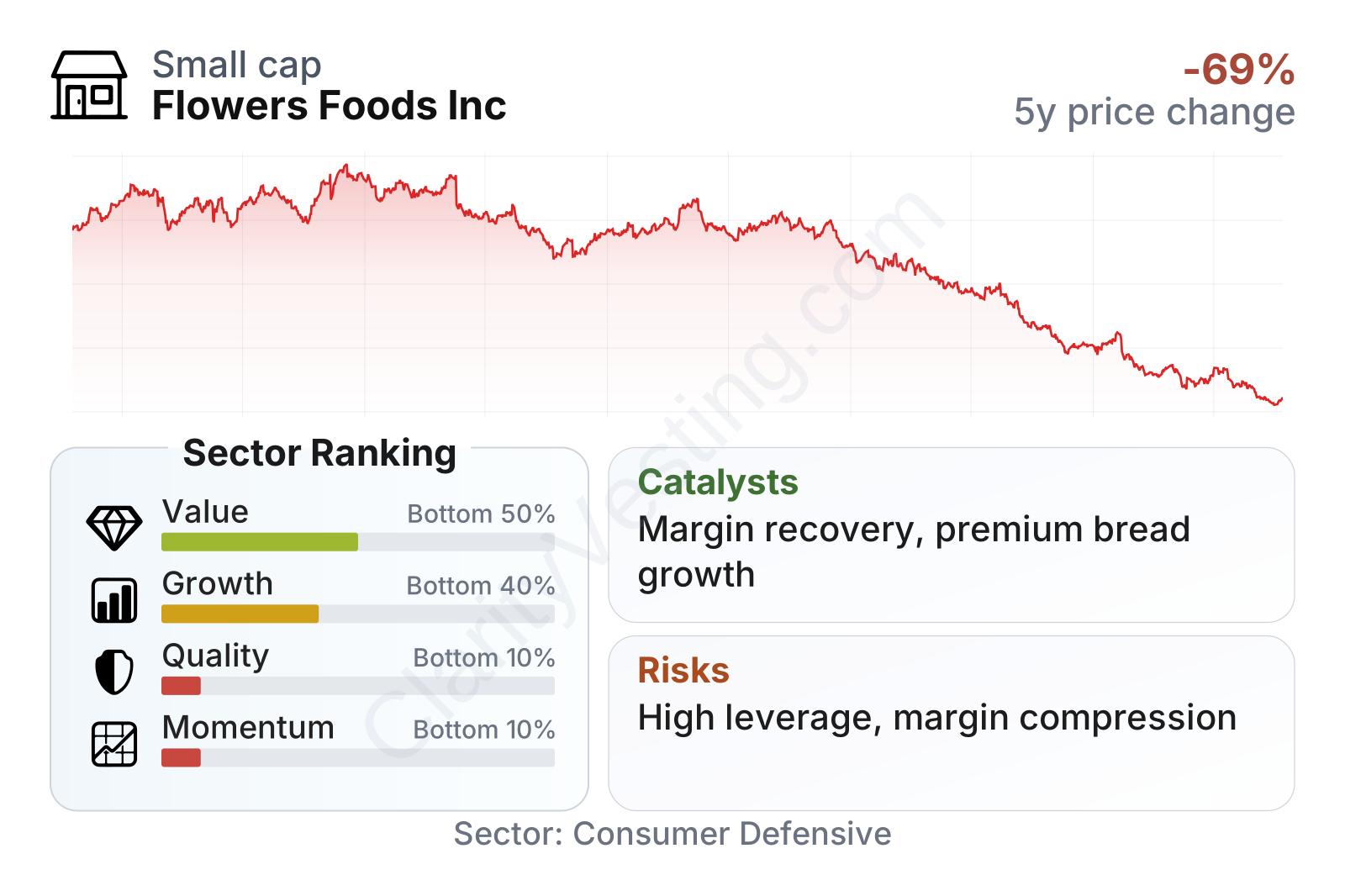
Flowers Foods is a small-cap consumer defensive company with a notably low beta, meaning its share-price swings have historically been less tied to broad market moves than many stocks. Even so, recent market performance has been weak. The stock has fallen heavily over the last three years, and the factor profile is mixed: cash generation and dividend yield stand out, but quality, growth durability, and momentum rank near the lower end of the sector. The current setup points to a company that still produces meaningful cash, yet faces investor skepticism about earnings strength and balance-sheet pressure.
Growth
The packaged bakery industry is not a high-growth sector, but it is a durable one. Bread, buns, snack cakes, and related staples benefit from repeat purchases and broad household penetration. For a company like Flowers Foods, long-term growth usually comes less from explosive category expansion and more from pricing, market-share gains, premium brands, product mix improvement, distribution gains, and targeted acquisitions.
That framework fits Flowers Foods well. Its strategy has increasingly leaned on stronger brands such as Nature’s Own, Dave’s Killer Bread, and Canyon Bakehouse, which give it exposure to premium, organic, and gluten-free segments. Those areas are attractive because they can grow faster than conventional packaged bread and often support better shelf positioning. The company has also invested in network optimization and bakery modernization, which can matter over time in a scale business where small efficiency gains add up.
Revenue growth has been uneven rather than smooth. The company posted strong gains during 2022 and parts of 2023, then slowed, with some quarters turning negative before a brief rebound and another recent pullback. That pattern suggests Flowers Foods can still grow, but not with the consistency usually associated with stronger consumer staples names. The latest yearly revenue growth remains above the sector median, yet the longer five-year record looks more modest.
Cash generation is a more favorable part of the picture. Free cash flow has improved meaningfully over the last several years and remains solid in absolute terms despite some recent moderation. That matters because a bakery business needs cash not only for shareholder returns, but also for plant investment, debt service, and supply-chain flexibility. In Flowers Foods’ case, free cash flow has held up much better than earnings per share, which suggests the business still has financial usefulness even when accounting profits come under pressure.
Potential catalysts are practical rather than dramatic. Better execution in pricing and promotions, stabilization in input costs, improved performance from premium brands, and margin recovery from productivity initiatives could all improve the outlook. Recent company communications have also emphasized portfolio discipline and operational efficiency, which is important given that the biggest current issue is not demand collapse, but weak profit conversion.
Risks
This article is for informational purposes only and does not constitute financial advice. Some content is AI-generated. See Disclaimer


