Stock Analysis · Fluence Energy Inc (FLNC)
Overview
Fluence Energy is a grid-scale energy storage company focused on battery-based systems and the software used to manage them. In simple terms, it helps electric utilities, renewable power developers, and commercial customers store electricity and use it when needed. This matters because solar and wind production can vary during the day, while electricity demand often peaks at different times. Fluence’s products are designed to make power grids more flexible, support renewable energy integration, and improve reliability.
The business is built around two main activities: selling and deploying energy storage systems, and providing software and digital services that optimize battery operations. Fluence was formed with backing from Siemens and AES, which still gives it industry relationships, project experience, and access to large power-sector customers. Geographically, the company operates across the Americas, Europe, the Middle East, Africa, and Asia-Pacific, which gives it exposure to multiple electricity markets rather than relying on one country alone.
Based on company reporting, revenue is heavily concentrated in products and services tied to battery storage projects, while software and recurring service contracts remain a smaller but strategically important part of the mix.
- Energy storage products and installation services: approximately 90% to 95% of revenue. This includes battery storage systems, engineering, procurement, project delivery, and related hardware and commissioning work.
- Software, digital applications, maintenance, and other services: approximately 5% to 10% of revenue. This includes grid optimization software, asset performance tools, and service agreements that can support recurring revenue over time.
The company’s revenue mix also helps explain why sales can swing from year to year. Large projects create sizable revenue when they are delivered, but they also bring thinner margins and working-capital pressure than software businesses typically do.
The broad trend is encouraging on the income-statement side: revenue expanded sharply from 2022 through 2024, gross profit improved from negative territory to clearly positive levels, and the company briefly reached positive operating income and net income in 2024 before slipping back into losses in 2025. That pattern suggests the business can become profitable at scale, but it has not yet shown stable execution.
Key Figures
| Metric | Value | Sector ⓘ |
|---|---|---|
| Date | Oct 17, 2026 | |
| Context | ||
| Sector | Utilities | |
| Industry | Utilities - Renewable | |
| Market Cap ⓘ | $1.32B | |
| Beta ⓘ | 2.77 | |
Value (Cheapness) | ||
| P/E Ratio ⓘ | N/A | 17.28 |
| P/B Ratio ⓘ | 2.72 | 1.51 |
| FCF Yield ⓘ | -9.99% | 0.65% |
| Dividend Yield ⓘ | N/A | 3.77% |
| EBIT / EV ⓘ | -8.22% | 5.01% |
| PEG ⓘ | 3.14 | |
Growth (Business expansion) | ||
| Revenue Growth ⓘ | 7.90% | 6.10% |
| RPS Growth (5Y CAGR) ⓘ | 8.41% | 3.87% |
| EPS Growth (5Y CAGR) ⓘ | -32.00% | -11.30% |
| BVPS Growth (5Y CAGR) ⓘ | N/A | 4.23% |
| Margin Growth (5Y Trend) ⓘ | N/A | 3.57% |
| FCF Growth (5Y CAGR) ⓘ | -10.19% | -8.84% |
| DPS Growth (5Y CAGR) ⓘ | N/A | 4.84% |
Quality (Business durability) | ||
| ROIC (Latest) ⓘ | -10.95% | 6.53% |
| ROA (Latest) ⓘ | -3.25% | 3.20% |
| ROIC (5Y Median) ⓘ | -19.77% | 5.95% |
| ROA (5Y Median) ⓘ | -4.49% | 2.75% |
| Net Debt / EBIT (Latest) ⓘ | N/A | 7.13 |
| Net Debt / EBIT (5Y Median) ⓘ | N/A | 7.23 |
| Net Debt / EBITDA (Latest) ⓘ | N/A | 4.31 |
| Net Debt / Assets ⓘ | 2.02% | 38.42% |
| EBITDA / Interest ⓘ | N/A | 4.58 |
| Operating Margin (Latest) ⓘ | -3.56% | 20.83% |
| Operating Margin (5Y Median) ⓘ | -5.08% | 20.08% |
| Debt to Equity (Latest) ⓘ | 105.08% | 137.69% |
| Profit Margin (Latest) ⓘ | -3.07% | 11.37% |
| Free Cash Flow (Latest) ⓘ | -$131.88M | |
Momentum (Price trend) | ||
| 3Y Return ⓘ | -70.00% | +52.37% |
| 12M Return (excl. last month) ⓘ | +34.43% | +8.84% |
| 6M Return ⓘ | -58.04% | -3.95% |
| Price vs. 200-Day MA ⓘ | -62.21% | -0.79% |
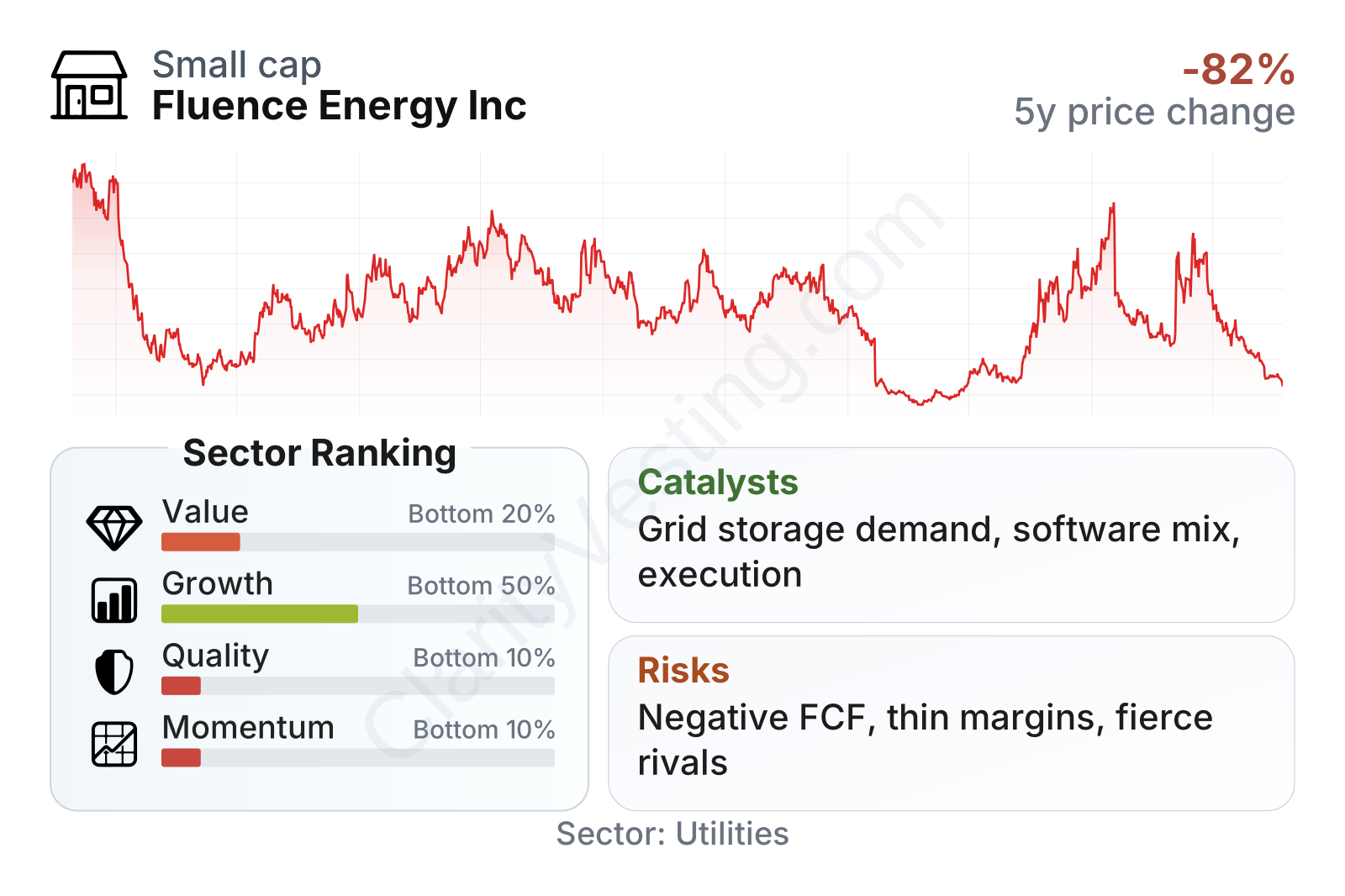
Fluence is a mid-sized company by market value, but its stock has behaved much more like a high-volatility growth name than a typical utility-related business. The share price history shows large swings since listing, which matches a beta well above 2.0. In the factor table, the clearest weakness is business quality: profitability, returns on capital, and cash generation remain well below the sector median. Growth is mixed rather than uniformly weak, with revenue trends still better than many sector peers, but earnings and free cash flow have lagged. Valuation metrics are also difficult to call attractive on traditional measures because the company is not consistently profitable and free cash flow remains negative.
Growth
Fluence operates in a sector with a strong long-term tailwind. Battery storage is becoming an important part of modern electric grids because it helps balance intermittent renewable generation, supports grid stability, and can reduce the need for expensive peak-power solutions. As more solar and wind capacity is added globally, storage becomes more useful, not less. That gives Fluence exposure to a market that many utilities and grid operators are expected to keep investing in over the next decade.
The company’s strategy also makes sense on paper. It is not just selling battery containers; it is trying to build a broader platform around storage deployment, long-term service, and software optimization. If Fluence can deepen the software and service side of the business, that could improve margin quality over time because recurring digital revenue is usually more attractive than one-time hardware-heavy projects.
Revenue per share has been uneven, but the broader direction over the last few years still points to expansion rather than stagnation. The company has shown it can win and deliver large projects at scale, even if the timing of those projects creates volatility from one year to the next. That is important because it shows market demand is real; the challenge is converting demand into steadier profitability.
Cash flow remains the bigger question. Fluence briefly generated positive free cash flow in 2024, but that improvement did not hold, and trailing free cash flow has returned to clearly negative territory. For a project-based company, this can happen because inventory, customer payment timing, and contract execution absorb cash before profit is fully realized. Still, long-term growth becomes more convincing when revenue growth is matched by repeatable cash generation, and Fluence has not reached that point yet.
A meaningful catalyst is the continued buildout of grid-scale storage in major power markets, especially in the United States and other regions modernizing their grids. Policy support for domestic clean-energy infrastructure, utility procurement programs, and rising renewable penetration can all enlarge Fluence’s addressable market. Another potential catalyst is execution improvement: if the company can repeat the margin progress seen in 2024 and show more disciplined project selection, the market may view the business less as a volatile contractor and more as a scalable energy-platform company.
Recent company updates have also emphasized order activity, project deployment, and software adoption as important indicators to watch. For Fluence, those are more useful than headline revenue alone because they help show whether the company is building a stronger installed base that can support higher-value services later on.
Risks
This article is for informational purposes only and does not constitute financial advice. Some content is AI-generated. See Disclaimer


