Stock Analysis · Flughafen Zürich AG (FLGZY)
Overview
Flughafen Zürich AG is the operator of Zurich Airport, the main international gateway for Switzerland. The company runs the airport’s core infrastructure, such as terminals, runways, security and passenger handling, but its business goes well beyond aircraft takeoffs and landings. It also earns money from retail and dining inside the airport, parking, real estate, and selected international airport projects. That mix matters for long-term analysis because airports can be more attractive when they are not relying only on airline traffic fees.
Based on the company’s recent reporting structure, revenue comes from several main activities. The approximate ranking below combines the airport’s core segments and gives a practical picture of where the business is concentrated.
- Aviation: about 35% to 40% of revenue. This includes passenger charges, landing fees, aircraft handling-related charges, and other airline-facing airport services.
- Commercial: about 25% to 30% of revenue. This mainly covers shopping, food and beverage, duty-free-related participation, advertising, and services sold to passengers and visitors.
- International business: about 15% to 20% of revenue. This includes management, development, and participation in airports outside Switzerland, notably in Latin America and India.
- Real estate: about 10% to 15% of revenue. This includes rental income from offices, airport-related buildings, and other property activities around the airport site.
- Parking and access: about 5% to 10% of revenue. This covers parking facilities and certain ground-access services.
This business model has become stronger since the pandemic period. Revenue and profit have recovered sharply, and the company now converts a large share of sales into operating income. Over the last few years, the business has moved from depressed earnings to solid profitability, helped by traffic normalization, resilient commercial spending, and a relatively efficient cost base.
The profit profile improved materially after 2021. Revenue is now far above the pandemic trough, while operating income and net income have recovered even faster, showing that the airport’s fixed-cost structure can create strong earnings leverage when passenger volumes rise.
Key Figures
| Metric | Value | Sector ⓘ |
|---|---|---|
| Date | Oct 24, 2026 | |
| Context | ||
| Sector | Industrials | |
| Industry | Airports & Air Services | |
| Market Cap ⓘ | $7.10B | |
| Beta ⓘ | 0.58 | |
Value (Cheapness) | ||
| P/E Ratio ⓘ | 16.23 | 22.29 |
| P/B Ratio ⓘ | 2.34 | 1.98 |
| FCF Yield ⓘ | 3.04% | 6.26% |
| Dividend Yield ⓘ | 4.67% | 1.92% |
| EBIT / EV ⓘ | N/A | 4.83% |
| PEG ⓘ | 7.97 | |
Growth (Business expansion) | ||
| Revenue Growth ⓘ | 5.10% | 9.30% |
| RPS Growth (5Y CAGR) ⓘ | 17.58% | 7.76% |
| EPS Growth (5Y CAGR) ⓘ | N/A | -13.17% |
| BVPS Growth (5Y CAGR) ⓘ | 6.93% | 6.13% |
| Margin Growth (5Y Trend) ⓘ | 33.41% | 0.74% |
| FCF Growth (5Y CAGR) ⓘ | 29.02% | 10.79% |
| DPS Growth (5Y CAGR) ⓘ | -3.88% | 9.41% |
Quality (Business durability) | ||
| ROIC (Latest) ⓘ | 16.26% | 10.75% |
| ROA (Latest) ⓘ | 12.66% | 5.41% |
| ROIC (5Y Median) ⓘ | 6.70% | 9.37% |
| ROA (5Y Median) ⓘ | 5.89% | 4.95% |
| Net Debt / EBIT (Latest) ⓘ | 1.73 | 2.04 |
| Net Debt / EBIT (5Y Median) ⓘ | 4.77 | 2.27 |
| Net Debt / EBITDA (Latest) ⓘ | 1.05 | 1.39 |
| Net Debt / Assets ⓘ | 28.51% | 19.27% |
| EBITDA / Interest ⓘ | N/A | 9.58 |
| Operating Margin (Latest) ⓘ | 33.90% | 10.49% |
| Operating Margin (5Y Median) ⓘ | 31.76% | 10.30% |
| Debt to Equity (Latest) ⓘ | 58.99% | 64.82% |
| Profit Margin (Latest) ⓘ | 25.03% | 6.67% |
| Free Cash Flow (Latest) ⓘ | $216.07M | |
Momentum (Price trend) | ||
| 3Y Return ⓘ | +35.47% | +67.77% |
| 12M Return (excl. last month) ⓘ | -13.96% | +12.05% |
| 6M Return ⓘ | -22.34% | 0.00% |
| Price vs. 200-Day MA ⓘ | -20.02% | +0.67% |
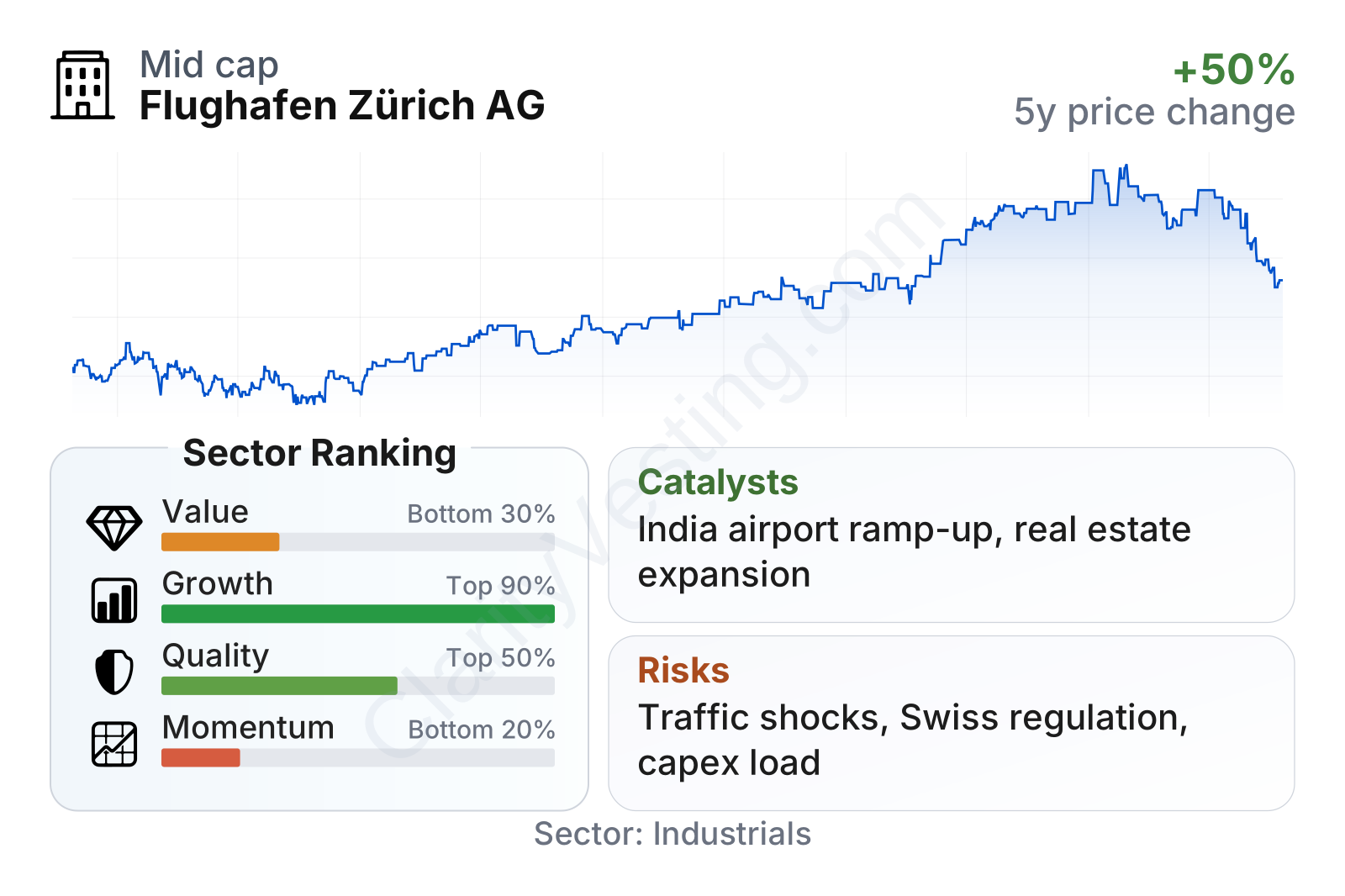
Flughafen Zürich AG stands out for business quality more than for classic cheapness. Profitability is strong, with returns on capital and assets above many sector peers, and operating margins are unusually high for a transport infrastructure company. Balance sheet leverage also looks manageable, with debt to equity around 59% and net debt to EBITDA close to 1x, which is moderate for an airport operator.
On valuation, the picture is mixed. The earnings multiple is below the sector median, but the price-to-book ratio is somewhat higher and the free cash flow yield is lower than many peers, which suggests the market is recognizing the quality and stability of the asset base. Dividend yield is clearly above the sector median, while recent share-price momentum has been weak despite a strong multi-year recovery in the business.
Growth
The company operates in a sector with long-term structural support. Air travel tends to benefit from population growth, rising mobility, tourism, and the role of major cities as business and transport hubs. Zurich Airport also has strategic importance as Switzerland’s primary international airport, which gives it a durable role in the national transport network. For long-term growth, that kind of infrastructure position is often more important than rapid short-term expansion.
Its strategy also makes sense. The company is not trying to grow only by adding more flights at home, where physical capacity, local regulations, and environmental constraints can limit expansion. Instead, it combines several growth paths: increasing passenger volumes, lifting spending per traveler through retail and services, expanding real estate around the airport, and developing international airport assets. This creates multiple ways to grow even if Swiss air traffic rises only moderately.
Recent revenue growth is not spectacular compared with the wider sector median, but the longer trend is more favorable. Over five years, revenue per share growth and free cash flow growth have been strong, and margins have improved meaningfully. That suggests the company is benefiting not only from recovery in traffic but also from a better earnings mix and operating discipline.
A notable catalyst is the continued development of the airport campus. Real estate and adjacent commercial uses can expand earnings without depending entirely on runway capacity. Another catalyst is the international portfolio, especially where Flughafen Zürich acts as developer or operator in airports with higher passenger growth than mature Western European markets. The opening and ramp-up of new airport infrastructure in India is particularly relevant because it gives the group exposure to a faster-growing aviation market than Switzerland.
Recent company updates have also pointed to resilient passenger demand and ongoing investment in capacity, service quality, and non-aviation offerings. For an airport operator, these are important signals because stronger passenger flows usually support several revenue lines at once: aviation fees, shopping, parking, and food services.
Risks
This article is for informational purposes only and does not constitute financial advice. Some content is AI-generated. See Disclaimer