Stock Analysis · National Beverage Corp (FIZZ)
Overview
National Beverage Corp is a U.S. beverage company focused on non-alcoholic drinks. It is best known for LaCroix, one of the most recognized sparkling water brands in the country, but it also sells juices, energy drinks, and carbonated soft drinks through a portfolio that includes brands such as Shasta, Faygo, Rip It, and Everfresh. The business is concentrated in packaged beverages sold through retailers, grocery stores, convenience channels, and food-service distributors.
Revenue is generated almost entirely from beverage sales in the United States. The company does not provide a detailed numeric revenue split by brand in its latest filings, so brand-level percentages are not available from primary public disclosures. Based on the structure of the business described in company filings, revenue sources can be understood as follows:
- Sparkling water: led by LaCroix and other flavored sparkling water products; this appears to be the company’s largest and most strategically important category.
- Carbonated soft drinks: including legacy brands such as Shasta and Faygo.
- Juices, energy drinks, and other beverages: including products such as Everfresh and Rip It.
National Beverage stands out because it is much smaller than the global beverage giants, yet it has built a meaningful niche through brand identity, flavor innovation, and a relatively asset-light financial profile. Over the last several years, revenue has stayed around the low-$1 billion range while profitability remained unusually strong for a packaged beverage company.
The business flow shows a notable pattern: sales have been fairly stable over time, while margins improved meaningfully from 2023 through 2025 before softening somewhat in 2026. That suggests the investment case is less about rapid expansion and more about whether the company can preserve premium profitability in a competitive category.
Key Figures
| Metric | Value | Sector ⓘ |
|---|---|---|
| Date | Oct 03, 2026 | |
| Context | ||
| Sector | Consumer Defensive | |
| Industry | Beverages - Non-Alcoholic | |
| Market Cap ⓘ | $2.77B | |
| Beta ⓘ | 0.76 | |
Value (Cheapness) | ||
| P/E Ratio ⓘ | 15.92 | 18.16 |
| P/B Ratio ⓘ | 7.54 | 1.27 |
| FCF Yield ⓘ | 5.84% | 12.39% |
| Dividend Yield ⓘ | N/A | 2.83% |
| EBIT / EV ⓘ | 7.60% | 6.45% |
| PEG ⓘ | 4.03 | |
Growth (Business expansion) | ||
| Revenue Growth ⓘ | N/A | 3.80% |
| RPS Growth (5Y CAGR) ⓘ | 0.90% | 6.20% |
| EPS Growth (5Y CAGR) ⓘ | -29.10% | -14.64% |
| BVPS Growth (5Y CAGR) ⓘ | 27.62% | 3.26% |
| Margin Growth (5Y Trend) ⓘ | 1.25% | -0.25% |
| FCF Growth (5Y CAGR) ⓘ | 10.66% | 4.65% |
| DPS Growth (5Y CAGR) ⓘ | N/A | 6.86% |
Quality (Business durability) | ||
| ROIC (Latest) ⓘ | 30.99% | 12.58% |
| ROA (Latest) ⓘ | 26.28% | 6.35% |
| ROIC (5Y Median) ⓘ | 37.94% | 10.36% |
| ROA (5Y Median) ⓘ | 26.29% | 5.44% |
| Net Debt / EBIT (Latest) ⓘ | -0.22 | 1.91 |
| Net Debt / EBIT (5Y Median) ⓘ | -0.62 | 2.32 |
| Net Debt / EBITDA (Latest) ⓘ | -0.20 | 1.36 |
| Net Debt / Assets ⓘ | -8.30% | 21.25% |
| EBITDA / Interest ⓘ | N/A | 9.61 |
| Operating Margin (Latest) ⓘ | 18.45% | 8.96% |
| Operating Margin (5Y Median) ⓘ | 19.29% | 9.53% |
| Debt to Equity (Latest) ⓘ | 15.98% | 71.66% |
| Profit Margin (Latest) ⓘ | 14.81% | 5.40% |
| Free Cash Flow (Latest) ⓘ | $161.90M | |
Momentum (Price trend) | ||
| 3Y Return ⓘ | -25.35% | +15.25% |
| 12M Return (excl. last month) ⓘ | -14.28% | +2.63% |
| 6M Return ⓘ | -3.08% | +2.43% |
| Price vs. 200-Day MA ⓘ | -5.24% | +0.43% |
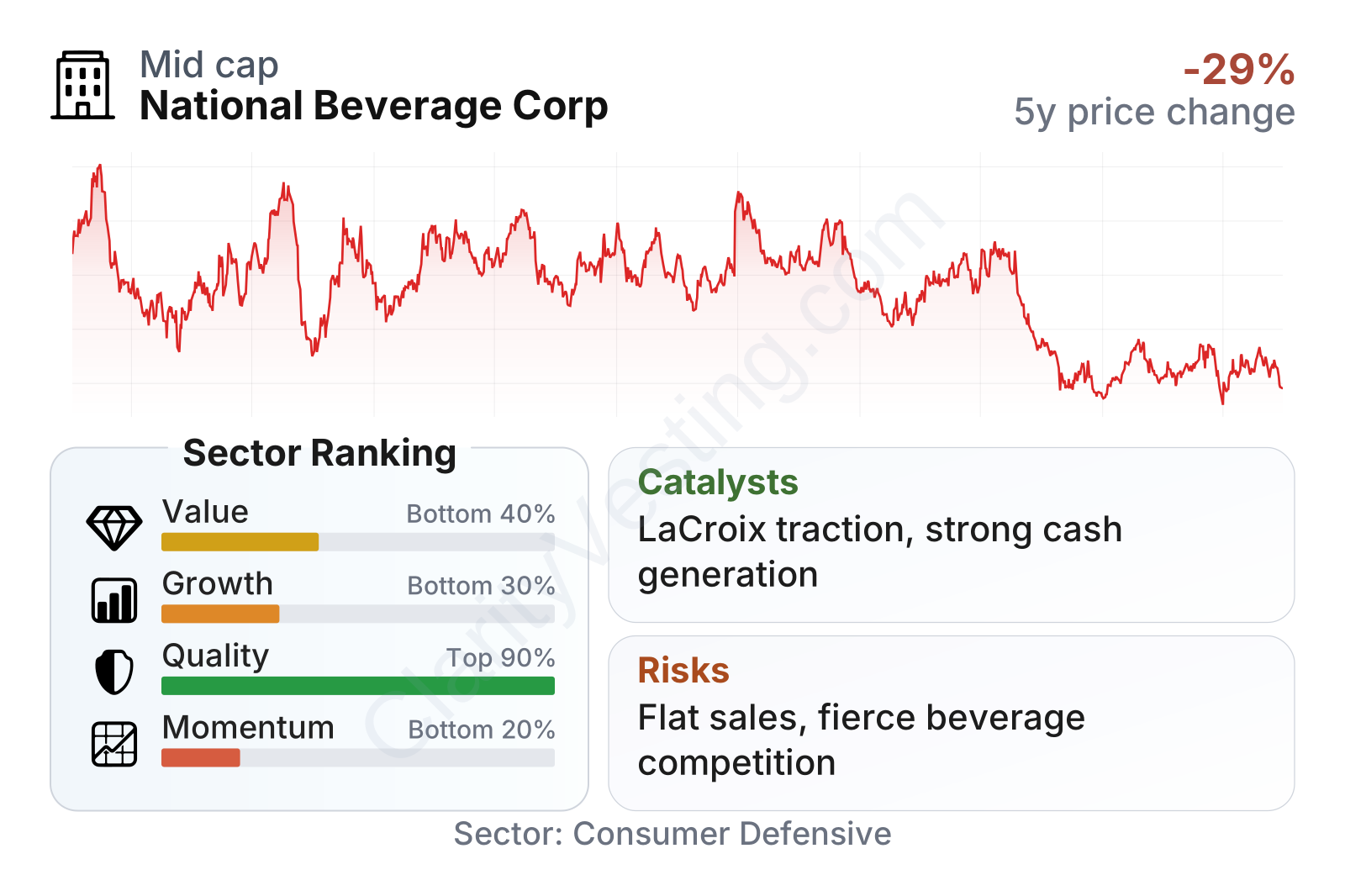
National Beverage is a mid-sized consumer staples company with lower share-price volatility than the broader market, as reflected by a beta below 1. The most striking feature in the metrics is quality: returns on capital and returns on assets are far above the sector median, profit margin is near 15%, and operating margin is around 18%, roughly double typical sector levels. The balance sheet is also unusually conservative, with very low leverage and net cash rather than net debt.
By contrast, growth and momentum look weak. Revenue growth has been flat recently, long-term revenue-per-share growth is modest, and the stock has underperformed much of the sector over the last one- and three-year periods. On valuation, the picture is mixed: the earnings multiple sits somewhat below the sector median, but the price-to-book ratio is much higher than average, which reflects the market’s willingness to pay for the company’s profitability and clean balance sheet.
Growth
The non-alcoholic beverage market is a durable sector, but not every part of it grows at the same speed. Sparkling water and better-for-you refreshment categories have been among the more attractive areas over the last decade because they benefit from changing consumer preferences toward low-calorie and flavored alternatives to traditional soda. That broader trend supports National Beverage’s positioning, especially through LaCroix.
At the same time, the company’s recent operating record shows that category exposure alone is not enough to guarantee growth. Revenue growth has slowed materially, and the latest year-over-year trend has hovered around flat to negative territory after stronger periods earlier in the cycle. That means the business currently looks more mature than high-growth.
Its strategy still makes sense for future growth because it is built around brand recognition, flavor variety, and maintaining shelf presence in categories where consumers make repeat purchases. If management can refresh demand through innovation, packaging, or distribution gains, even modest sales growth could translate into solid earnings because the margin structure is already strong.
Cash generation is another important support. Free cash flow has trended upward over several years and remains substantial for a company of this size, even after a slight pullback from the peak. Strong cash generation gives the company flexibility to support operations, marketing, special distributions, or strategic investments without relying heavily on debt.
A realistic catalyst is not a dramatic new business line, but a return to steadier volume growth in sparkling water combined with sustained high margins. In a defensive sector, a company that can keep margins elevated while reviving even low-single-digit sales growth can improve earnings quality noticeably. The latest filings also continue to show a business that remains firmly profitable despite softer top-line momentum, which keeps that possibility open.
Risks
This article is for informational purposes only and does not constitute financial advice. Some content is AI-generated. See Disclaimer