Stock Analysis · Comfort Systems USA Inc (FIX)
Overview
Comfort Systems USA is a mechanical, electrical, and plumbing contractor focused on commercial, industrial, and institutional buildings. In simple terms, the company helps design, install, maintain, and upgrade the systems that make buildings work: heating and air conditioning, ventilation, piping, plumbing, electrical systems, controls, and related services. It also has a growing presence in more specialized projects such as data centers, advanced manufacturing facilities, healthcare buildings, and modular or prefabricated construction.
The business is organized around two reporting segments, and recent annual results show a clear revenue mix:
- Mechanical segment: about 77% of revenue. This includes HVAC, plumbing, piping, controls, off-site fabrication, maintenance, repair, and retrofit work for commercial and industrial customers.
- Electrical segment: about 23% of revenue. This includes electrical contracting, installation, and related services, with increasing exposure to complex projects requiring integrated building systems.
Another useful way to think about revenue is by the type of work performed. Comfort Systems generates sales from new construction and large project work, but it also has recurring activity from service, repair, replacement, and ongoing facility support. That recurring service element matters because it can help stabilize the business when construction activity slows.
The company has expanded both organically and through acquisitions, building a broad national network of local operating companies. That structure gives it exposure to many end markets rather than relying on one single customer group or one region of the country.
The long-term trend has been notable: revenue has grown strongly in recent years, while profitability has improved even faster. Gross profit and operating income have expanded much more quickly than sales, which suggests the company has recently been executing at a higher level rather than merely getting bigger.
Key Figures
| Metric | Value | Sector ⓘ |
|---|---|---|
| Date | Oct 03, 2026 | |
| Context | ||
| Sector | Industrials | |
| Industry | Engineering & Construction | |
| Market Cap ⓘ | $58.60B | |
| Beta ⓘ | 1.68 | |
Value (Cheapness) | ||
| P/E Ratio ⓘ | 40.82 | 22.45 |
| P/B Ratio ⓘ | 18.13 | 1.98 |
| FCF Yield ⓘ | 3.69% | 6.31% |
| Dividend Yield ⓘ | 0.16% | 1.96% |
| EBIT / EV ⓘ | 3.32% | 4.81% |
| PEG ⓘ | 0.54 | |
Growth (Business expansion) | ||
| Revenue Growth ⓘ | 50.30% | 9.10% |
| RPS Growth (5Y CAGR) ⓘ | 32.13% | 7.75% |
| EPS Growth (5Y CAGR) ⓘ | 47.78% | -13.59% |
| BVPS Growth (5Y CAGR) ⓘ | 32.99% | 6.22% |
| Margin Growth (5Y Trend) ⓘ | 7.96% | 0.72% |
| FCF Growth (5Y CAGR) ⓘ | 59.89% | 10.98% |
| DPS Growth (5Y CAGR) ⓘ | 42.08% | 9.48% |
Quality (Business durability) | ||
| ROIC (Latest) ⓘ | 52.01% | 10.92% |
| ROA (Latest) ⓘ | 20.11% | 5.41% |
| ROIC (5Y Median) ⓘ | 25.66% | 9.21% |
| ROA (5Y Median) ⓘ | 10.96% | 4.94% |
| Net Debt / EBIT (Latest) ⓘ | -0.83 | 2.07 |
| Net Debt / EBIT (5Y Median) ⓘ | 0.13 | 2.28 |
| Net Debt / EBITDA (Latest) ⓘ | -0.78 | 1.43 |
| Net Debt / Assets ⓘ | -17.99% | 19.27% |
| EBITDA / Interest ⓘ | 208.35 | 9.53 |
| Operating Margin (Latest) ⓘ | 16.45% | 10.50% |
| Operating Margin (5Y Median) ⓘ | 7.63% | 10.27% |
| Debt to Equity (Latest) ⓘ | 10.20% | 65.48% |
| Profit Margin (Latest) ⓘ | 12.78% | 6.62% |
| Free Cash Flow (Latest) ⓘ | $2.16B | |
Momentum (Price trend) | ||
| 3Y Return ⓘ | +880.02% | +58.56% |
| 12M Return (excl. last month) ⓘ | +120.19% | +15.63% |
| 6M Return ⓘ | +20.06% | +4.19% |
| Price vs. 200-Day MA ⓘ | +6.89% | +0.93% |
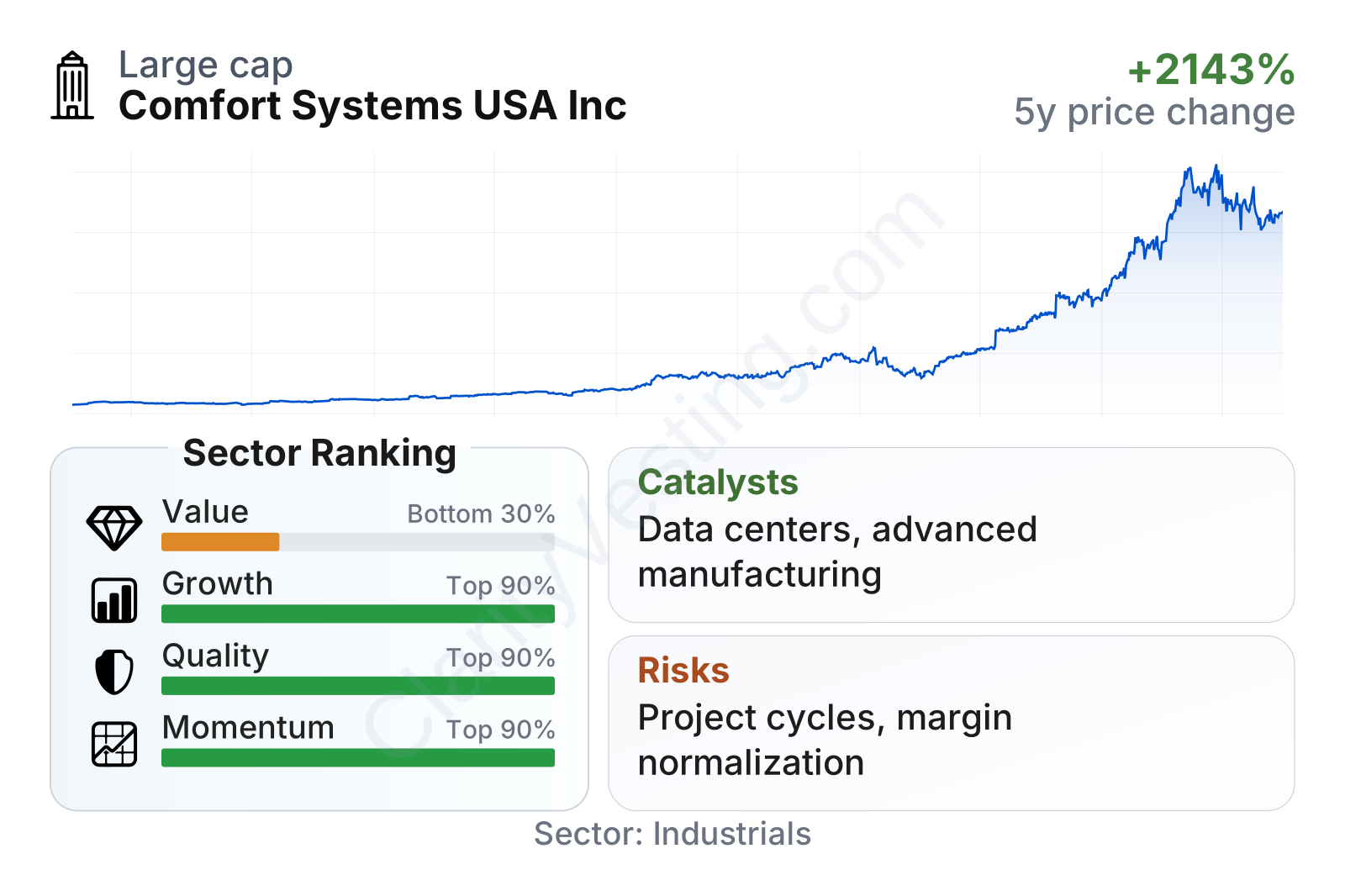
Comfort Systems is now a very large company within its industry, and its stock has shown unusually strong momentum over the last three years. The quality and growth profile ranks near the top of the sector, supported by high returns on assets, low leverage, and fast earnings expansion. The weak point in the snapshot is valuation: multiples are clearly above sector norms, which means the market is already recognizing much of the company’s recent strength.
Growth
Comfort Systems operates in parts of construction and building services that currently have attractive structural drivers. Demand is being supported by data center expansion, advanced manufacturing investment, semiconductor-related construction, energy infrastructure upgrades, building electrification, and the ongoing need to improve efficiency in existing buildings. These are not short-lived themes limited to one quarter; many are backed by multi-year capital spending plans across the United States.
The company’s strategy appears aligned with those trends. It has been investing in complex, high-value projects where labor skill, engineering capabilities, execution, and customer relationships matter more than simple low-bid competition. It has also been building prefabrication and modular capabilities, which can reduce on-site labor needs, improve speed, and make execution more predictable for customers working on technically demanding facilities.
Revenue growth has remained far above the sector median for an extended period, and the latest yearly pace is still running around 50%. That is especially important because it suggests the business is not just benefiting from an old backlog; it is still participating in active end-market demand.
Cash generation has also accelerated sharply. Over the last several years, free cash flow has risen from relatively modest levels to well above $1 billion on a trailing basis. For a contractor, that matters because accounting profits do not always turn into cash smoothly. In Comfort Systems’ case, the recent trend points to strong project execution, favorable working capital dynamics, and a business model that is converting growth into real financial flexibility.
A significant near-term catalyst is continued spending on data centers and advanced manufacturing plants, both of which require extensive mechanical and electrical systems. Comfort Systems has repeatedly emphasized larger, more sophisticated projects as an area of opportunity, and that focus matches where some of the strongest construction demand is currently concentrated. The company’s acquisition pipeline can also remain a growth lever, especially when it adds local capabilities or specialized technical expertise.
Risks
This article is for informational purposes only and does not constitute financial advice. Some content is AI-generated. See Disclaimer