Stock Analysis · Fifth Third Bancorp (FITB)
Overview
Fifth Third Bancorp is a large U.S. regional bank headquartered in Cincinnati. It provides everyday banking services such as checking accounts, savings, mortgages, credit cards, auto lending, and business loans, while also offering treasury management, payments, wealth management, and capital-markets services. Its footprint is centered in the Midwest and Southeast, with commercial banking and consumer banking as the core of the franchise.
Like most banks, Fifth Third makes most of its money from the spread between what it earns on loans and securities and what it pays on deposits and other funding. It also earns fee income from payment processing, wealth and asset management, service charges, and capital-markets activity. Based on the company’s recent annual reporting structure, revenue is best understood through the following mix:
- Net interest income: approximately 65% to 75% of total revenue in a typical year. This is the bank’s largest source of revenue and includes income from commercial loans, consumer loans, residential mortgages, credit products, and investment securities after funding costs.
- Commercial banking: approximately 35% to 45% of total revenue. This includes lending, treasury management, leasing, and advisory services for middle-market and larger business clients.
- Branch banking / consumer banking: approximately 30% to 40% of total revenue. This covers deposits, mortgages, home equity, auto lending, credit cards, and other services for households and small businesses.
- Fee-based noninterest income: approximately 25% to 35% of total revenue. This includes card and processing fees, wealth and asset management fees, service charges, and securities-related income.
- Wealth and asset management plus capital-markets-related activities: a smaller but meaningful portion within noninterest income, supporting diversification beyond plain lending.
That revenue mix matters because it shows Fifth Third is not a pure loan-and-deposit bank. Lending still drives results, but payments, treasury services, and wealth activities help reduce reliance on interest-rate conditions alone.
The multi-year flow of revenue and expenses shows a bank that expanded revenue strongly from 2021 through 2024, then stabilized in 2025. Profitability remained positive throughout, but higher interest expense became a much larger drag after rates rose, which helps explain why revenue growth did not fully translate into equally strong earnings growth.
Key Figures
| Metric | Value | Sector ⓘ |
|---|---|---|
| Date | Oct 23, 2026 | |
| Context | ||
| Sector | Financial Services | |
| Industry | Banks - Regional | |
| Market Cap ⓘ | $48.26B | |
| Beta ⓘ | 0.99 | |
Value (Cheapness) | ||
| P/E Ratio ⓘ | 17.74 | 12.46 |
| P/B Ratio ⓘ | 1.47 | 1.25 |
| FCF Yield ⓘ | 6.24% | 9.82% |
| Dividend Yield ⓘ | 0.76% | 2.94% |
| EBIT / EV ⓘ | 4.72% | 8.11% |
| PEG ⓘ | 1.69 | |
Growth (Business expansion) | ||
| Revenue Growth ⓘ | 50.00% | 9.10% |
| RPS Growth (5Y CAGR) ⓘ | 14.53% | 12.31% |
| EPS Growth (5Y CAGR) ⓘ | -10.18% | -6.97% |
| BVPS Growth (5Y CAGR) ⓘ | 3.53% | 5.02% |
| Margin Growth (5Y Trend) ⓘ | -19.31% | -4.00% |
| FCF Growth (5Y CAGR) ⓘ | 12.27% | 4.71% |
| DPS Growth (5Y CAGR) ⓘ | 8.35% | 8.92% |
Quality (Business durability) | ||
| ROIC (Latest) ⓘ | 5.30% | 9.18% |
| ROE (Latest) ⓘ | 9.20% | 13.93% |
| ROA (Latest) ⓘ | 0.99% | 1.57% |
| ROIC (5Y Median) ⓘ | 7.22% | 7.80% |
| ROE (5Y Median) ⓘ | 12.87% | 12.15% |
| ROA (5Y Median) ⓘ | 1.17% | 1.28% |
| Net Debt / EBIT (Latest) ⓘ | 5.98 | 1.02 |
| Net Debt / EBIT (5Y Median) ⓘ | 4.90 | 0.72 |
| Net Debt / EBITDA (Latest) ⓘ | 3.69 | 0.88 |
| Operating Margin (Latest) ⓘ | 20.11% | 22.30% |
| Operating Margin (5Y Median) ⓘ | 24.95% | 24.50% |
| Debt to Equity (Latest) ⓘ | 54.44% | 59.34% |
| Profit Margin (Latest) ⓘ | 23.04% | 26.42% |
| Free Cash Flow (Latest) ⓘ | $3.01B | |
Momentum (Price trend) | ||
| 3Y Return ⓘ | +157.38% | +95.73% |
| 12M Return (excl. last month) ⓘ | +21.36% | +17.30% |
| 6M Return ⓘ | +6.91% | +6.07% |
| Price vs. 200-Day MA ⓘ | +4.03% | +5.36% |
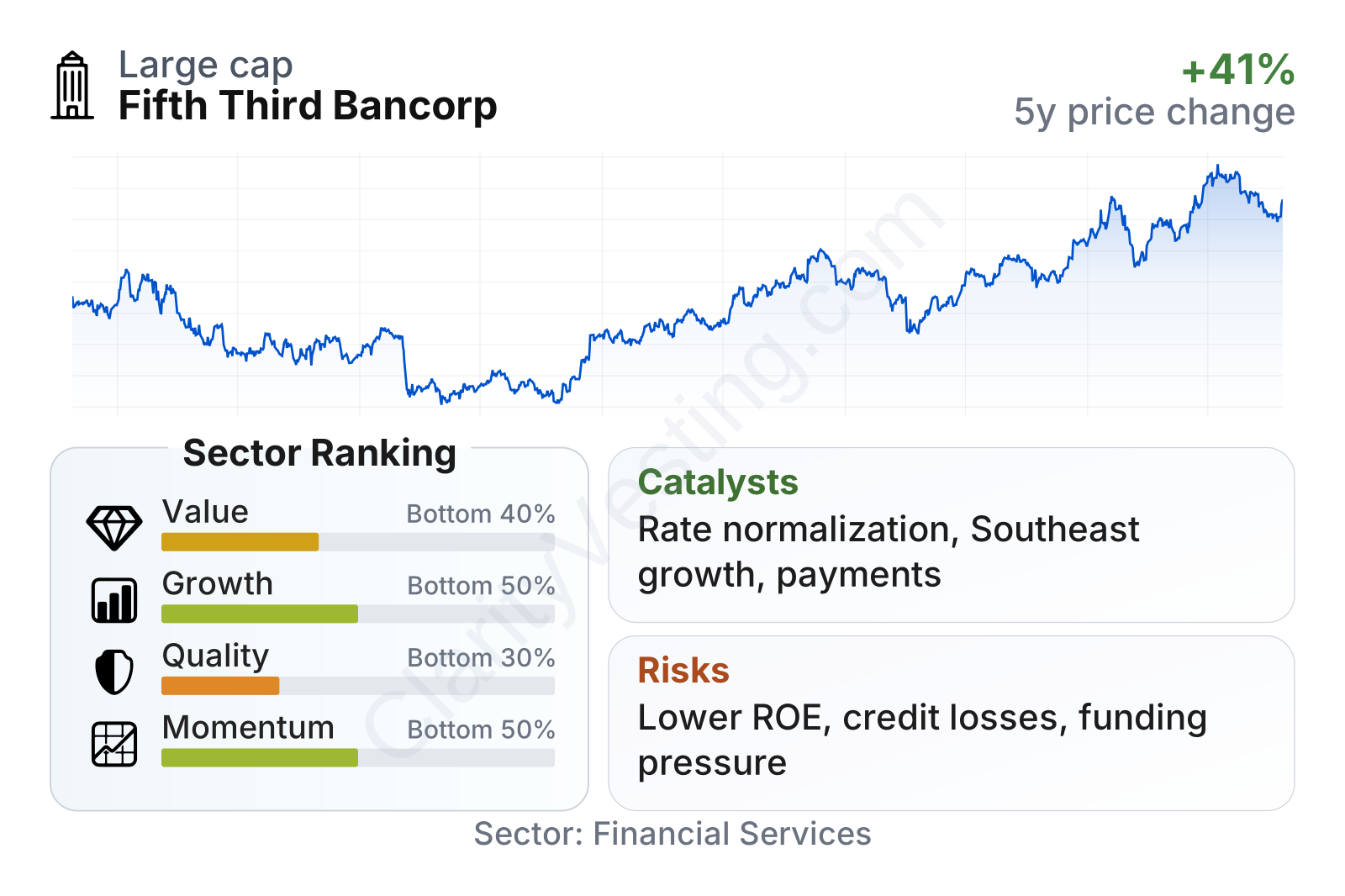
Fifth Third is a large regional bank with market volatility close to the broader market. The stock has recovered sharply from the regional-bank stress period in 2023 and has delivered stronger multi-year share performance than the median company in its sector. Even so, the latest factor profile is mixed: valuation metrics sit in the weaker part of the sector, quality measures are also below many peers, and growth looks uneven despite strong recent revenue expansion.
Growth
Banking is not a high-growth sector in the same way as software or semiconductors, but it remains a structurally important one. Over long periods, banks grow through loan balances, deposits, fee businesses, market-share gains, and acquisitions. For Fifth Third, the most credible growth path is not rapid expansion everywhere, but disciplined growth in higher-return commercial banking, payments, treasury management, and selected Southeast markets where population and business activity have been stronger than in many Midwestern regions.
Its strategy is broadly logical for the current environment. Management has spent years building fee-generating capabilities around commercial clients, including payments and treasury services, which can deepen relationships and improve profitability without relying only on larger loan books. The company has also pushed digital banking and branch optimization, which can support efficiency if execution remains solid.
Recent operating trends are encouraging in some areas. Revenue growth over the last year stands far above the sector median, and five-year revenue-per-share growth has also been better than many peers. Book value per share has resumed an upward path after the 2022 decline that affected many banks as interest rates moved sharply and securities values adjusted.
Earnings per share have been fairly stable rather than consistently compounding higher. After peaking above pre-2022 levels, EPS weakened and then started to recover, which suggests the franchise is resilient but not currently in a powerful earnings acceleration phase. For a bank, that usually means margin pressure, funding costs, or credit normalization are offsetting part of the revenue growth.
Book value per share is especially important for banks because it is a rough measure of the underlying capital base. Fifth Third’s book value has improved materially since 2022 and reached a new high in 2025, which supports the idea that capital has been rebuilt and retained earnings are still adding value over time.
One notable catalyst is the interest-rate backdrop. If deposit costs stabilize while loan yields remain healthy, net interest income can improve without dramatic balance-sheet expansion. Another potential catalyst is continued growth in commercial payments and treasury services, where banks with strong corporate relationships can gain recurring fee income. In addition, Fifth Third has exposure to faster-growing Sun Belt markets, which could support customer and loan growth above the pace of slower regional economies.
Recent company updates have also highlighted ongoing share repurchases, capital return flexibility, and continued investment in technology and payments capabilities. None of these are transformational alone, but together they can support per-share growth if credit quality stays under control.
Risks
This article is for informational purposes only and does not constitute financial advice. Some content is AI-generated. See Disclaimer


