Stock Analysis · First Interstate BancSystem Inc (FIBK)
Overview
First Interstate BancSystem is a regional bank centered in the western and Midwestern United States. It provides traditional banking services to individuals, businesses, municipalities, and other institutions through a branch network and digital channels. Its model is straightforward: gather deposits, lend that money at higher rates, earn fees from customer services, and manage credit risk carefully over time.
The company’s revenue is mainly generated from net interest income, which is the spread between what it earns on loans and securities and what it pays on deposits and other funding. Non-interest income adds a smaller but still meaningful contribution through service-based activities. Based on recent annual disclosures and segment presentation, the main sources of revenue can be summarized as follows:
- Net interest income: about 75% to 85% — income from commercial loans, real estate loans, agricultural lending, consumer lending, and the securities portfolio, after funding costs.
- Wealth management, trust, and investment services fees: about 5% to 10% — advisory, fiduciary, and asset-related fees.
- Service charges and deposit account fees: about 3% to 6% — account maintenance, overdraft-related, treasury management, and transaction fees.
- Mortgage banking and loan-related fees: about 2% to 5% — mortgage origination, secondary market activity, and some loan servicing-related income.
- Card, interchange, and other customer transaction fees: about 2% to 4% — debit card usage and payment processing activity.
- Other non-interest income: usually a small remainder — bank-owned life insurance, gains or losses on asset sales, and miscellaneous banking income.
Geographically, First Interstate is not a national giant but a sizable regional institution, with a strong presence in states such as Montana, Wyoming, South Dakota, Idaho, Colorado, Arizona, and neighboring markets. That footprint matters because many of these areas are less saturated than major coastal banking markets, giving the bank room to deepen customer relationships in local communities.
The business mix also remains fairly traditional for a regional bank. That can be a strength for long-term analysis because the core economics are easier to understand than those of more complex financial firms. At the same time, it means performance depends heavily on loan demand, deposit stability, credit quality, and interest-rate conditions.
The long-term picture shows a bank that has expanded revenue materially over the last several years, while profitability has been more uneven as funding costs and operating expenses moved around. Net income improved again in 2025 after softer results in 2024, which suggests the earnings base is still sensitive to the rate cycle but remains intact.
Key Figures
| Metric | Value | Sector ⓘ |
|---|---|---|
| Date | Oct 24, 2026 | |
| Context | ||
| Sector | Financial Services | |
| Industry | Banks - Regional | |
| Market Cap ⓘ | $3.40B | |
| Beta ⓘ | 0.71 | |
Value (Cheapness) | ||
| P/E Ratio ⓘ | 11.04 | 12.46 |
| P/B Ratio ⓘ | 1.07 | 1.25 |
| FCF Yield ⓘ | 7.16% | 9.82% |
| Dividend Yield ⓘ | 5.29% | 2.94% |
| EBIT / EV ⓘ | 13.75% | 8.11% |
| PEG ⓘ | 1.16 | |
Growth (Business expansion) | ||
| Revenue Growth ⓘ | 7.40% | 9.10% |
| RPS Growth (5Y CAGR) ⓘ | -0.79% | 12.31% |
| EPS Growth (5Y CAGR) ⓘ | -18.18% | -6.97% |
| BVPS Growth (5Y CAGR) ⓘ | 1.03% | 5.02% |
| Margin Growth (5Y Trend) ⓘ | -0.76% | -4.00% |
| FCF Growth (5Y CAGR) ⓘ | 0.53% | 4.71% |
| DPS Growth (5Y CAGR) ⓘ | 3.52% | 8.92% |
Quality (Business durability) | ||
| ROIC (Latest) ⓘ | 8.78% | 9.18% |
| ROE (Latest) ⓘ | 9.58% | 13.93% |
| ROA (Latest) ⓘ | 1.22% | 1.57% |
| ROIC (5Y Median) ⓘ | 5.14% | 7.80% |
| ROE (5Y Median) ⓘ | 8.17% | 12.15% |
| ROA (5Y Median) ⓘ | 0.82% | 1.28% |
| Net Debt / EBIT (Latest) ⓘ | -18.15 | 1.02 |
| Net Debt / EBIT (5Y Median) ⓘ | 5.06 | 0.72 |
| Net Debt / EBITDA (Latest) ⓘ | -16.01 | 0.88 |
| Operating Margin (Latest) ⓘ | 43.80% | 22.30% |
| Operating Margin (5Y Median) ⓘ | 37.01% | 24.50% |
| Debt to Equity (Latest) ⓘ | 22.63% | 59.34% |
| Profit Margin (Latest) ⓘ | 30.64% | 26.42% |
| Free Cash Flow (Latest) ⓘ | $243.30M | |
Momentum (Price trend) | ||
| 3Y Return ⓘ | +99.67% | +95.73% |
| 12M Return (excl. last month) ⓘ | +17.59% | +17.30% |
| 6M Return ⓘ | +9.70% | +6.07% |
| Price vs. 200-Day MA ⓘ | +3.30% | +5.36% |
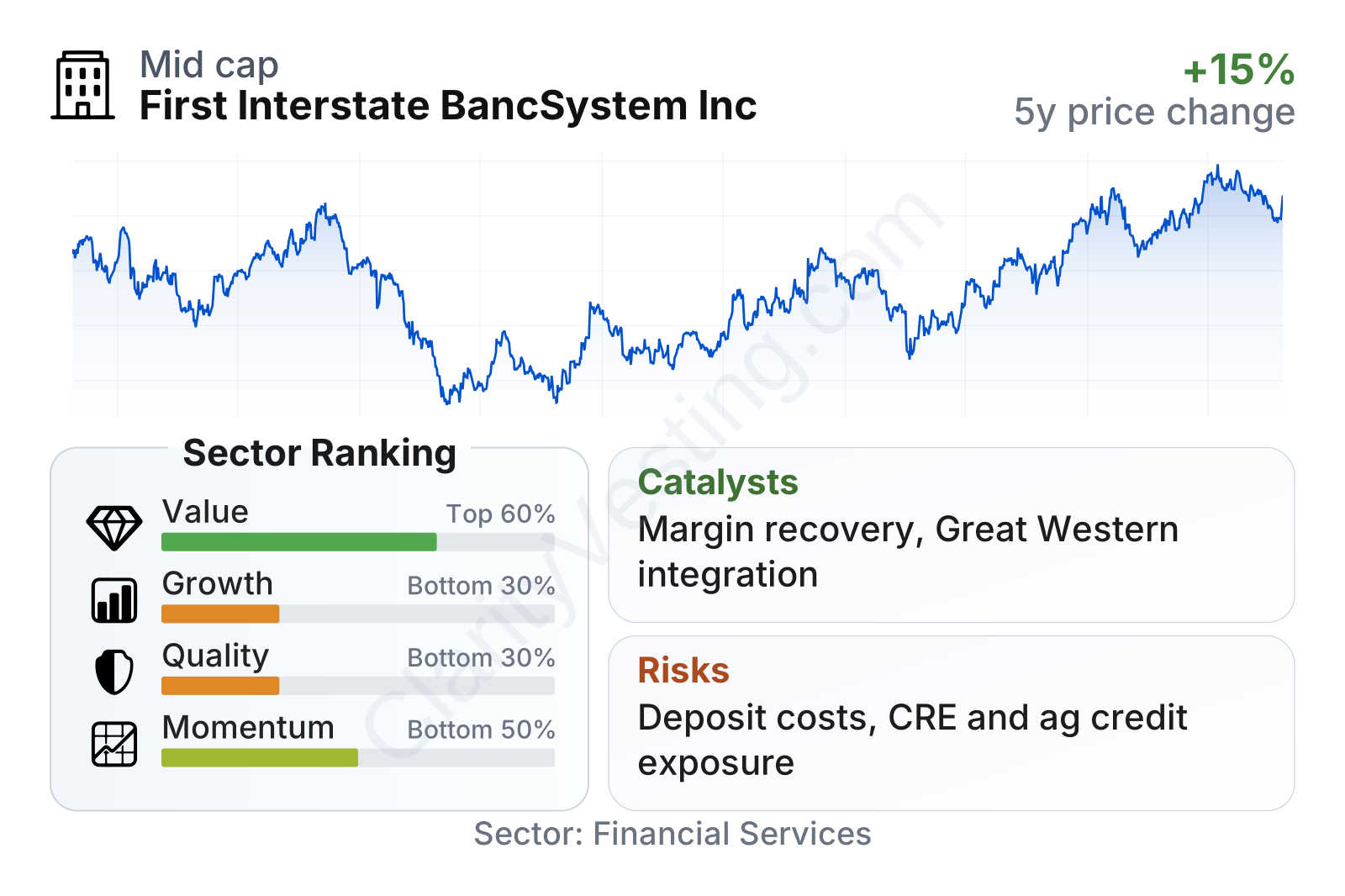
First Interstate sits in the mid-sized range among listed regional banks and has had lower share-price volatility than the broader market, reflected in a beta below 1. Valuation metrics are generally a bit cheaper than the sector median, especially on price-to-book and earnings, while the dividend yield stands clearly above the sector median. The weaker area is growth and overall quality relative to peers: profitability ratios trail the median, and the bank’s longer-term growth record has been modest. On the positive side, margins and balance-sheet leverage look better than many peers, which helps explain why the stock does not screen as distressed despite softer return metrics.
Growth
Regional banking is not a high-growth industry in the way software or semiconductors can be, but it remains a necessary part of the economy. Demand for deposits, business lending, treasury services, mortgage products, and wealth management tends to grow over time with population, business formation, and local economic activity. For First Interstate, the opportunity is tied less to a booming sector and more to whether it can gain share in attractive local markets while keeping funding costs under control.
The company’s strategy is sensible for that kind of environment. It focuses on relationship banking in smaller and mid-sized communities, where local knowledge and branch presence can still matter. The 2022 Great Western Bancorp acquisition significantly expanded the franchise and scale of the bank. Since then, one of the central tasks has been converting that larger footprint into stronger efficiency, steadier deposit gathering, and better earnings power. That integration angle remains one of the most important growth levers because successful cost discipline and deeper customer penetration can support profit growth even if industry loan growth stays moderate.
Earnings per share show why the name requires some patience. Results moved down from the 2021-2024 period before recovering in 2025. That pattern suggests earnings are not on a smooth upward path, but the rebound also indicates the pressure was not purely structural. For a bank like First Interstate, future EPS improvement will likely depend on a mix of lower deposit-cost pressure, disciplined expense control, and stable credit quality rather than rapid top-line expansion alone.
Book value per share has been comparatively stable and has edged upward again after the post-acquisition adjustment period. For banks, this metric matters because it represents the capital base that supports lending and absorbs losses. A gradually rising book value can be a sign that retained earnings are rebuilding underlying value even when market sentiment shifts sharply.
A meaningful catalyst is the possibility of a more favorable interest-rate setup. If deposit costs stabilize or decline faster than asset yields compress, net interest margin can improve. Another potential tailwind is continued balance-sheet remixing toward higher-yielding loans and disciplined pricing on deposits. In addition, fee businesses such as wealth management and treasury-related services offer a way to diversify income without taking large balance-sheet risk.
Recent company updates in 2026 have continued to emphasize capital strength, deposit trends, credit discipline, and operating execution rather than transformational moves. That is consistent with the current phase of the bank: it is more about extracting better returns from the existing franchise than chasing aggressive expansion.
Risks
This article is for informational purposes only and does not constitute financial advice. Some content is AI-generated. See Disclaimer


