Stock Analysis · First Horizon Corporation (FHN)
Overview
First Horizon Corporation is a regional bank headquartered in Tennessee. It operates through First Horizon Bank and serves consumers, businesses, and commercial clients, mainly across the Southern U.S. The company’s business is built around gathering deposits, making loans, providing treasury and wealth services, and earning fees from capital markets and other banking activities.
Its revenue mix can move from year to year because bank results are heavily influenced by interest rates, deposit costs, and market activity. Based on recent company reporting, the largest sources of revenue are approximately:
- Net interest income: about 65% to 75% of total revenue. This is the spread between what First Horizon earns on loans and securities and what it pays on deposits and other funding.
- Fixed income and capital markets: about 10% to 15%. This includes bond trading, underwriting-related activity, and services tied to institutional and commercial clients.
- Wealth management, trust, and brokerage: about 5% to 10%. These are fee-based services for individuals, families, and institutions.
- Service charges, card and digital payments, and other fees: about 5% to 10%. This includes deposit account fees, interchange, and other banking service income.
- Mortgage banking and smaller lines: usually low single-digit percentages or variable, depending on housing activity and interest-rate conditions.
For a long-term reader, the key point is simple: First Horizon is primarily a traditional spread-based bank, so its core earnings power depends mostly on loan growth, funding costs, and credit quality rather than on high-growth technology-style expansion.
Over the last several years, total revenue has trended higher, reaching close to $5.0 billion in 2025, while net income recovered to just under $1.0 billion after a softer 2024. That pattern suggests a business with meaningful earnings capacity, but also one that remains sensitive to the banking cycle and interest-rate environment.
The revenue base has expanded materially since 2021, but a large share of that improvement was absorbed by higher interest expense as funding costs rose. Even so, operating profitability remained solid, showing that the franchise still generates healthy underlying banking income despite a more difficult rate environment.
Key Figures
| Metric | Value | Sector ⓘ |
|---|---|---|
| Date | Oct 19, 2026 | |
| Context | ||
| Sector | Financial Services | |
| Industry | Banks - Regional | |
| Market Cap ⓘ | $10.84B | |
| Beta ⓘ | 0.63 | |
Value (Cheapness) | ||
| P/E Ratio ⓘ | 16.58 | 12.26 |
| P/B Ratio ⓘ | 1.23 | 1.23 |
| FCF Yield ⓘ | 12.78% | 10.40% |
| Dividend Yield ⓘ | 2.89% | 3.02% |
| EBIT / EV ⓘ | 11.60% | 8.14% |
| PEG ⓘ | 1.76 | |
Growth (Business expansion) | ||
| Revenue Growth ⓘ | -51.70% | 9.25% |
| RPS Growth (5Y CAGR) ⓘ | 15.12% | 12.19% |
| EPS Growth (5Y CAGR) ⓘ | -1.14% | -9.36% |
| BVPS Growth (5Y CAGR) ⓘ | 6.51% | 4.99% |
| Margin Growth (5Y Trend) ⓘ | -15.01% | -3.86% |
| FCF Growth (5Y CAGR) ⓘ | 8.54% | 4.81% |
| DPS Growth (5Y CAGR) ⓘ | 0.80% | 8.79% |
Quality (Business durability) | ||
| ROIC (Latest) ⓘ | 9.87% | 9.49% |
| ROE (Latest) ⓘ | 8.15% | 13.87% |
| ROA (Latest) ⓘ | 0.85% | 1.54% |
| ROIC (5Y Median) ⓘ | 8.60% | 7.86% |
| ROE (5Y Median) ⓘ | 11.20% | 12.17% |
| ROA (5Y Median) ⓘ | 1.12% | 1.30% |
| Net Debt / EBIT (Latest) ⓘ | 2.38 | 0.99 |
| Net Debt / EBIT (5Y Median) ⓘ | 1.43 | 0.73 |
| Net Debt / EBITDA (Latest) ⓘ | 3.18 | 0.91 |
| Operating Margin (Latest) ⓘ | 29.89% | 22.30% |
| Operating Margin (5Y Median) ⓘ | 25.70% | 24.63% |
| Debt to Equity (Latest) ⓘ | 46.69% | 58.04% |
| Profit Margin (Latest) ⓘ | 23.43% | 26.57% |
| Free Cash Flow (Latest) ⓘ | $1.39B | |
Momentum (Price trend) | ||
| 3Y Return ⓘ | +132.27% | +88.26% |
| 12M Return (excl. last month) ⓘ | +10.47% | +19.24% |
| 6M Return ⓘ | -3.27% | +4.70% |
| Price vs. 200-Day MA ⓘ | -4.93% | +3.66% |
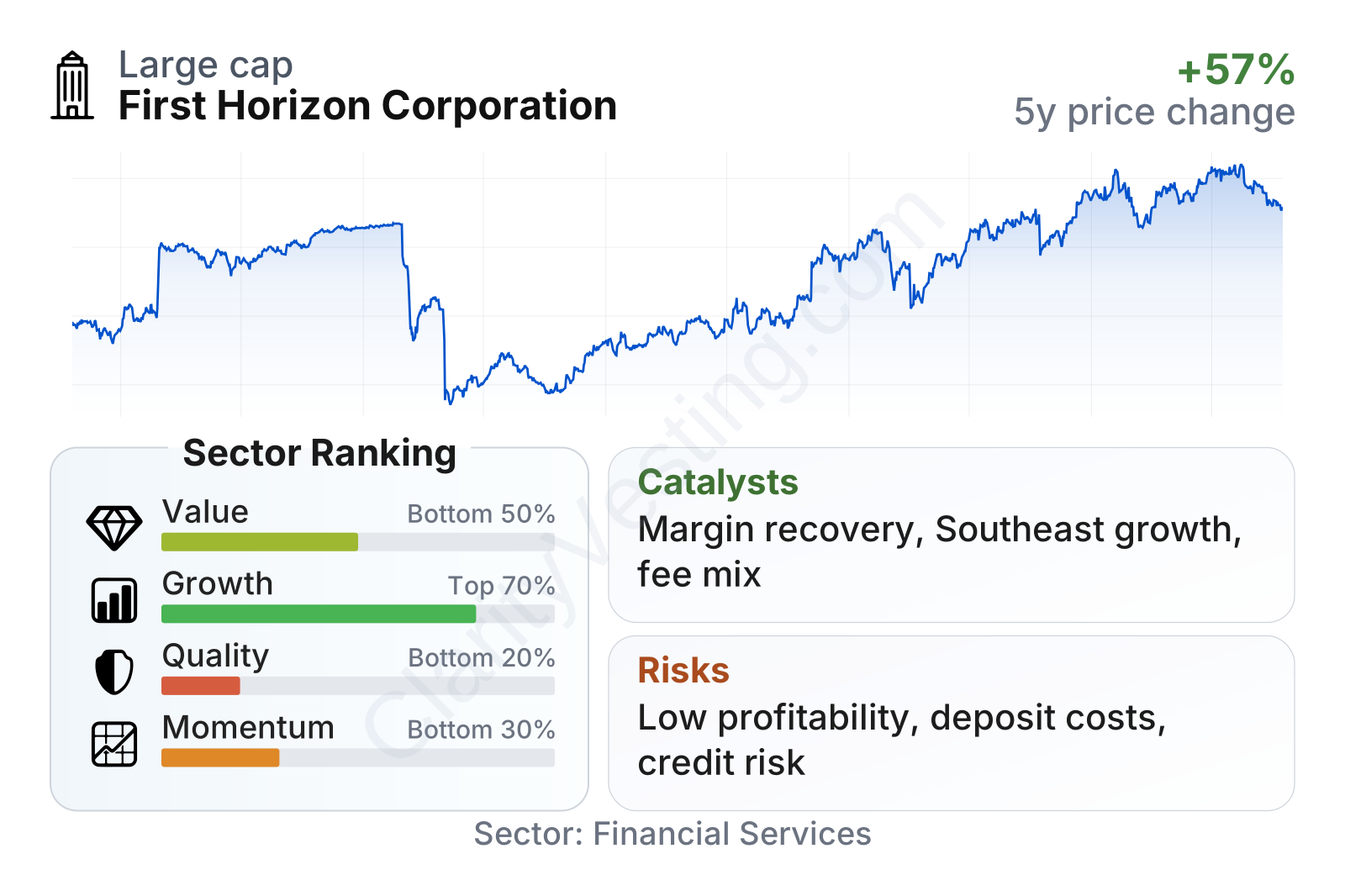
First Horizon is a mid-sized regional bank with a market value around $10 billion to $11 billion and a below-market beta, which points to lower share-price volatility than many stocks. The table shows a mixed profile: value metrics are not especially cheap relative to the sector, growth rankings are acceptable on a multi-year basis, but quality and recent momentum sit below many peers. In practical terms, the market appears to be recognizing the company’s recovery, while still discounting its lower profitability compared with stronger regional banks.
The stock-price history also shows how sharply sentiment changed after the 2023 regional banking stress. Shares later recovered strongly through 2025 and into 2026, indicating that confidence in deposits, capital, and earnings resilience improved, though not enough to place the company among the sector’s strongest momentum names today.
Growth
Banking is a mature industry, but it remains structurally important and tends to grow over time with population growth, business formation, household borrowing, and payment activity. In First Horizon’s footprint, long-term demographic and economic trends in the Southeast remain supportive. That matters because regional banks often win by deepening relationships in growing local markets rather than by expanding nationally at any cost.
First Horizon’s strategy is logical for that environment. The company focuses on relationship banking, commercial lending, treasury management, wealth services, and selected capital-markets capabilities. This mix can support steadier growth than a bank that relies too heavily on one niche. It also gives the company multiple ways to expand revenue: more loans, more deposits, more fee income, and better cross-selling to existing customers.
Earnings per share weakened from 2021 through 2023, then began to recover in 2024 and 2025. That pattern fits the broader industry backdrop: higher funding costs and pressure on margins hurt profits, but the business has shown an ability to rebuild earnings as conditions normalized. Multi-year EPS growth is not impressive in absolute terms, yet it compares better than a meaningful part of the regional-bank universe because many peers also went through a difficult profitability cycle.
Book value per share has moved upward over the last five years and has grown faster than the sector median over that period. For banks, this is an important signal because book value reflects the capital base supporting future lending and earnings. A rising book value per share, especially after the 2023 stress period, suggests the balance sheet retained enough strength to continue compounding rather than simply defending itself.
One potential catalyst is the company’s ability to benefit if deposit pricing stabilizes and loan spreads improve. Regional banks can see earnings rise meaningfully when the pressure from funding costs eases. Another opportunity comes from continued expansion in Southern markets, where business migration and household growth can support commercial banking, mortgage, payments, and wealth-management demand.
Recent company updates have also pointed to ongoing efforts to improve efficiency, manage capital carefully, and maintain liquidity. For a bank in First Horizon’s position, those are practical drivers of future growth because even moderate revenue expansion can translate into stronger earnings if expense discipline and funding costs improve at the same time.
Risks
This article is for informational purposes only and does not constitute financial advice. Some content is AI-generated. See Disclaimer


