Stock Analysis · Federated Investors Inc B (FHI)
Overview
Federated Investors Inc. B, now operating as Federated Hermes, is an asset management company. In simple terms, it manages money on behalf of clients such as corporations, governments, financial institutions, retirement plans, and individual investors. The company offers products across money market funds, fixed-income strategies, equity funds, and alternative/private market solutions. It also has a recognized presence in responsible investing and stewardship through its Hermes heritage.
The business model is mainly based on collecting management fees tied to the amount of client assets under management. When clients place more money with the firm, or when market values rise, revenue usually increases. Performance fees and certain service-related fees can add to that, but they are typically much smaller than recurring management fees.
Based on recent company disclosures, the revenue mix is largely concentrated in investment management and related activities. A practical breakdown is:
- Money market and cash management fees: approximately the largest contributor, supported by the company’s strong franchise in liquidity products for institutions and intermediaries.
- Fixed-income management fees: another major source, including government, credit, municipal, and multi-sector bond strategies.
- Equity management fees: a meaningful but smaller contributor, covering U.S., international, and specialty equity products.
- Alternative/private markets and multi-asset solutions: a growing but still smaller piece, including private markets, sustainable strategies, and specialized mandates.
- Performance fees and other revenue: a relatively small and more variable contribution.
Because asset managers often report assets under management by strategy more clearly than revenue by strategy, precise revenue percentages are not always disclosed in a simple line-item format. Still, the broad picture is clear: Federated Hermes remains heavily exposed to money market and fixed-income activities, which gives it a somewhat different profile from equity-heavy asset managers.
The earnings structure also shows a business that converts a high share of revenue into profit. Revenue rose steadily from 2021 through 2025, while operating income and net income also expanded overall despite some year-to-year volatility. That pattern fits a company with scalable fee revenue, disciplined costs, and favorable operating leverage when assets and fee rates improve.
The long-term pattern points to a business with improving revenue and profit generation, especially in 2025, when revenue and operating income moved noticeably higher. Costs also increased, but profitability still strengthened, suggesting that higher client assets and a favorable product mix more than offset expense growth.
Key Figures
| Metric | Value | Sector ⓘ |
|---|---|---|
| Date | Oct 17, 2026 | |
| Context | ||
| Sector | Financial Services | |
| Industry | Asset Management | |
| Market Cap ⓘ | $4.10B | |
| Beta ⓘ | 0.64 | |
Value (Cheapness) | ||
| P/E Ratio ⓘ | 10.24 | 12.26 |
| P/B Ratio ⓘ | 3.26 | 1.23 |
| FCF Yield ⓘ | 8.87% | 10.40% |
| Dividend Yield ⓘ | 2.54% | 3.02% |
| EBIT / EV ⓘ | 13.29% | 8.14% |
| PEG ⓘ | 1.40 | |
Growth (Business expansion) | ||
| Revenue Growth ⓘ | 18.30% | 9.35% |
| RPS Growth (5Y CAGR) ⓘ | 14.61% | 12.19% |
| EPS Growth (5Y CAGR) ⓘ | -0.10% | -9.53% |
| BVPS Growth (5Y CAGR) ⓘ | 6.04% | 4.99% |
| Margin Growth (5Y Trend) ⓘ | -0.53% | -3.86% |
| FCF Growth (5Y CAGR) ⓘ | 16.49% | 4.81% |
| DPS Growth (5Y CAGR) ⓘ | 5.43% | 8.79% |
Quality (Business durability) | ||
| ROIC (Latest) ⓘ | N/A | 9.49% |
| ROE (Latest) ⓘ | 33.83% | 13.90% |
| ROA (Latest) ⓘ | 18.27% | 1.55% |
| ROIC (5Y Median) ⓘ | 20.70% | 7.86% |
| ROE (5Y Median) ⓘ | 23.97% | 12.17% |
| ROA (5Y Median) ⓘ | 13.25% | 1.30% |
| Net Debt / EBIT (Latest) ⓘ | 0.26 | 0.96 |
| Net Debt / EBIT (5Y Median) ⓘ | -0.03 | 0.73 |
| Net Debt / EBITDA (Latest) ⓘ | 0.25 | 0.92 |
| Operating Margin (Latest) ⓘ | 29.23% | 22.30% |
| Operating Margin (5Y Median) ⓘ | 25.47% | 24.63% |
| Debt to Equity (Latest) ⓘ | 36.08% | 58.56% |
| Profit Margin (Latest) ⓘ | 21.30% | 26.57% |
| Free Cash Flow (Latest) ⓘ | $363.79M | |
Momentum (Price trend) | ||
| 3Y Return ⓘ | +91.47% | +88.33% |
| 12M Return (excl. last month) ⓘ | +13.32% | +19.38% |
| 6M Return ⓘ | -1.36% | +4.75% |
| Price vs. 200-Day MA ⓘ | -0.41% | +3.50% |
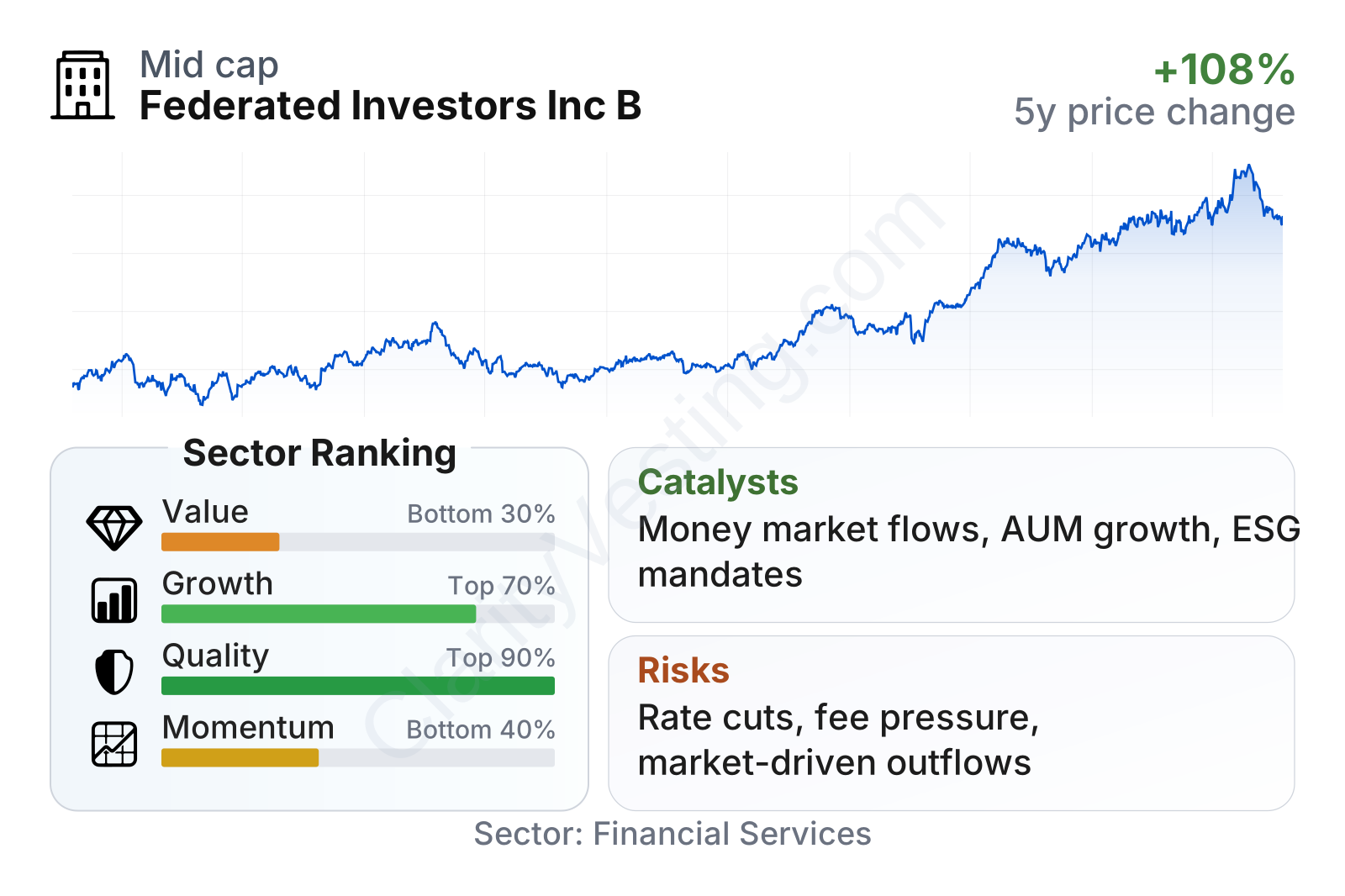
Federated Hermes is a mid-sized listed asset manager with a market value in the low single-digit billions of dollars and a stock that has shown lower volatility than the broader market, reflected in a beta well below 1. On valuation, the earnings multiple sits below the sector median, but the price-to-book multiple is much higher than the sector median, which usually means the market is assigning a premium to its profitability and business quality rather than to its balance-sheet book value alone.
The overall profile is strongest in quality, where returns on equity, returns on assets, margins, and leverage all compare favorably with peers. Growth indicators are also solid, especially for revenue and free cash flow over multi-year periods. Momentum is more mixed: the longer-term share price trend has been good, but shorter-term performance has cooled relative to many financial stocks.
Growth
Federated Hermes operates in a sector that can grow over time, but not in a straight line. Asset management benefits from rising household savings, retirement investing, institutional outsourcing, and the expansion of global capital markets. Within that broad market, one of the company’s most important niches is cash management. Higher short-term interest rates in recent years made money market funds more attractive, drawing large industry inflows and improving fee economics for firms with scale in that category. That has been an important tailwind for Federated Hermes.
The company’s strategy for future growth appears sensible because it combines a mature cash-management franchise with broader diversification. Management has continued to build fixed-income, equity, private market, and responsible-investing capabilities. That matters because money market revenue can be strong when rates are elevated, but long-term diversification helps reduce dependence on one specific environment.
Another constructive point is that the business has shown good operating leverage. Revenue growth has outpaced the sector median recently, and free cash flow growth over five years has been strong. Margins have also trended better than many peers. That suggests the company is not just gathering assets, but doing so in a way that can support profit expansion.
Earnings per share have not moved in a perfectly smooth line, but the broader direction has improved, with a clear step-up in 2025 compared with earlier years. That kind of pattern is common in asset management, where earnings are influenced by markets, fee mix, and asset flows. What stands out here is that the company has still managed to keep its five-year earnings trend around flat to slightly positive while many peers have had a more difficult period.
Book value per share has also trended upward over the last several years. For a financial company, that is a useful signal that retained earnings and capital discipline have added to shareholder equity over time. It also supports the view that the company’s recent profitability has not been purely temporary.
A meaningful catalyst is continued demand for money market products from institutions, corporations, and financial advisors. Another is any sustained improvement in fixed-income and equity markets, which can lift assets under management and fee revenue. Public company updates in 2026 have also highlighted ongoing monthly asset reporting, which is important for this business because shifts in client assets can quickly affect earnings power. In addition, the firm’s global responsible-investing and stewardship platform remains a differentiator for winning mandates from institutions that increasingly want both performance and governance oversight.
Risks
This article is for informational purposes only and does not constitute financial advice. Some content is AI-generated. See Disclaimer


