Stock Analysis · FirstGroup PLC (FGROY)
Overview
FirstGroup PLC is a U.K.-based public transportation company focused on moving passengers by rail and bus. Its business today is much simpler than it was a few years ago after portfolio changes and disposals. The group now centers on two main activities: contracted passenger rail services and regional bus operations. For U.S. readers using the FGROY ticker, the shares represent an over-the-counter listing of the London-listed company.
The company’s largest business is rail. Through its rail division, FirstGroup operates passenger train services under contracts and management arrangements in the U.K., and it also has open access rail operations that sell tickets directly to travelers on routes where it runs services commercially. The second core business is bus, mainly through First Bus, which provides local and regional transport services in the U.K. FirstGroup has also been developing adjacent opportunities such as decarbonization projects and fleet electrification that support its transport network over time.
Based on the latest annual reporting structure, revenue is mainly generated from the following sources:
- Rail: approximately 75% to 85% of revenue. This includes contracted train operating activities and open access passenger rail services.
- Bus: approximately 15% to 25% of revenue. This includes local and regional bus ticketing, contracted routes, and related transport services.
The broad mix shows that FirstGroup is primarily a rail operator with a meaningful but smaller bus platform. That matters because rail contracts can create large revenue flows but often on thinner margins, while bus operations can offer more direct operational control.
The business has expanded revenue strongly over the last several years, but the profit conversion has been uneven. Revenue moved from roughly £2.9 billion in fiscal 2022 to about £4.8 billion in fiscal 2026, while operating profit and net income fluctuated much more, which is typical for transport operators dealing with contract transitions, cost inflation, and regulated frameworks.
Key Figures
| Metric | Value | Sector ⓘ |
|---|---|---|
| Date | Oct 22, 2026 | |
| Context | ||
| Sector | Industrials | |
| Industry | Railroads | |
| Market Cap ⓘ | $1.55B | |
| Beta ⓘ | 0.68 | |
Value (Cheapness) | ||
| P/E Ratio ⓘ | 11.11 | 22.29 |
| P/B Ratio ⓘ | 2.32 | 1.98 |
| FCF Yield ⓘ | 64.03% | 6.26% |
| Dividend Yield ⓘ | 3.22% | 1.92% |
| EBIT / EV ⓘ | N/A | 4.83% |
| PEG ⓘ | N/A | |
Growth (Business expansion) | ||
| Revenue Growth ⓘ | -14.20% | 9.30% |
| RPS Growth (5Y CAGR) ⓘ | 33.06% | 7.76% |
| EPS Growth (5Y CAGR) ⓘ | N/A | -13.17% |
| BVPS Growth (5Y CAGR) ⓘ | 11.02% | 6.13% |
| Margin Growth (5Y Trend) ⓘ | -1.37% | 0.74% |
| FCF Growth (5Y CAGR) ⓘ | N/A | 10.79% |
| DPS Growth (5Y CAGR) ⓘ | -46.25% | 9.41% |
Quality (Business durability) | ||
| ROIC (Latest) ⓘ | 38.86% | 10.75% |
| ROA (Latest) ⓘ | 7.43% | 5.41% |
| ROIC (5Y Median) ⓘ | 12.33% | 9.37% |
| ROA (5Y Median) ⓘ | 3.41% | 4.95% |
| Net Debt / EBIT (Latest) ⓘ | 1.75 | 2.04 |
| Net Debt / EBIT (5Y Median) ⓘ | 5.26 | 2.27 |
| Net Debt / EBITDA (Latest) ⓘ | 0.53 | 1.39 |
| Net Debt / Assets ⓘ | 23.39% | 19.27% |
| EBITDA / Interest ⓘ | N/A | 9.58 |
| Operating Margin (Latest) ⓘ | 4.21% | 10.49% |
| Operating Margin (5Y Median) ⓘ | 4.23% | 10.30% |
| Debt to Equity (Latest) ⓘ | 163.00% | 64.82% |
| Profit Margin (Latest) ⓘ | 2.49% | 6.67% |
| Free Cash Flow (Latest) ⓘ | $989.44M | |
Momentum (Price trend) | ||
| 3Y Return ⓘ | +81.49% | +67.77% |
| 12M Return (excl. last month) ⓘ | -18.50% | +12.05% |
| 6M Return ⓘ | +30.38% | 0.00% |
| Price vs. 200-Day MA ⓘ | +35.41% | +0.67% |
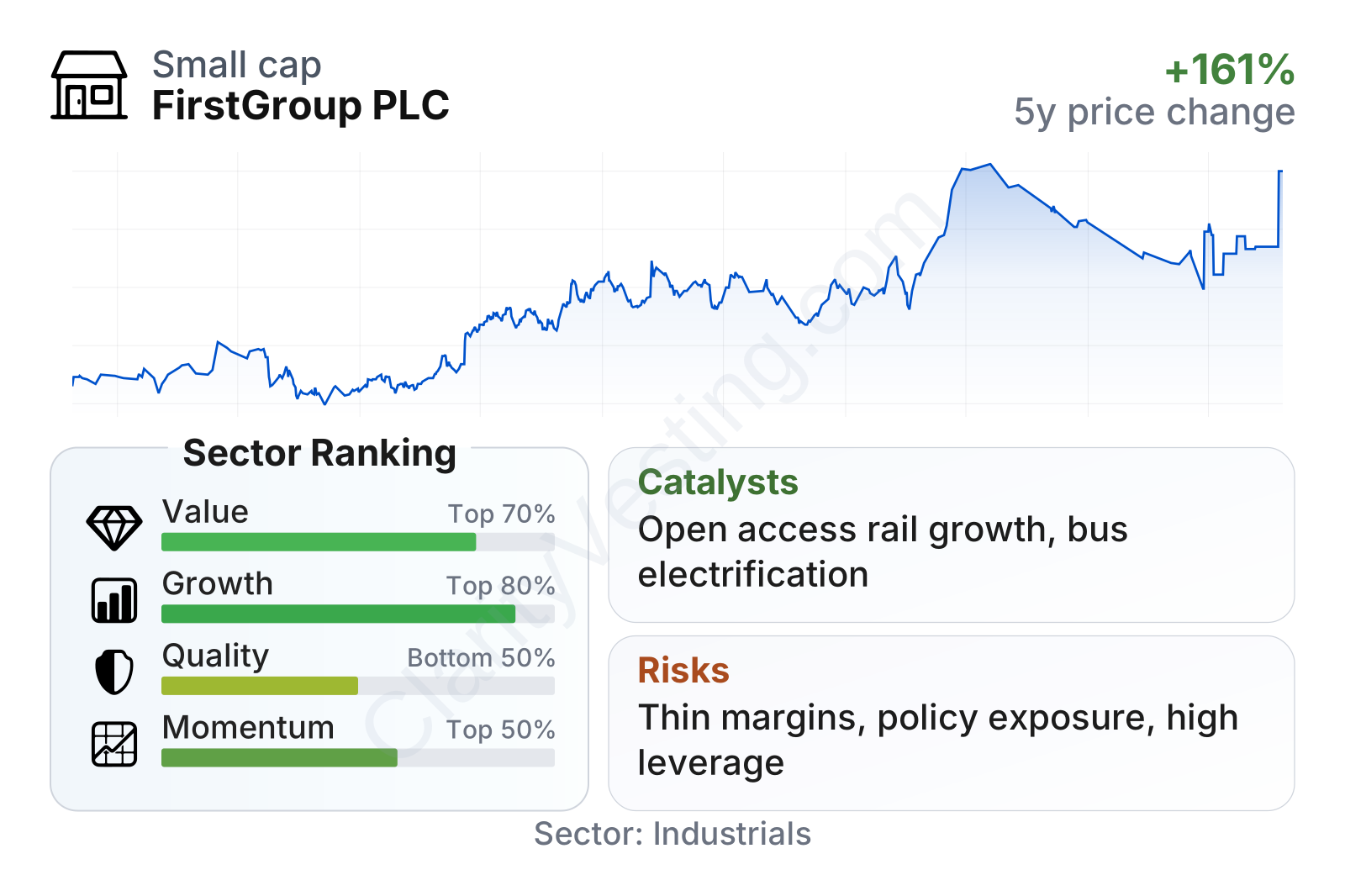
FirstGroup sits in the smaller end of listed transport companies by market value, and its share price history shows a strong rebound from 2022 levels despite some volatility more recently. On valuation, the stock trades at a lower earnings multiple than the sector median, while the dividend yield is also above the median. Free cash flow stands out as unusually strong relative to the company’s size, which is one of the most supportive features in the current profile.
Growth indicators are mixed. The recent year-over-year revenue comparison is negative, but the five-year revenue-per-share trend remains very strong, well above the broader sector. Quality metrics are less clean: returns on invested capital are strong, yet operating margin and profit margin remain below sector norms. That combination suggests a business with decent asset productivity and cash generation, but with limited room for operational mistakes.
Price momentum is also mixed depending on the period measured. Longer-term performance has been solid, but the stock has also had periods of pullback, which fits a company whose outlook is tied to contract awards, rail policy, and operating execution.
Growth
FirstGroup operates in a sector that should remain relevant for decades. Public transportation benefits from urbanization, congestion pressures, decarbonization policies, and government support for lower-emission mobility. In the U.K. especially, rail and bus networks are essential infrastructure rather than discretionary services. That does not guarantee smooth growth every year, but it does provide a durable demand base.
The company’s strategy broadly makes sense for long-term development because it is more focused than in the past. Management has concentrated the portfolio around transport activities where it already has operating expertise, and it has also emphasized capital discipline, fleet modernization, and open access rail opportunities. Open access is important because it can offer a more entrepreneurial growth path than standard government-backed contracts, although it also comes with more commercial risk.
A meaningful catalyst is the push to decarbonize public transport. Bus electrification, depot upgrades, and cleaner fleets can improve FirstGroup’s relevance with local authorities and strengthen its position in future tenders. On the rail side, demand recovery and new route opportunities can support volume growth if passenger trends remain healthy.
Another potentially important opportunity is the company’s ability to recycle cash into shareholder distributions, selective acquisitions, and network investments. The current cash generation profile gives FirstGroup flexibility that many transport peers do not have. If that cash conversion remains durable, it can support expansion without excessive balance-sheet strain.
Recent company communications have also pointed to continued interest in growing the rail portfolio, especially where the group can use its operating track record and customer-facing experience. For a business of this size, even a small number of successful contract wins or route expansions can make a noticeable difference to earnings.
Risks
This article is for informational purposes only and does not constitute financial advice. Some content is AI-generated. See Disclaimer


