Stock Analysis · FirstGroup plc (FGROF)
Overview
FirstGroup plc is a U.K.-based public transport company focused on rail and bus services. After reshaping the business over the last few years, it is now much more concentrated than it used to be, with its core activities centered on U.K. rail operations and regional bus networks. The company runs contracted rail services, open access rail services, and local bus routes, mainly serving commuters, students, airport travelers, and other everyday passengers.
Its revenue base is now largely tied to transportation services, but the mix matters because not all revenue comes with the same risk. Contracted rail operations tend to offer more predictable income because they are linked to management fees and performance terms, while open access rail and bus operations depend more directly on passenger demand and operating efficiency.
Based on the latest annual reporting, the main sources of revenue are approximately:
- Rail: about 70% to 75% of revenue. This includes U.K. rail contracts such as Avanti West Coast, Great Western Railway, South Western Railway, and TransPennine Express, along with open access services including Lumo and Hull Trains.
- First Bus: about 25% to 30% of revenue. This segment includes regional bus services across the U.K., school transport, and some airport-related and local mobility routes.
- Other and central activities: a small residual share of revenue, mainly support and group items rather than a major operating division.
The business mix has become simpler than in the past. That matters for long-term analysis because it makes the company easier to understand: rail provides scale, while buses provide a steadier local transport platform and room for operational improvement.
The income flow over recent years shows a business with large revenue volume but relatively narrow operating margins, which is common in transport. The latest year points to stable top-line activity around the recent peak, with profitability recovering from earlier volatility rather than moving in a straight line.
Key Figures
| Metric | Value | Sector ⓘ |
|---|---|---|
| Date | Oct 17, 2026 | |
| Context | ||
| Sector | Industrials | |
| Industry | Railroads | |
| Market Cap ⓘ | $1.29B | |
| Beta ⓘ | 0.68 | |
Value (Cheapness) | ||
| P/E Ratio ⓘ | 9.26 | 22.10 |
| P/B Ratio ⓘ | 1.93 | 1.97 |
| FCF Yield ⓘ | 76.56% | 6.38% |
| Dividend Yield ⓘ | 2.88% | 1.94% |
| EBIT / EV ⓘ | N/A | 4.79% |
| PEG ⓘ | N/A | |
Growth (Business expansion) | ||
| Revenue Growth ⓘ | -14.20% | 9.30% |
| RPS Growth (5Y CAGR) ⓘ | 31.51% | 7.81% |
| EPS Growth (5Y CAGR) ⓘ | -27.20% | -13.06% |
| BVPS Growth (5Y CAGR) ⓘ | 10.18% | 6.14% |
| Margin Growth (5Y Trend) ⓘ | -1.37% | 0.88% |
| FCF Growth (5Y CAGR) ⓘ | N/A | 11.01% |
| DPS Growth (5Y CAGR) ⓘ | -46.87% | 9.48% |
Quality (Business durability) | ||
| ROIC (Latest) ⓘ | 38.79% | 10.84% |
| ROA (Latest) ⓘ | 7.40% | 5.41% |
| ROIC (5Y Median) ⓘ | 12.16% | 9.38% |
| ROA (5Y Median) ⓘ | 3.41% | 4.95% |
| Net Debt / EBIT (Latest) ⓘ | 1.76 | 2.08 |
| Net Debt / EBIT (5Y Median) ⓘ | 5.34 | 2.27 |
| Net Debt / EBITDA (Latest) ⓘ | 0.53 | 1.39 |
| Net Debt / Assets ⓘ | 23.39% | 19.28% |
| EBITDA / Interest ⓘ | N/A | 9.58 |
| Operating Margin (Latest) ⓘ | 4.21% | 10.50% |
| Operating Margin (5Y Median) ⓘ | 4.23% | 10.29% |
| Debt to Equity (Latest) ⓘ | 163.00% | 65.48% |
| Profit Margin (Latest) ⓘ | 2.49% | 6.67% |
| Free Cash Flow (Latest) ⓘ | $985.84M | |
Momentum (Price trend) | ||
| 3Y Return ⓘ | +53.89% | +61.68% |
| 12M Return (excl. last month) ⓘ | -9.28% | +12.58% |
| 6M Return ⓘ | +2.85% | 0.00% |
| Price vs. 200-Day MA ⓘ | +5.17% | +0.02% |
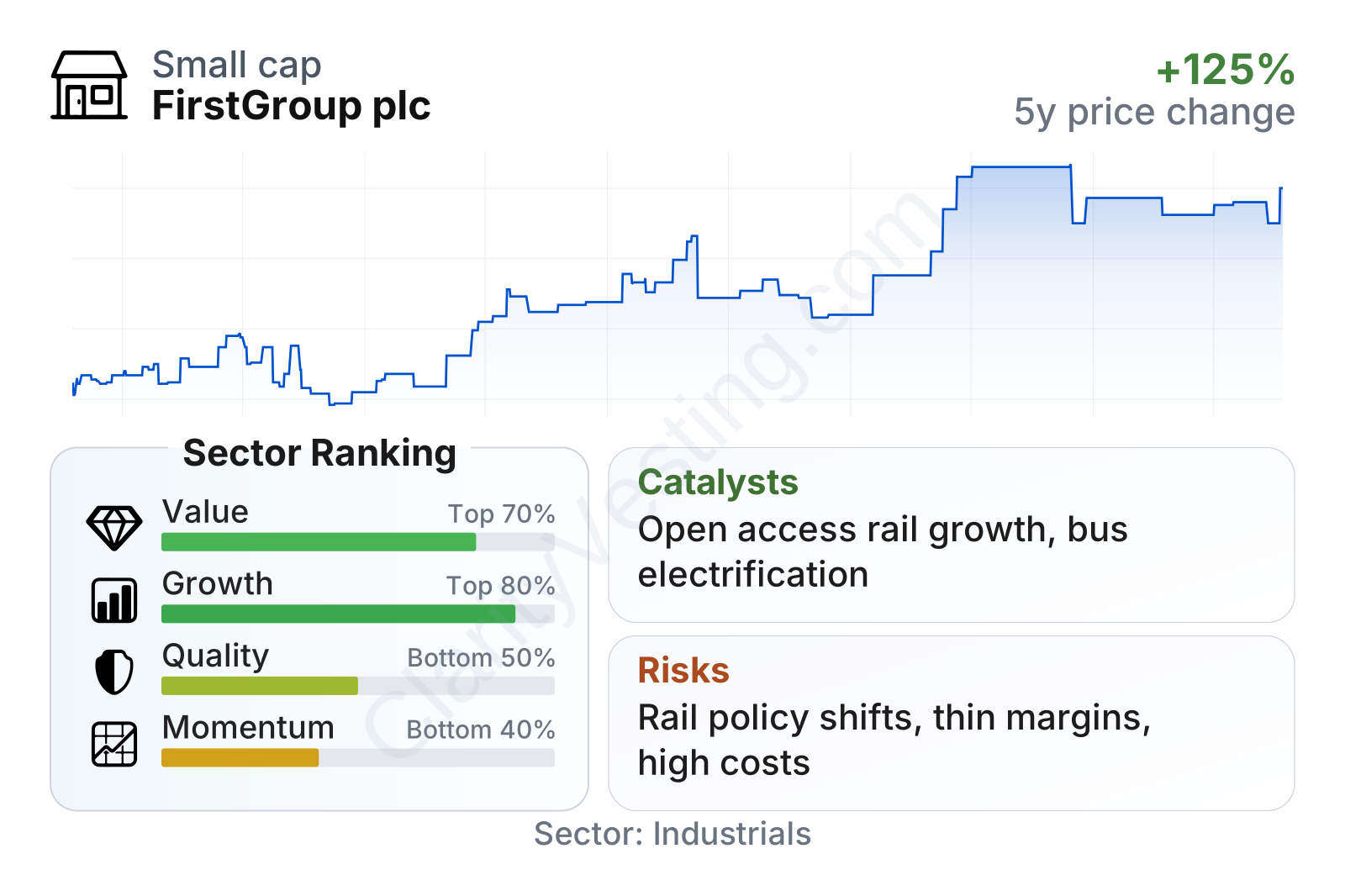
FirstGroup is a mid-sized transport operator with a share price history that shows a strong rerating from 2023 into 2025, followed by some cooling in 2026. The market still appears cautious in the near term, as momentum measures sit below much of the sector, but the valuation profile remains notably undemanding. Earnings are valued at a much lower multiple than the sector median, while the dividend yield is modestly above the sector norm.
One of the most striking points is cash generation. Free cash flow stands at an unusually high level relative to the current market value, which suggests either temporary strength, market skepticism about sustainability, or both. Balance-sheet leverage looks manageable on recent earnings, with net debt to EBITDA below the sector median, although debt to equity remains elevated and margins are still thinner than many peers. In short, the company looks inexpensive and cash-generative, but not like a classic high-margin industrial compounder.
Growth
FirstGroup operates in a sector that has durable long-term relevance. Public transport remains important for urban mobility, commuting, airport access, and decarbonization policy. In the U.K., rail and bus systems also benefit from the fact that they are difficult to replace at scale. That does not automatically create rapid growth, but it does support long-lived demand.
The company’s strategy is reasonably clear. In rail, it is leaning on a mix of contracted services and open access routes. Contracted services can limit downside because revenue is less exposed to ticket sales alone, while open access can offer higher upside if demand and yield are strong. In buses, management has been emphasizing network optimization, cost control, fleet investment, and electrification. Those efforts can improve service quality and make the business more competitive when local authorities and passengers place greater value on cleaner fleets and reliability.
A meaningful catalyst is the company’s expansion in open access rail. FirstGroup has been pushing for additional open access routes, which are important because they can provide growth outside the traditional franchised or management-contract framework. If approvals continue, that could gradually increase the share of business with stronger commercial upside. Another favorable factor is ongoing public support for sustainable transport infrastructure in the U.K., which aligns with both bus electrification and rail usage.
Recent company updates have also highlighted continued capital returns and disciplined portfolio management alongside operational investment. That combination matters because it suggests management sees room both to improve the existing network and to deploy excess cash selectively rather than simply chase scale.
Risks
This article is for informational purposes only and does not constitute financial advice. Some content is AI-generated. See Disclaimer


