Stock Analysis · First Financial Bancorp (FFBC)
Overview
First Financial Bancorp is a regional bank headquartered in Ohio. Through First Financial Bank, it provides traditional banking services to consumers, small businesses, middle-market companies, and specialized commercial clients. Its footprint is centered in Ohio, Indiana, Kentucky, and Illinois, with lending and fee businesses that are tied mainly to local and regional economic activity.
Like most regional banks, the business is built primarily on gathering deposits and making loans. It earns money from the spread between what it receives on loans and securities and what it pays on deposits and other funding, while also collecting fees from treasury management, wealth services, card activity, and loan-related services.
The main sources of revenue are broadly the following:
- Net interest income: approximately 75% to 85% of total revenue in recent periods. This is the core banking engine and includes income from commercial loans, consumer loans, residential real estate lending, and securities, minus interest paid on deposits and borrowings.
- Wealth management and trust fees: approximately 4% to 7%. This includes fiduciary, advisory, retirement, and related asset management services.
- Service charges on deposits: approximately 3% to 5%. These are fees linked to deposit accounts, treasury management, and cash-handling services.
- Card, merchant, and payments-related fees: approximately 2% to 4%. This includes debit and credit card income and certain transaction services.
- Mortgage banking and loan-related fees: approximately 1% to 3%. These are tied to mortgage production, secondary market activity, and other lending services.
- Other noninterest income: approximately 5% to 10%. This may include leasing revenue, capital markets-related activity, bank-owned life insurance, and miscellaneous banking fees.
Over the past several years, total revenue has expanded materially, rising from roughly $650 million in 2021 to more than $1.25 billion in 2025. That growth was not perfectly smooth, because higher interest expense also consumed a larger share of revenue when rates rose, but the overall earnings base remained profitable.
The revenue base has grown meaningfully since 2021, but funding costs also climbed sharply in 2023 and 2024 before easing somewhat. That pattern is typical for regional banks in a higher-rate environment: more income from loans, but also more competition for deposits and tighter pressure on margins.
Key Figures
| Metric | Value | Sector ⓘ |
|---|---|---|
| Date | Oct 24, 2026 | |
| Context | ||
| Sector | Financial Services | |
| Industry | Banks - Regional | |
| Market Cap ⓘ | $3.33B | |
| Beta ⓘ | 0.95 | |
Value (Cheapness) | ||
| P/E Ratio ⓘ | 11.11 | 12.46 |
| P/B Ratio ⓘ | 1.14 | 1.25 |
| FCF Yield ⓘ | 23.11% | 9.82% |
| Dividend Yield ⓘ | 3.14% | 2.94% |
| EBIT / EV ⓘ | 10.10% | 8.11% |
| PEG ⓘ | 1.12 | |
Growth (Business expansion) | ||
| Revenue Growth ⓘ | 16.50% | 9.10% |
| RPS Growth (5Y CAGR) ⓘ | 17.81% | 12.31% |
| EPS Growth (5Y CAGR) ⓘ | -11.23% | -6.97% |
| BVPS Growth (5Y CAGR) ⓘ | 5.26% | 5.02% |
| Margin Growth (5Y Trend) ⓘ | -11.29% | -4.00% |
| FCF Growth (5Y CAGR) ⓘ | -4.11% | 4.71% |
| DPS Growth (5Y CAGR) ⓘ | 2.07% | 8.92% |
Quality (Business durability) | ||
| ROIC (Latest) ⓘ | 7.45% | 9.18% |
| ROE (Latest) ⓘ | 10.15% | 13.93% |
| ROA (Latest) ⓘ | 1.39% | 1.57% |
| ROIC (5Y Median) ⓘ | 6.82% | 7.80% |
| ROE (5Y Median) ⓘ | 9.82% | 12.15% |
| ROA (5Y Median) ⓘ | 1.29% | 1.28% |
| Net Debt / EBIT (Latest) ⓘ | 0.46 | 1.02 |
| Net Debt / EBIT (5Y Median) ⓘ | 1.13 | 0.72 |
| Net Debt / EBITDA (Latest) ⓘ | 0.40 | 0.88 |
| Operating Margin (Latest) ⓘ | 26.86% | 22.30% |
| Operating Margin (5Y Median) ⓘ | 28.56% | 24.50% |
| Debt to Equity (Latest) ⓘ | 31.89% | 59.34% |
| Profit Margin (Latest) ⓘ | 29.93% | 26.42% |
| Free Cash Flow (Latest) ⓘ | $769.16M | |
Momentum (Price trend) | ||
| 3Y Return ⓘ | +91.86% | +95.73% |
| 12M Return (excl. last month) ⓘ | +24.72% | +17.30% |
| 6M Return ⓘ | +13.59% | +6.07% |
| Price vs. 200-Day MA ⓘ | +6.73% | +5.36% |
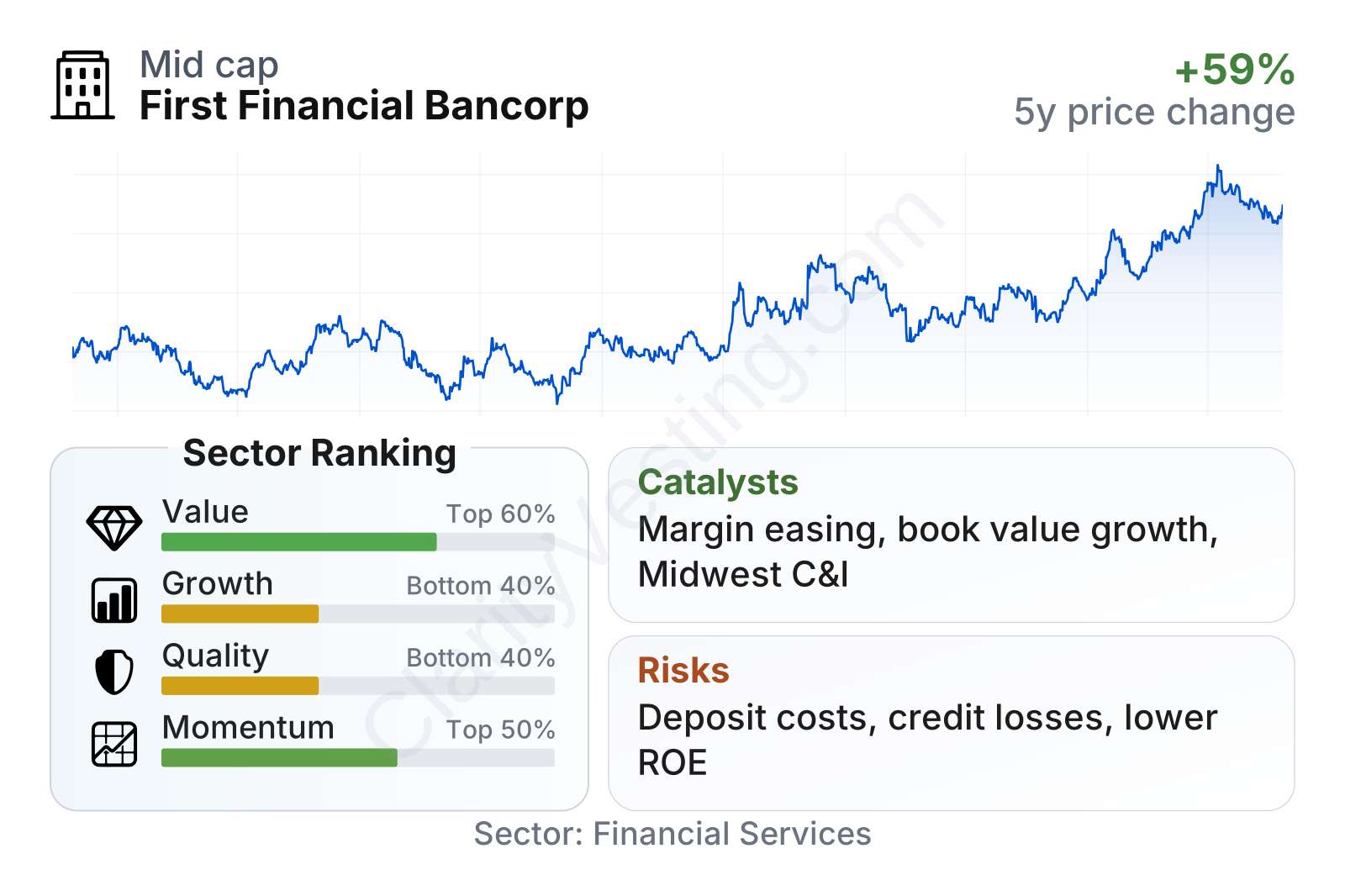
First Financial Bancorp is a mid-sized regional bank with a market value around $3 billion and a share price that has trended upward strongly over the past year. In the factor view, valuation looks slightly cheaper than the sector median on both earnings and book value, while momentum has been better than average in recent months. The weaker area is quality and broader long-term growth efficiency, where profitability ratios sit below many regional bank peers even though margins and balance-sheet leverage remain fairly disciplined.
Growth
Regional banking is not a high-growth industry in the same way as software or semiconductors, but it remains an essential sector with steady long-term demand. Banks that can add deposits, deepen business relationships, and expand fee income can still grow at a respectable pace. First Financial Bancorp operates in Midwest markets where population growth is modest, so its expansion depends more on execution, commercial lending, treasury services, selective acquisitions, and share gains than on a fast-growing geographic backdrop.
The company’s strategy is sensible for that environment. It emphasizes commercial banking, specialized lending, payments and treasury management, and wealth services rather than relying only on plain-vanilla consumer banking. That matters because fee income and relationship banking can make earnings less dependent on interest rates alone. Management has also spent the past several years building scale, and that is visible in the much larger revenue base compared with 2021.
Earnings per share have been uneven rather than linear, but the broader pattern has still been resilient. EPS improved from the low-$2 range in 2021 and 2022 to the upper-$2 range in 2023 and 2025, with 2024 showing a temporary pullback. For a bank, that kind of pattern suggests a business that can stay profitable across changing rate conditions, even if it has not produced smooth compounding every year.
Book value per share has moved up clearly since 2022, reaching close to $29 by 2025. That is an important sign for a bank because book value reflects the underlying capital base supporting loans and future earnings. Growth in book value, combined with revenue per share growth that has outpaced the sector median over five years, points to a franchise that has been getting larger even if profitability has not consistently led peers.
One practical catalyst is the path of interest rates. If deposit pricing pressure continues to ease while loan yields remain relatively firm, net interest margin can improve. Another support is commercial and treasury-management activity in its regional footprint, where middle-market banking relationships can produce both loan growth and recurring fee income. The recent stock performance also suggests the market has become more confident that earnings have stabilized after the tougher funding-cost period.
Recent company updates in 2026 have also pointed to continued profitability, capital strength, and ongoing capital returns through common dividends. None of that changes the fact that this is still a traditional bank, but it does reinforce that the company is operating from a position of stability rather than stress.
Risks
This article is for informational purposes only and does not constitute financial advice. Some content is AI-generated. See Disclaimer


