Stock Analysis · Ferguson Plc (FERG)
Overview
Ferguson Plc is a large distributor of plumbing, HVAC, waterworks, and other infrastructure-related products used in residential, non-residential, and civil construction. In simple terms, it sits between manufacturers and end customers such as contractors, builders, utilities, and facility managers. Rather than making the products itself, Ferguson focuses on sourcing, stocking, delivering, and supporting a very broad catalog of essential building and repair items.
The company is now overwhelmingly focused on North America, especially the United States. Its business model is built around scale, local branch coverage, specialized product knowledge, digital ordering tools, and the ability to deliver products quickly to job sites. That combination is particularly valuable in repair, maintenance, and replacement work, where customers often need parts fast and delays can be costly.
Based on recent company reporting, Ferguson’s revenue mix is heavily concentrated in the U.S. and spread across end markets rather than manufacturing lines.
- United States: approximately 95% to 97% of revenue. This includes plumbing, HVAC, waterworks, fire and fabrication, industrial, facilities supply, and related construction distribution activities.
- Canada: approximately 3% to 5% of revenue. This is a much smaller operation serving similar professional customer groups.
Within the business, revenue is also diversified by customer activity:
- Residential end market: roughly 50% of revenue in recent years, including new housing construction and repair, maintenance, and improvement.
- Non-residential end market: roughly 40% of revenue, including commercial buildings, institutions, and facility upgrades.
- Infrastructure / civil / waterworks: roughly 10% of revenue, including municipal water and wastewater projects and related underground infrastructure.
That mix matters because it gives Ferguson exposure not only to new construction cycles, but also to recurring repair and replacement demand, which is usually more stable than pure housing starts. Over the last several years, revenue has stayed resilient and gross profit has held up relatively well, even as operating costs have risen and net income has fluctuated more than sales.
The overall picture is of a large distribution platform with steady gross profit generation, but one that still needs tight cost control because selling and administrative expenses absorb a meaningful share of that gross profit.
Key Figures
| Metric | Value | Sector ⓘ |
|---|---|---|
| Date | Oct 03, 2026 | |
| Context | ||
| Sector | Industrials | |
| Industry | Industrial Distribution | |
| Market Cap ⓘ | $43.31B | |
| Beta ⓘ | 1.11 | |
Value (Cheapness) | ||
| P/E Ratio ⓘ | 22.36 | 22.45 |
| P/B Ratio ⓘ | 6.96 | 1.98 |
| FCF Yield ⓘ | 2.92% | 6.31% |
| Dividend Yield ⓘ | 1.87% | 1.96% |
| EBIT / EV ⓘ | N/A | 4.81% |
| PEG ⓘ | 1.38 | |
Growth (Business expansion) | ||
| Revenue Growth ⓘ | 4.60% | 9.10% |
| RPS Growth (5Y CAGR) ⓘ | -24.14% | 7.75% |
| EPS Growth (5Y CAGR) ⓘ | 1.95% | -13.59% |
| BVPS Growth (5Y CAGR) ⓘ | 9.49% | 6.22% |
| Margin Growth (5Y Trend) ⓘ | -1.14% | 0.72% |
| FCF Growth (5Y CAGR) ⓘ | -13.45% | 10.98% |
| DPS Growth (5Y CAGR) ⓘ | -8.62% | 9.48% |
Quality (Business durability) | ||
| ROIC (Latest) ⓘ | N/A | 10.92% |
| ROA (Latest) ⓘ | 11.02% | 5.41% |
| ROIC (5Y Median) ⓘ | 33.13% | 9.21% |
| ROA (5Y Median) ⓘ | 10.82% | 4.94% |
| Net Debt / EBIT (Latest) ⓘ | N/A | 2.07 |
| Net Debt / EBIT (5Y Median) ⓘ | 1.80 | 2.28 |
| Net Debt / EBITDA (Latest) ⓘ | 1.91 | 1.43 |
| Net Debt / Assets ⓘ | 30.94% | 19.27% |
| EBITDA / Interest ⓘ | 16.38 | 9.53 |
| Operating Margin (Latest) ⓘ | N/A | 10.50% |
| Operating Margin (5Y Median) ⓘ | 8.91% | 10.27% |
| Debt to Equity (Latest) ⓘ | 103.37% | 65.48% |
| Profit Margin (Latest) ⓘ | 6.32% | 6.62% |
| Free Cash Flow (Latest) ⓘ | $1.26B | |
Momentum (Price trend) | ||
| 3Y Return ⓘ | +42.75% | +58.56% |
| 12M Return (excl. last month) ⓘ | -1.01% | +15.63% |
| 6M Return ⓘ | -3.84% | +4.19% |
| Price vs. 200-Day MA ⓘ | -5.77% | +0.93% |
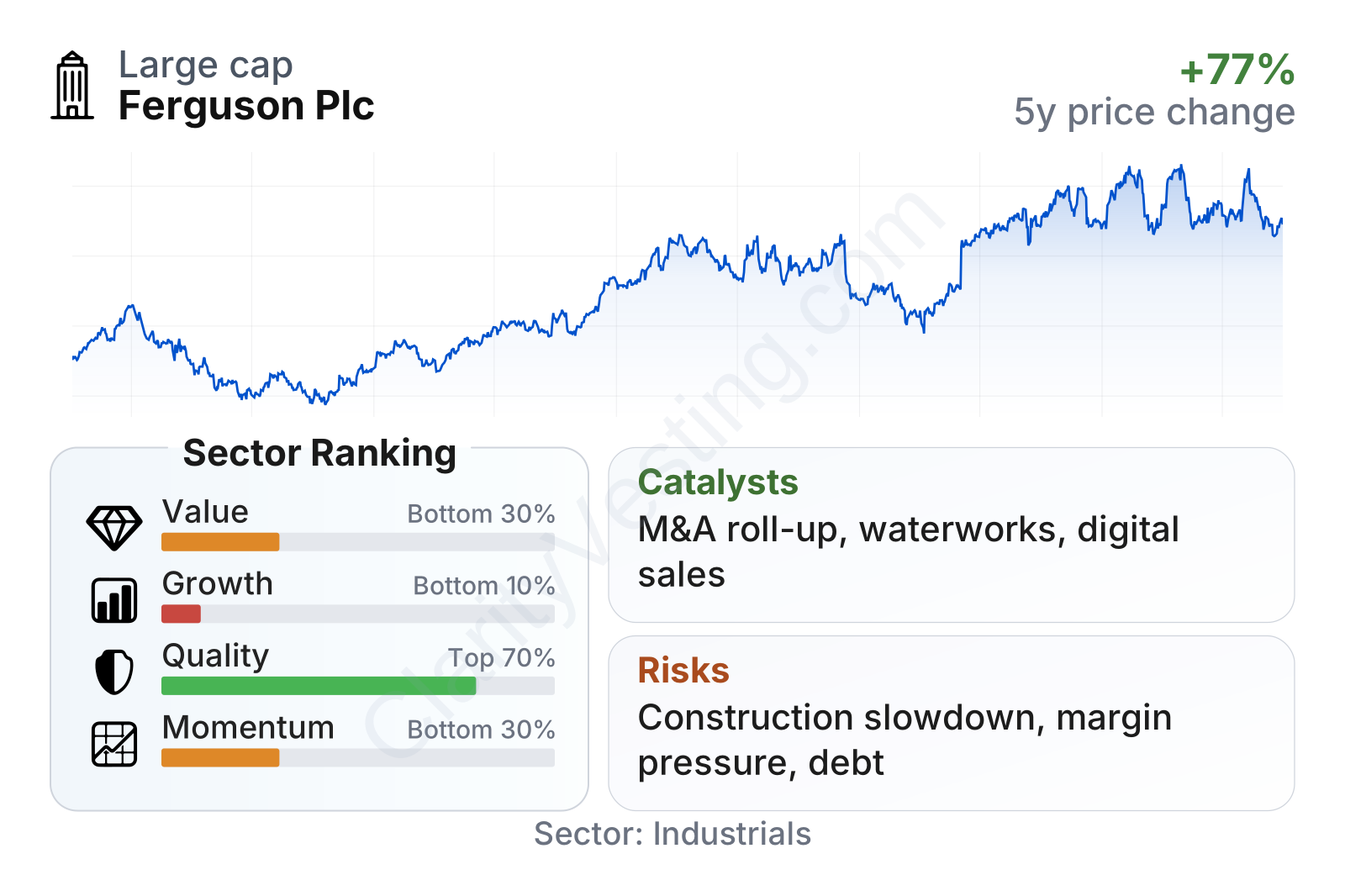
Ferguson is a large-cap industrial distributor with a share price record that has been strong over several years, although performance has been uneven more recently. The financial profile stands out more for business quality than for cheap valuation or fast growth. Returns on assets and long-term returns on invested capital are notably strong for the sector, showing an efficient operating model. By contrast, the growth profile is weaker relative to peers, and balance sheet leverage is somewhat higher than the sector median. In short, the company looks like a solid operator trading closer to a quality premium than a bargain setup.
Growth
Ferguson operates in a sector with durable long-term demand. Plumbing, HVAC, water infrastructure, and building maintenance are not niche categories; they are tied to housing stock, commercial buildings, aging infrastructure, energy efficiency upgrades, and recurring repair work. That gives the company exposure to structural demand drivers that extend beyond short-term construction cycles.
The growth case is less about a breakthrough product and more about execution. Ferguson’s strategy has centered on expanding market share, deepening specialization, improving digital capabilities, and using acquisitions to widen local coverage and product depth. For a distributor, this is a logical approach: customers often prefer suppliers that can combine broad inventory, dependable delivery, technical support, and digital convenience in one relationship.
Revenue growth has cooled substantially from the unusually strong levels seen in 2022. After a period of negative and low-single-digit comparisons, growth recovered, though it remains modest by broader industrial standards. That pattern suggests the business is still growing, but in a more normalized environment where volume, pricing, and end-market mix matter more than post-pandemic demand surges.
Cash generation remains an important positive. Free cash flow has moved around from year to year, but the business still produces meaningful cash in absolute terms. That matters because distributors need working capital discipline, and sustained cash generation supports acquisitions, dividends, share repurchases, and investment in logistics and technology.
Recent company announcements and investor communications have continued to emphasize acquisitions, customer service upgrades, and digital tools. These are relevant catalysts because Ferguson’s market remains fragmented in many local and specialty categories. A well-capitalized operator can keep consolidating smaller players, add cross-selling opportunities, and improve purchasing power with suppliers. Another potential tailwind is public and private investment in water systems, commercial facilities, and energy-efficient equipment replacement, all of which align with Ferguson’s product exposure.
Risks
This article is for informational purposes only and does not constitute financial advice. Some content is AI-generated. See Disclaimer