Stock Analysis · Franklin Electric Co Inc (FELE)
Overview
Franklin Electric Co. is an industrial company focused on moving water and fuel. Its products are used in groundwater pumping, water transfer, pressure boosting, wastewater handling, and fueling systems. In practical terms, the company sells the equipment that helps bring water from underground wells, move water through residential, agricultural, commercial, and municipal systems, and handle fuel distribution infrastructure at service stations and other sites.
The business is organized mainly around water systems, with a smaller but still meaningful fueling business. Based on the latest annual reporting structure, revenue is concentrated as follows:
- Water Systems: about 75% to 80% of revenue. This is the core segment and includes submersible motors, pumps, drives, controls, pressure boosting equipment, wastewater and drainage products, and related water movement systems sold into residential, agricultural, industrial, and municipal uses.
- Distribution: about 10% to 15% of revenue. This activity mainly comes from the company’s distribution operations serving groundwater and water-related contractors, giving Franklin Electric a direct route to customers and product pull-through for its own brands.
- Fueling Systems: about 10% to 15% of revenue. This segment includes pumps, piping, containment, monitoring, and other components used in fuel station and fuel-handling infrastructure.
Geographically, Franklin Electric is not only a U.S. business. It also has meaningful international exposure, which helps diversify demand but also adds some currency and macroeconomic sensitivity. The overall profile is that of a mid-sized industrial manufacturer with a strong niche in essential infrastructure rather than a highly cyclical capital-goods name tied to a single end market.
Over the last several years, revenue has moved from roughly $1.7 billion to just above $2.1 billion, while gross profit has held up relatively well even as net income became more volatile. That pattern suggests the company has kept pricing and product mix reasonably resilient, but rising operating costs and shifting demand have weighed on the bottom line more recently.
Key Figures
| Metric | Value | Sector ⓘ |
|---|---|---|
| Date | Oct 10, 2026 | |
| Context | ||
| Sector | Industrials | |
| Industry | Specialty Industrial Machinery | |
| Market Cap ⓘ | $4.39B | |
| Beta ⓘ | 1.02 | |
Value (Cheapness) | ||
| P/E Ratio ⓘ | 28.60 | 22.32 |
| P/B Ratio ⓘ | 3.13 | 1.98 |
| FCF Yield ⓘ | 4.97% | 6.34% |
| Dividend Yield ⓘ | 1.10% | 1.95% |
| EBIT / EV ⓘ | 4.90% | 4.71% |
| PEG ⓘ | 1.54 | |
Growth (Business expansion) | ||
| Revenue Growth ⓘ | 6.00% | 9.25% |
| RPS Growth (5Y CAGR) ⓘ | 7.28% | 7.75% |
| EPS Growth (5Y CAGR) ⓘ | -12.94% | -13.37% |
| BVPS Growth (5Y CAGR) ⓘ | 9.58% | 6.12% |
| Margin Growth (5Y Trend) ⓘ | -2.10% | 0.81% |
| FCF Growth (5Y CAGR) ⓘ | 18.05% | 11.01% |
| DPS Growth (5Y CAGR) ⓘ | 11.51% | 9.48% |
Quality (Business durability) | ||
| ROIC (Latest) ⓘ | 10.70% | 10.70% |
| ROA (Latest) ⓘ | 7.52% | 5.38% |
| ROIC (5Y Median) ⓘ | 15.31% | 9.26% |
| ROA (5Y Median) ⓘ | 10.81% | 4.94% |
| Net Debt / EBIT (Latest) ⓘ | 0.96 | 2.08 |
| Net Debt / EBIT (5Y Median) ⓘ | 0.65 | 2.29 |
| Net Debt / EBITDA (Latest) ⓘ | 0.77 | 1.43 |
| Net Debt / Assets ⓘ | 9.81% | 19.34% |
| EBITDA / Interest ⓘ | 23.08 | 9.54 |
| Operating Margin (Latest) ⓘ | 9.89% | 10.34% |
| Operating Margin (5Y Median) ⓘ | 11.78% | 10.29% |
| Debt to Equity (Latest) ⓘ | 21.91% | 65.52% |
| Profit Margin (Latest) ⓘ | 7.06% | 6.63% |
| Free Cash Flow (Latest) ⓘ | $218.28M | |
Momentum (Price trend) | ||
| 3Y Return ⓘ | +12.81% | +61.33% |
| 12M Return (excl. last month) ⓘ | +3.32% | +14.82% |
| 6M Return ⓘ | +2.67% | +3.53% |
| Price vs. 200-Day MA ⓘ | -2.22% | +0.88% |
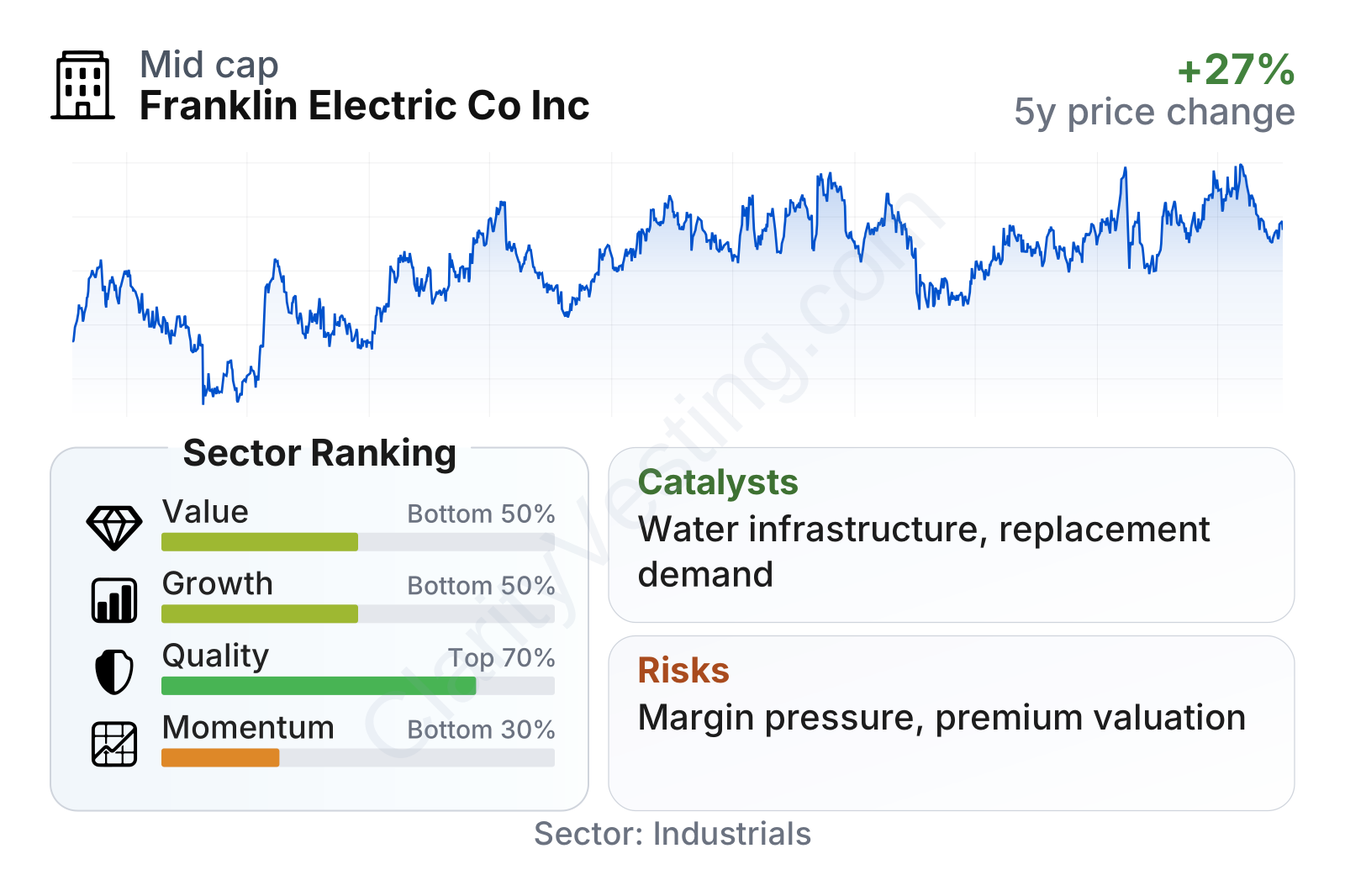
Franklin Electric sits in the mid-cap range, with stock-market volatility close to the broader market. The quality profile is the strongest part of the picture: profitability on assets has been better than much of the sector over time, debt is low, and interest coverage is very comfortable. Growth and valuation are less favorable by comparison. Revenue growth is positive but below the sector median, while the earnings multiple and price-to-book ratio stand above typical industrial peers. Share-price performance has also trailed much of the sector over the last few years, which shows that the market has become more selective on the company’s growth outlook.
Growth
Franklin Electric operates in a part of the market that benefits from long-term structural demand. Water is the clearest growth theme. Groundwater access, aging water infrastructure, pressure management, drainage, wastewater handling, and agricultural water efficiency all support steady demand over time. These are not niche trends likely to disappear quickly; they are connected to housing, farming, industrial activity, and basic infrastructure maintenance.
The company’s strategy also makes sense for that backdrop. Franklin Electric has built a broad product portfolio around pumps, motors, controls, and related equipment, and it has expanded through acquisitions in water-related categories to add technologies and local channels. Its distribution presence is especially important because it strengthens customer relationships and can help the company place more of its own products across contractor networks.
Recent growth has been uneven rather than explosive. After very strong post-pandemic gains, revenue growth turned negative for a period and then recovered. The latest trend points back to modest positive expansion, around the mid-single-digit range. That is not exceptional for the sector, but it does suggest the business is stabilizing after a softer patch in demand.
Cash generation remains a notable strength even though it has cooled from an earlier peak. Free cash flow expanded sharply over the last several years before retreating from very high levels. Even after that pullback, the business still produces meaningful cash, which gives management room for dividends, acquisitions, debt management, and internal investment. That matters for a company whose growth plan relies on disciplined expansion rather than dramatic breakthrough products.
One important catalyst is the continued need for water infrastructure upgrades and efficient water handling in both developed and emerging markets. Another is the company’s exposure to non-discretionary replacement demand: when a pump, motor, or control system fails in a well or water system, customers often need a quick replacement, not a delayed purchase. That can make parts of the business more resilient than many industrial categories.
On the fuel side, the opportunity is more mixed. Traditional fueling infrastructure is a mature market, but it still requires maintenance, upgrades, and compliance-related spending. That segment is unlikely to be the main long-term engine, yet it can remain a useful cash contributor if managed well.
Risks
This article is for informational purposes only and does not constitute financial advice. Some content is AI-generated. See Disclaimer