Stock Analysis · FedEx Corporation (FDX)
Overview
FedEx Corporation is one of the world’s largest transportation and logistics companies. It moves packages, freight, and business documents across domestic and international networks, and it also provides related services such as supply chain support, customs brokerage, and last-mile delivery. In simple terms, FedEx helps businesses and consumers ship goods quickly, reliably, and at scale.
The business is organized mainly around express parcel delivery, ground parcel delivery, and freight and logistics services. In June 2024, FedEx completed a major internal change by combining FedEx Express, FedEx Ground, and FedEx Services into a single Federal Express Corporation organization. The goal is to reduce duplication, use aircraft and trucking assets more efficiently, and present customers with a more unified network.
Based on the latest annual filing for fiscal 2026, revenue is still concentrated in the company’s core transportation operations. The largest sources are approximately:
- Federal Express segment: about 89% of total revenue. This includes time-definite air express, deferred parcel shipping, small-package ground delivery, international export and import services, and a broad range of logistics-related transportation services.
- FedEx Freight segment: about 11% of total revenue. This business focuses on less-than-truckload freight, meaning shipments too large for parcel networks but too small to fill a full truck.
Within that mix, small-package delivery remains the economic center of the company, while freight adds diversification and exposure to industrial shipping demand. FedEx’s customer base is broad, spanning e-commerce merchants, large enterprises, healthcare, industrial customers, and individual consumers.
Over the last several years, revenue has fluctuated with freight demand and macroeconomic conditions, but the company has continued to produce large gross profit dollars and meaningful net income. The latest fiscal year showed a return to stronger top-line growth, with revenue rising back toward the mid-$90 billion range and net income above $4 billion.
The broad pattern is clear: revenue and gross profit improved in fiscal 2026 after a softer period, while interest expense moved lower than the prior year. That combination suggests that network efficiency efforts and a better demand backdrop are helping support earnings recovery.
Key Figures
| Metric | Value | Sector ⓘ |
|---|---|---|
| Date | Oct 24, 2026 | |
| Context | ||
| Sector | Industrials | |
| Industry | Integrated Freight & Logistics | |
| Market Cap ⓘ | $70.71B | |
| Beta ⓘ | 1.33 | |
Value (Cheapness) | ||
| P/E Ratio ⓘ | 16.11 | 22.29 |
| P/B Ratio ⓘ | 2.27 | 1.98 |
| FCF Yield ⓘ | 7.24% | 6.26% |
| Dividend Yield ⓘ | 1.90% | 1.92% |
| EBIT / EV ⓘ | 6.33% | 4.83% |
| PEG ⓘ | 1.23 | |
Growth (Business expansion) | ||
| Revenue Growth ⓘ | 12.50% | 9.30% |
| RPS Growth (5Y CAGR) ⓘ | 3.04% | 7.76% |
| EPS Growth (5Y CAGR) ⓘ | N/A | -13.17% |
| BVPS Growth (5Y CAGR) ⓘ | 9.01% | 6.13% |
| Margin Growth (5Y Trend) ⓘ | 1.17% | 0.74% |
| FCF Growth (5Y CAGR) ⓘ | 13.63% | 10.79% |
| DPS Growth (5Y CAGR) ⓘ | 17.84% | 9.41% |
Quality (Business durability) | ||
| ROIC (Latest) ⓘ | 9.11% | 10.75% |
| ROA (Latest) ⓘ | 4.73% | 5.41% |
| ROIC (5Y Median) ⓘ | 9.76% | 9.37% |
| ROA (5Y Median) ⓘ | 4.69% | 4.95% |
| Net Debt / EBIT (Latest) ⓘ | 4.74 | 2.04 |
| Net Debt / EBIT (5Y Median) ⓘ | 5.12 | 2.27 |
| Net Debt / EBITDA (Latest) ⓘ | 2.79 | 1.39 |
| Net Debt / Assets ⓘ | 29.95% | 19.27% |
| EBITDA / Interest ⓘ | 19.95 | 9.58 |
| Operating Margin (Latest) ⓘ | 6.59% | 10.49% |
| Operating Margin (5Y Median) ⓘ | 7.09% | 10.30% |
| Debt to Equity (Latest) ⓘ | 135.69% | 64.82% |
| Profit Margin (Latest) ⓘ | 4.68% | 6.67% |
| Free Cash Flow (Latest) ⓘ | $5.12B | |
Momentum (Price trend) | ||
| 3Y Return ⓘ | +63.34% | +67.77% |
| 12M Return (excl. last month) ⓘ | +61.08% | +12.05% |
| 6M Return ⓘ | -5.49% | 0.00% |
| Price vs. 200-Day MA ⓘ | -0.90% | +0.67% |
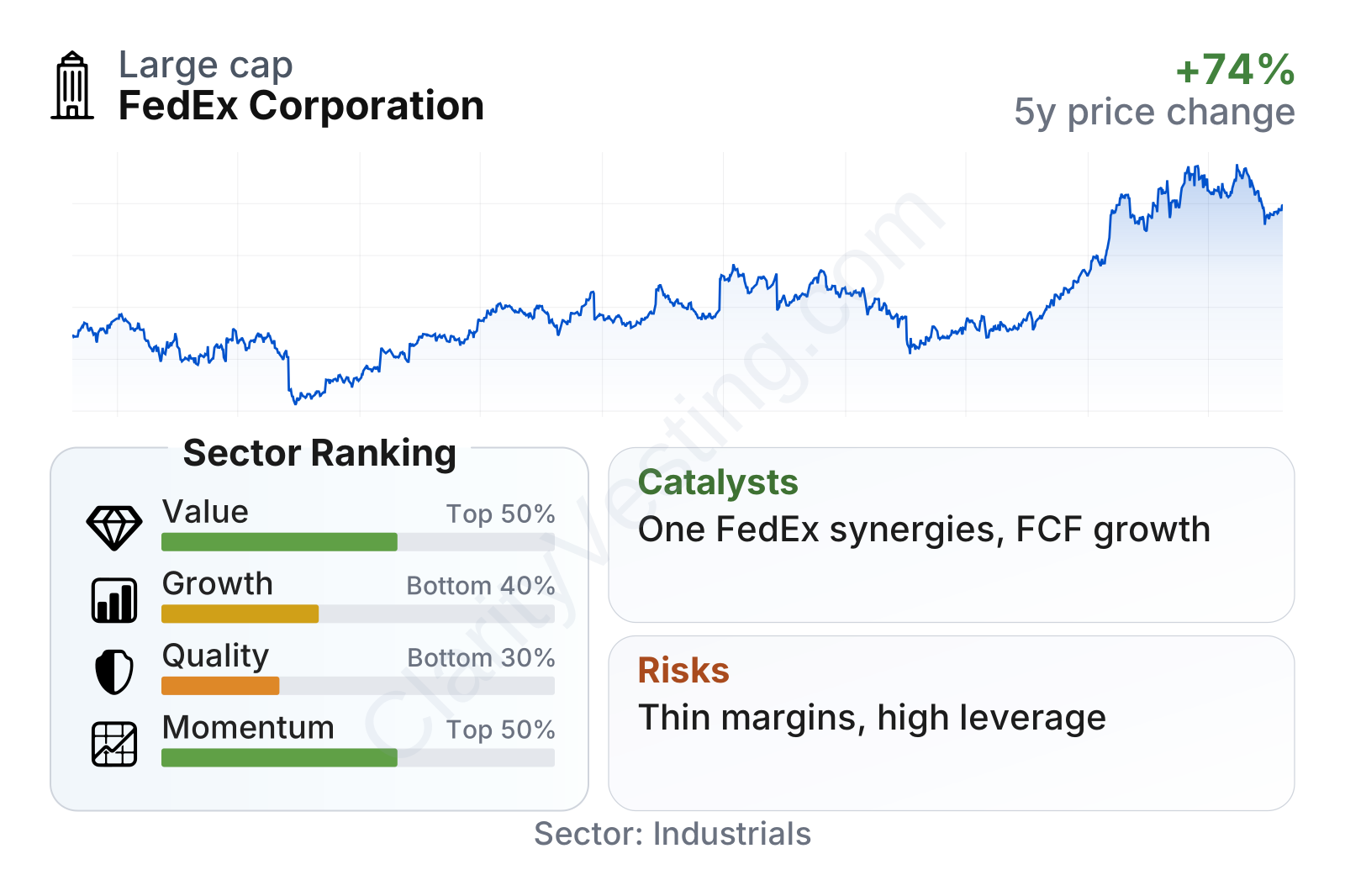
FedEx is a very large company in global logistics, and its recent profile is mixed but understandable. On valuation, it screens better than many industrial peers, with an earnings multiple below the sector median and a free cash flow yield above it. Growth signals are uneven over long periods, but recent revenue momentum has improved. Quality measures are the weakest area: margins and returns on capital remain below sector norms, and leverage is clearly higher than average. Price performance has been strong over the last year, although the shares have recently traded a bit below their 200-day average, showing that momentum is positive but not one-directional.
Growth
FedEx operates in a sector with durable long-term relevance. Global trade, e-commerce fulfillment, healthcare logistics, and time-sensitive industrial shipments all require large transportation networks. Even when economic activity slows, package and freight transportation remains essential infrastructure. The more important question is not whether the sector matters, but which operators can convert scale into higher margins and more efficient capital use.
FedEx’s current strategy is built around exactly that issue. Management’s multiyear transformation program, including the “One FedEx” network integration and cost-reduction efforts, is meant to simplify operations and improve asset utilization across air and ground networks. This makes strategic sense because the company historically ran overlapping structures that were powerful but expensive. A more unified system can improve routing density, reduce handling costs, and make it easier to serve customers across shipping speeds and geographies.
The recent revenue trend is encouraging. After a period of contraction in 2023 and mostly flat demand in parts of 2024 and 2025, year-over-year growth turned positive again and accelerated into fiscal 2026, reaching the low double digits by the latest reading. That matters because cost programs are most powerful when volumes are also improving.
Cash generation has also strengthened. Free cash flow moved up materially over the last few years and recently climbed above $5 billion on a trailing basis. For a capital-intensive business that relies on aircraft, vehicles, hubs, and technology, rising free cash flow is especially important because it supports debt reduction, capital spending discipline, dividends, and share repurchases without relying on stronger accounting earnings alone.
There are also specific catalysts that could support future growth. FedEx has been expanding its network and service capabilities for healthcare shipments, which tend to be time-critical and quality-sensitive. It also continues to benefit from e-commerce parcel demand, even though that market is highly competitive. Another meaningful opportunity is margin expansion rather than pure sales growth: if the integrated network delivers the expected efficiency gains, earnings can improve faster than revenue.
Recent company updates in fiscal 2026 point to continued execution on network consolidation, efficiency initiatives, and capital allocation discipline. Those are not speculative opportunities; they are visible operational levers already being worked through the business.
Risks
This article is for informational purposes only and does not constitute financial advice. Some content is AI-generated. See Disclaimer