Stock Analysis · 4DMedical Limited (FDMDF)
Overview
4DMedical Limited is a medical imaging company focused on the lungs. Its main product family uses advanced software to turn standard scans such as CT and X-ray images into functional views of how air moves through the lungs and how well different regions are ventilating. In simple terms, the company is trying to help doctors move beyond static pictures and get a clearer view of how the lungs are actually working. This matters in conditions such as chronic obstructive pulmonary disease, asthma, cystic fibrosis, lung cancer treatment planning, and respiratory complications after infections or surgery.
The company’s commercial model is still developing, but public disclosures indicate that revenue comes primarily from imaging services and software-related activities tied to its respiratory imaging platform. Based on recent annual reporting, the mix appears concentrated in a small number of categories rather than broadly diversified.
- Imaging and clinical service revenue: the largest source. This includes scans, analysis, and related clinical use of the company’s lung imaging technology through hospital and provider relationships.
- Software and platform-related revenue: likely the second source. This includes access to the company’s software tools, workflow integration, and other technology-enabled respiratory imaging services.
- Research, development, and other collaboration revenue: smaller and more variable. This may include work with research institutions, biopharma, or pilot programs using the company’s imaging capabilities.
Recent revenue levels suggest the business is still in an early commercialization phase. Total revenue has improved meaningfully over the past two fiscal years, rising from about $3.0 million in fiscal 2024 to about $5.9 million in fiscal 2025 and roughly $7.1 million in fiscal 2026. That growth shows increasing commercial activity, but the company remains far from the scale usually associated with durable profitability in medical technology.
The cost structure is also unusual and important. Gross profit was positive in fiscal 2024 and fiscal 2025, but turned sharply negative in fiscal 2026 because cost of revenue rose far faster than sales. That may reflect one-time items, expansion costs, or a change in accounting mix, but for long-term analysis it means investors need to treat recent reported economics with caution until operating leverage becomes clearer.
The business flow highlights a company that is building commercial traction, yet still spending much more on commercialization and administration than it generates in sales. Selling and administrative costs have remained the dominant expense line, which is common for a healthcare company trying to establish hospital adoption, reimbursement pathways, and physician awareness.
Key Figures
| Metric | Value | Sector ⓘ |
|---|---|---|
| Date | Oct 17, 2026 | |
| Context | ||
| Sector | Healthcare | |
| Industry | Medical Devices | |
| Market Cap ⓘ | $1.75B | |
| Beta ⓘ | 1.84 | |
Value (Cheapness) | ||
| P/E Ratio ⓘ | N/A | 24.79 |
| P/B Ratio ⓘ | 9.49 | 3.08 |
| FCF Yield ⓘ | -3.82% | 3.15% |
| Dividend Yield ⓘ | N/A | 1.94% |
| EBIT / EV ⓘ | -6.74% | 0.57% |
| PEG ⓘ | N/A | |
Growth (Business expansion) | ||
| Revenue Growth ⓘ | 42.30% | 7.45% |
| RPS Growth (5Y CAGR) ⓘ | -26.68% | 8.61% |
| EPS Growth (5Y CAGR) ⓘ | N/A | -17.81% |
| BVPS Growth (5Y CAGR) ⓘ | -40.73% | 3.72% |
| Margin Growth (5Y Trend) ⓘ | N/A | -0.62% |
| FCF Growth (5Y CAGR) ⓘ | N/A | 1.04% |
| DPS Growth (5Y CAGR) ⓘ | N/A | 6.77% |
Quality (Business durability) | ||
| ROIC (Latest) ⓘ | N/A | 3.24% |
| ROA (Latest) ⓘ | -100.41% | 3.01% |
| ROIC (5Y Median) ⓘ | -53.09% | 4.60% |
| ROA (5Y Median) ⓘ | -33.79% | 1.89% |
| Net Debt / EBIT (Latest) ⓘ | N/A | 1.34 |
| Net Debt / EBIT (5Y Median) ⓘ | N/A | 1.84 |
| Net Debt / EBITDA (Latest) ⓘ | N/A | 1.00 |
| Net Debt / Assets ⓘ | -75.20% | 5.45% |
| EBITDA / Interest ⓘ | N/A | 9.64 |
| Operating Margin (Latest) ⓘ | -812.71% | 9.27% |
| Operating Margin (5Y Median) ⓘ | -1177.89% | 7.38% |
| Debt to Equity (Latest) ⓘ | 1.89% | 28.58% |
| Profit Margin (Latest) ⓘ | N/A | 3.59% |
| Free Cash Flow (Latest) ⓘ | -$66.75M | |
Momentum (Price trend) | ||
| 3Y Return ⓘ | +407.14% | +42.80% |
| 12M Return (excl. last month) ⓘ | +126.09% | +18.50% |
| 6M Return ⓘ | -37.50% | +7.57% |
| Price vs. 200-Day MA ⓘ | -5.04% | +5.12% |
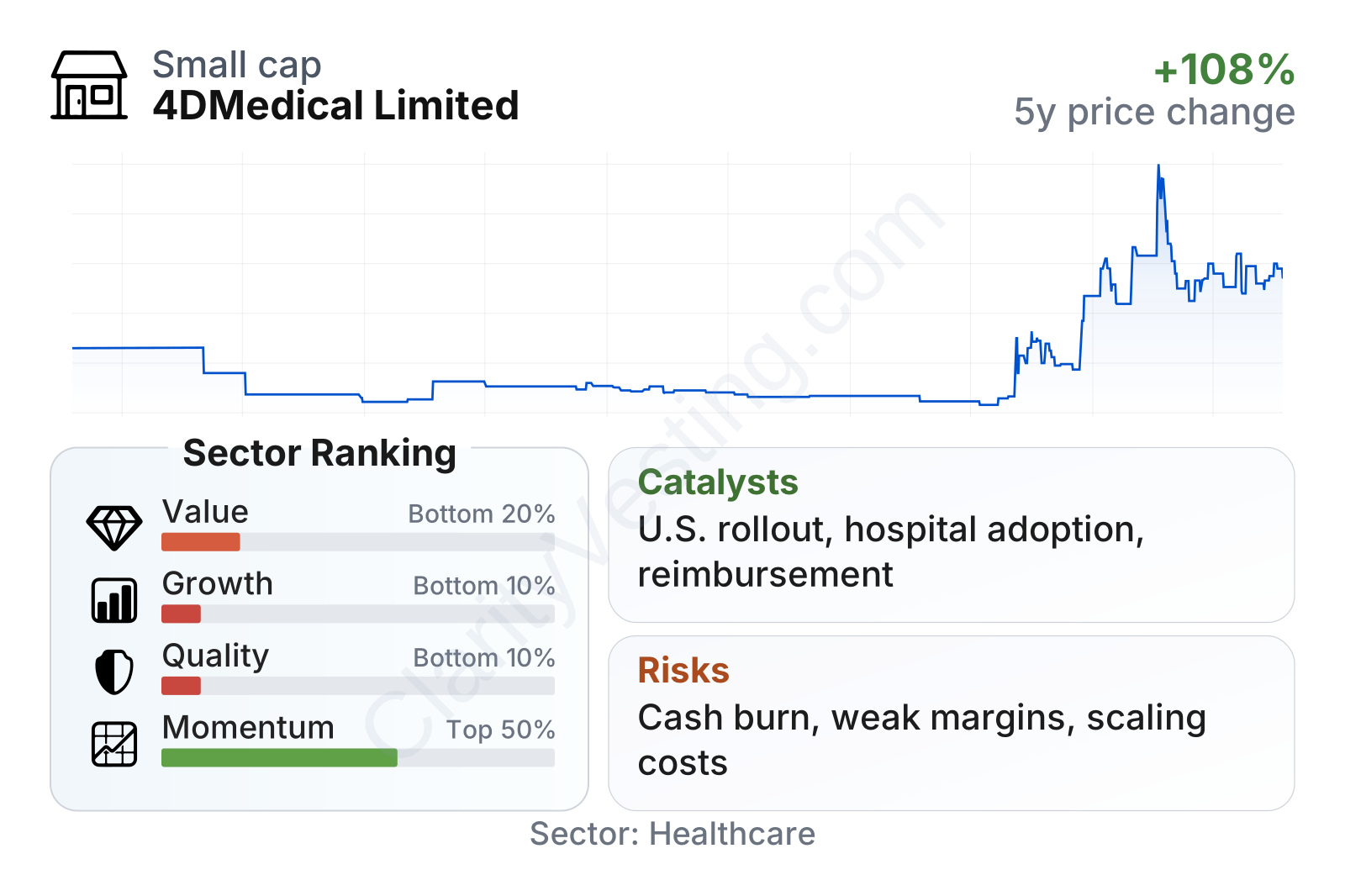
The market is valuing 4DMedical like a high-expectation healthcare company rather than a mature device business. Revenue growth has recently been strong, well above the sector median, but quality and profitability measures remain among the weakest in the healthcare group. Returns on assets and capital are deeply negative, free cash flow remains negative, and operating margins are far below sector norms. One notable offset is balance-sheet leverage: debt is very low, and net cash provides some financial flexibility. Share price performance has been exceptionally strong over the last one to three years despite a softer last six months, which suggests enthusiasm has run ahead of the current earnings profile.
Growth
4DMedical operates in a part of healthcare with credible long-term tailwinds. Lung disease is common, imaging remains central to diagnosis and treatment planning, and hospitals are increasingly interested in tools that can provide more information without always requiring entirely new hardware. A software-driven imaging approach can be attractive because it may fit into existing clinical workflows more easily than building a new installed-device base from scratch.
The company’s strategy broadly makes sense for future expansion. It is targeting areas where clinicians already use chest imaging and trying to add functional insight that could improve decisions. That creates several possible growth paths: direct hospital adoption, reimbursement-supported clinical use, partnerships with health systems, and use in drug development or clinical trials where lung function measurement matters.
A major catalyst is progress in the United States. For a company of this size, broader adoption in the U.S. healthcare market can change the commercial profile quickly because pricing, reimbursement, and hospital volumes are typically much larger than in smaller home markets. Regulatory clearances already obtained for parts of the platform reduce one barrier, although commercialization remains the harder step.
Another positive sign is that headline revenue growth has accelerated. Recent year-over-year growth of roughly 42% is strong by healthcare standards, and total revenue has more than doubled since fiscal 2024. If that pace is supported by repeat usage rather than one-off projects, it would strengthen the case that the platform is moving from proof-of-concept toward a more recurring commercial model.
There is also a strategic angle in respiratory care and oncology. Functional lung imaging can be useful not only in chronic disease but also in radiation therapy planning and monitoring changes after treatment. If the company can show that its imaging improves clinical decisions or lowers downstream costs, that would be a meaningful commercial catalyst because hospitals and payers usually need evidence of practical value, not just technical novelty.
Risks
This article is for informational purposes only and does not constitute financial advice. Some content is AI-generated. See Disclaimer


