Stock Analysis · Freeport-McMoran Copper & Gold Inc (FCX)
Overview
Freeport-McMoRan is one of the world’s largest publicly traded copper producers. The company operates large, long-life mining assets in North America, South America, and Indonesia, and it also produces gold and molybdenum as by-products or secondary products from those mining systems. Its business is relatively simple to understand: it digs metals out of the ground, processes them, and sells them into global industrial markets.
Copper is the core of the business and the main reason the company matters for long-term market watchers. Copper is used in power grids, electric vehicles, construction, industrial equipment, electronics, and data infrastructure. Gold adds an important earnings swing factor, especially from Indonesia, while molybdenum is a smaller specialty-metal contributor used mainly in steel alloys.
Based on the latest annual reporting, Freeport-McMoRan’s revenue mix is heavily concentrated in metals, with copper by far the largest contributor.
- Copper: approximately 74% of revenue. This includes copper cathode, copper concentrates, and copper rod sales across the company’s mining operations.
- Gold: approximately 17% of revenue. Most of this is tied to the Grasberg district in Indonesia, where gold output can materially affect yearly results.
- Molybdenum: approximately 8% of revenue. This business includes mined and processed molybdenum products used in alloy and industrial applications.
- Other and adjustments: approximately 1%. This can include smaller product streams and commercial adjustments.
The business is geographically diversified, but operationally it still depends heavily on a relatively small number of very large mines. That creates both strength and concentration: strong asset quality, but meaningful exposure to site-specific issues.
The multi-year financial flow shows a business with revenue that has remained very large and fairly resilient, while earnings have been much more sensitive to metal prices, taxes, and operating costs. Revenue moved up from roughly the low-$20 billions to the mid-$20 billions over the last several years, but net income has been more volatile. Interest expense has improved noticeably, which suggests a healthier balance sheet and lower financing pressure than a few years ago.
Key Figures
| Metric | Value | Sector ⓘ |
|---|---|---|
| Date | Oct 24, 2026 | |
| Context | ||
| Sector | Basic Materials | |
| Industry | Copper | |
| Market Cap ⓘ | $98.90B | |
| Beta ⓘ | 1.39 | |
Value (Cheapness) | ||
| P/E Ratio ⓘ | 33.93 | 16.92 |
| P/B Ratio ⓘ | 12.43 | 1.66 |
| FCF Yield ⓘ | 5.98% | 5.83% |
| Dividend Yield ⓘ | 0.86% | 2.07% |
| EBIT / EV ⓘ | 6.20% | 6.38% |
| PEG ⓘ | 4.54 | |
Growth (Business expansion) | ||
| Revenue Growth ⓘ | -7.30% | 11.25% |
| RPS Growth (5Y CAGR) ⓘ | 4.28% | 4.49% |
| EPS Growth (5Y CAGR) ⓘ | -15.20% | -15.24% |
| BVPS Growth (5Y CAGR) ⓘ | 9.95% | 5.49% |
| Margin Growth (5Y Trend) ⓘ | -11.65% | -1.54% |
| FCF Growth (5Y CAGR) ⓘ | -33.19% | 0.37% |
| DPS Growth (5Y CAGR) ⓘ | 27.99% | 5.91% |
Quality (Business durability) | ||
| ROIC (Latest) ⓘ | 16.44% | 9.59% |
| ROA (Latest) ⓘ | 5.05% | 4.92% |
| ROIC (5Y Median) ⓘ | 17.45% | 7.91% |
| ROA (5Y Median) ⓘ | 3.90% | 3.92% |
| Net Debt / EBIT (Latest) ⓘ | 0.92 | 1.36 |
| Net Debt / EBIT (5Y Median) ⓘ | 0.70 | 1.69 |
| Net Debt / EBITDA (Latest) ⓘ | 0.70 | 0.93 |
| Net Debt / Assets ⓘ | 10.51% | 13.69% |
| EBITDA / Interest ⓘ | 21.12 | 12.38 |
| Operating Margin (Latest) ⓘ | 26.49% | 13.24% |
| Operating Margin (5Y Median) ⓘ | 28.72% | 11.82% |
| Debt to Equity (Latest) ⓘ | 51.51% | 40.30% |
| Profit Margin (Latest) ⓘ | 11.39% | 6.38% |
| Free Cash Flow (Latest) ⓘ | $5.92B | |
Momentum (Price trend) | ||
| 3Y Return ⓘ | +111.03% | +73.47% |
| 12M Return (excl. last month) ⓘ | +62.30% | +27.59% |
| 6M Return ⓘ | +2.44% | -4.02% |
| Price vs. 200-Day MA ⓘ | +6.57% | -0.65% |
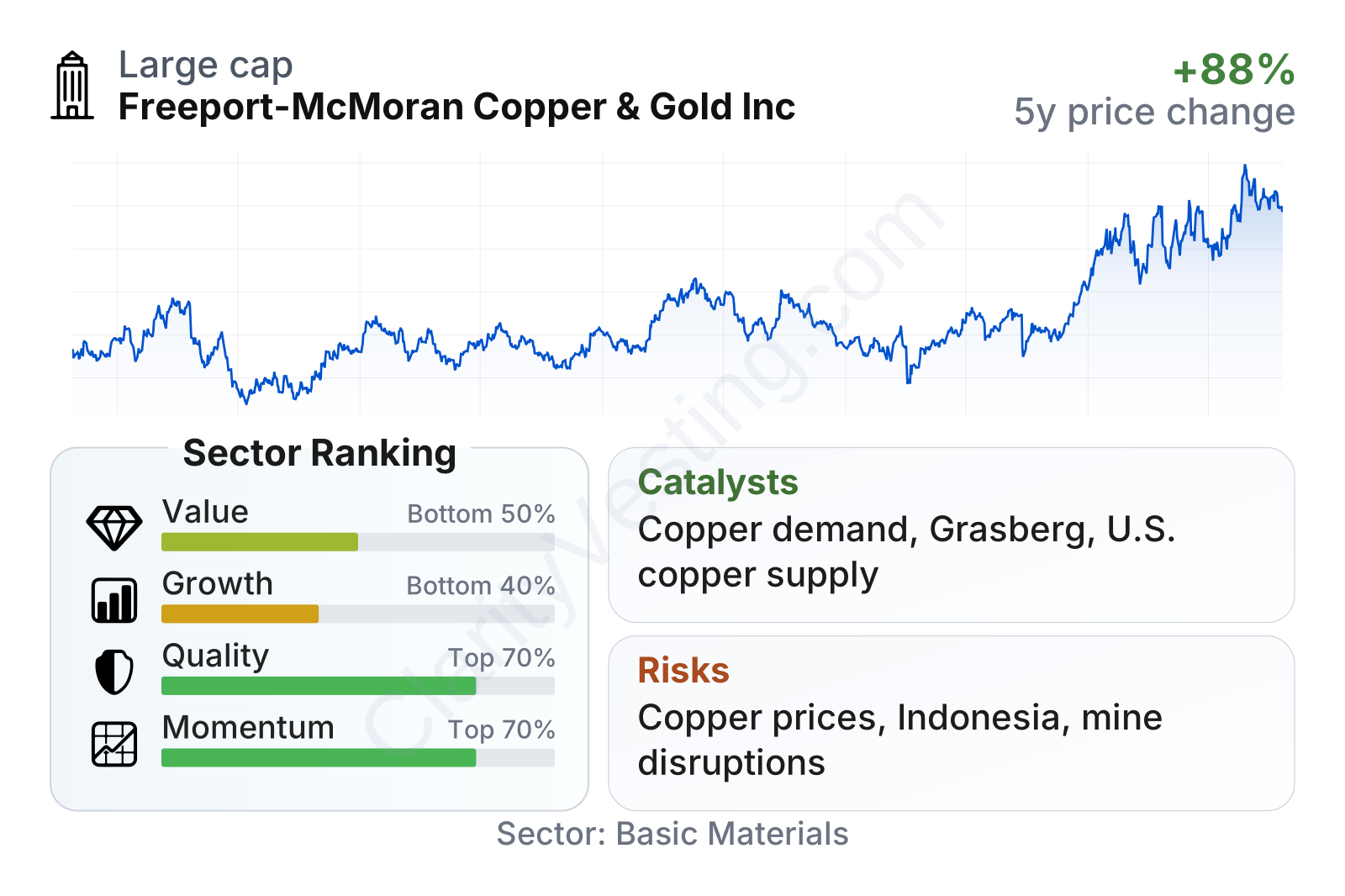
Freeport-McMoRan is a very large mining company with above-average share price volatility, which is normal for a cyclical copper producer. The current factor profile is mixed. Quality and market momentum rank relatively well versus the broader materials sector, supported by strong operating margins, solid returns on capital, and manageable leverage. By contrast, value and growth rank lower, mainly because the stock trades at richer earnings and book multiples than the sector median while recent year-over-year revenue growth has been uneven.
The dividend yield remains modest at around 1%, below the sector median, so the stock’s financial profile is driven more by commodity exposure, profitability, and cash generation than by income.
Growth
Freeport-McMoRan operates in a sector with an attractive long-term demand backdrop. Copper sits at the center of electrification. Power transmission, renewable energy systems, electric vehicles, charging networks, and data center buildouts all require large amounts of copper. That does not mean demand rises in a straight line every year, but it does create a structural case for sustained consumption growth over time.
The company’s strategy broadly fits that backdrop. Freeport focuses on large, long-life assets rather than frequent acquisitions, and it has emphasized underground development, mill expansion, and leaching technologies that can extend mine life or lift recovery rates. This is especially important in mining, where replacing reserves is difficult, expensive, and slow.
A major catalyst is the Grasberg complex in Indonesia, one of the world’s most important copper and gold mining districts. Grasberg is valuable not just because of its size, but because gold volumes can meaningfully lower net copper costs when production is strong. In North America, the company has also highlighted opportunities to increase output through brownfield expansions and advanced leach initiatives rather than relying only on new greenfield megaprojects.
Recent revenue growth has not been smooth, which is typical for a miner. Quarterly year-over-year sales have swung between strong gains and declines as production timing and commodity prices moved around. That pattern matters: the company is exposed to a favorable long-term theme, but the path is cyclical and can look weak over shorter periods.
Cash generation has improved sharply after a weaker stretch. Trailing free cash flow has rebounded to roughly the mid-single-digit billions of dollars, showing that when copper prices and operating conditions cooperate, Freeport can convert its asset base into substantial excess cash. That cash can support project spending, debt management, and shareholder distributions.
One recent development with strategic importance is the growing attention on domestic and allied-country copper supply. Governments and industrial customers increasingly view copper as a critical material for infrastructure and energy systems. Freeport’s large U.S. footprint gives it relevance in that discussion, especially as supply growth globally remains constrained by permitting delays, capital intensity, and declining ore grades at many mines.
Risks
This article is for informational purposes only and does not constitute financial advice. Some content is AI-generated. See Disclaimer


