Stock Analysis · First Citizens BancShares Inc (FCNCA)
Overview
First Citizens BancShares is a U.S. regional banking group headquartered in North Carolina. Through First-Citizens Bank & Trust Company and a set of specialized lending and service platforms, it provides traditional banking products such as deposits, commercial and consumer loans, treasury services, wealth management, and card products. The company has become much larger in recent years after major acquisitions, most notably CIT Group and later a large portion of Silicon Valley Bank.
Its business is not built around selling physical products. Like most banks, it mainly earns money from the spread between what it charges on loans and what it pays on deposits and borrowings, plus fees from services. Based on the latest annual filing, revenue is primarily concentrated in interest-related income, with noninterest income making up a smaller but still meaningful share.
- Net interest income: approximately 70% to 80% of total revenue. This is the core banking engine and reflects income from commercial loans, equipment finance, mortgages, credit cards, and securities, minus interest paid on deposits and other funding.
- Noninterest income: approximately 20% to 30% of total revenue. This includes wealth and advisory fees, service charges, card and payment fees, swap and treasury-related fees, leasing-related income, and gains or other income tied to specialized finance activities.
Within lending, the company is unusually diversified for a regional bank. It has meaningful exposure to general commercial banking, commercial real estate, rail and equipment finance inherited from CIT, and a technology and innovation banking platform built from the Silicon Valley Bank transaction. That mix gives it more niche capabilities than many similarly sized regional banks.
The broad financial flow over the last several years shows how dramatically the franchise expanded after acquisitions: revenue and profit rose sharply from 2022 through 2024, then normalized in 2025 as acquisition-related benefits faded and expenses remained elevated. Even after that normalization, the company still operates at a much larger scale than it did before those deals.
Key Figures
| Metric | Value | Sector ⓘ |
|---|---|---|
| Date | Oct 17, 2026 | |
| Context | ||
| Sector | Financial Services | |
| Industry | Banks - Regional | |
| Market Cap ⓘ | $23.21B | |
| Beta ⓘ | 0.58 | |
Value (Cheapness) | ||
| P/E Ratio ⓘ | 11.12 | 12.26 |
| P/B Ratio ⓘ | 1.10 | 1.23 |
| FCF Yield ⓘ | 11.03% | 10.40% |
| Dividend Yield ⓘ | 0.40% | 3.02% |
| EBIT / EV ⓘ | 8.93% | 8.14% |
| PEG ⓘ | 1.15 | |
Growth (Business expansion) | ||
| Revenue Growth ⓘ | 8.50% | 9.35% |
| RPS Growth (5Y CAGR) ⓘ | 56.91% | 12.19% |
| EPS Growth (5Y CAGR) ⓘ | 7.58% | -9.53% |
| BVPS Growth (5Y CAGR) ⓘ | -25.32% | 4.99% |
| Margin Growth (5Y Trend) ⓘ | -16.42% | -3.86% |
| FCF Growth (5Y CAGR) ⓘ | N/A | 4.81% |
| DPS Growth (5Y CAGR) ⓘ | 32.39% | 8.79% |
Quality (Business durability) | ||
| ROIC (Latest) ⓘ | 4.24% | 9.49% |
| ROE (Latest) ⓘ | 10.73% | 13.90% |
| ROA (Latest) ⓘ | 1.00% | 1.55% |
| ROIC (5Y Median) ⓘ | 10.20% | 7.86% |
| ROE (5Y Median) ⓘ | 9.92% | 12.17% |
| ROA (5Y Median) ⓘ | 1.27% | 1.30% |
| Net Debt / EBIT (Latest) ⓘ | 9.71 | 0.96 |
| Net Debt / EBIT (5Y Median) ⓘ | 1.22 | 0.73 |
| Net Debt / EBITDA (Latest) ⓘ | 8.28 | 0.92 |
| Operating Margin (Latest) ⓘ | 21.88% | 22.30% |
| Operating Margin (5Y Median) ⓘ | 26.73% | 24.63% |
| Debt to Equity (Latest) ⓘ | 146.98% | 58.56% |
| Profit Margin (Latest) ⓘ | 25.23% | 26.57% |
| Free Cash Flow (Latest) ⓘ | $2.56B | |
Momentum (Price trend) | ||
| 3Y Return ⓘ | +52.94% | +88.33% |
| 12M Return (excl. last month) ⓘ | +13.54% | +19.38% |
| 6M Return ⓘ | +5.76% | +4.75% |
| Price vs. 200-Day MA ⓘ | +2.06% | +3.50% |
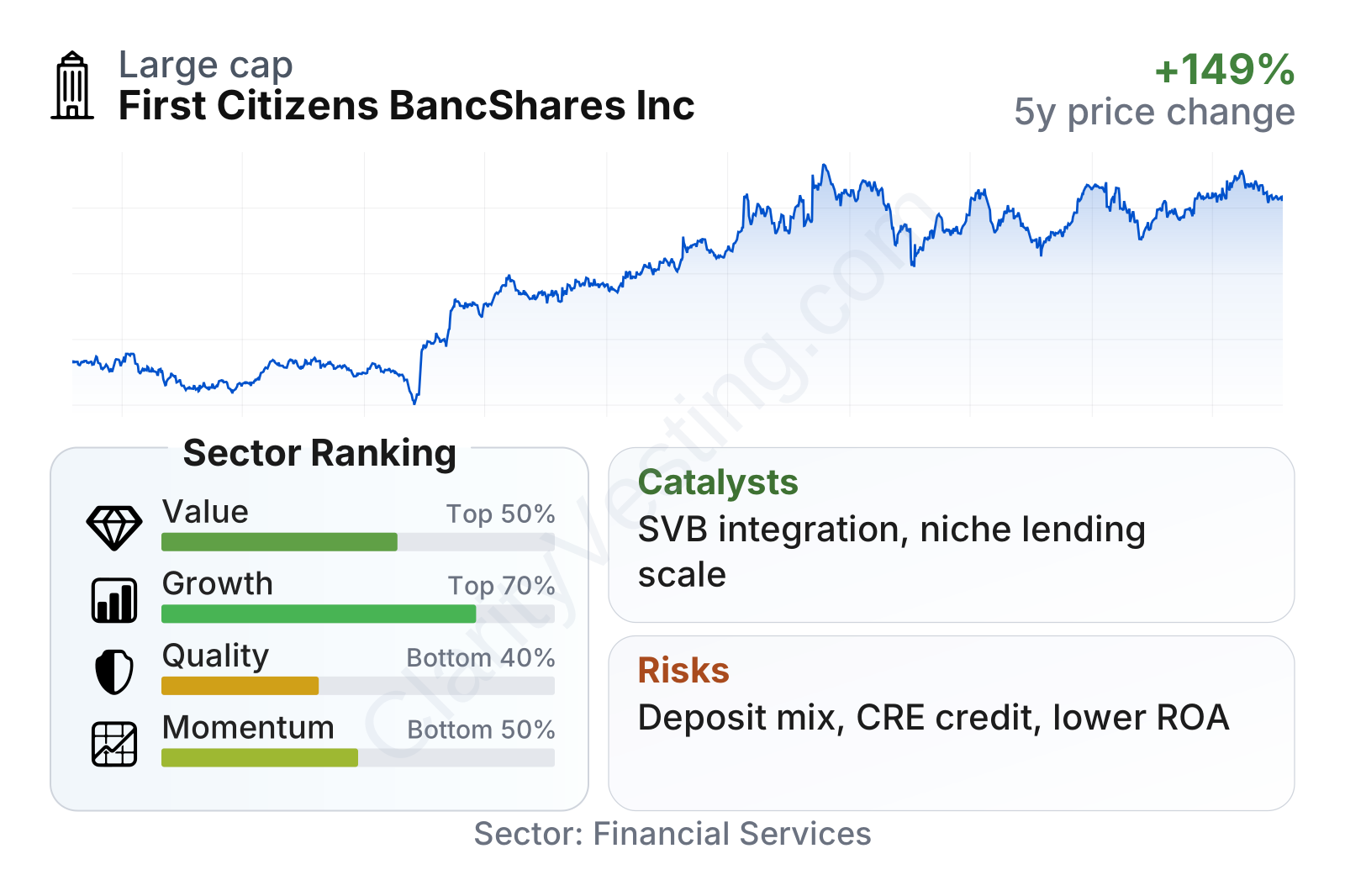
First Citizens sits in the large regional-bank range, with a market value around the mid-$20 billion area and a stock that has historically moved less than the broader market, reflected by a beta well below 1. In the factor snapshot, valuation looks somewhat cheaper than the sector median on both earnings and book value, while growth ranks better than average mainly because the company expanded rapidly through acquisitions. Quality and share-price momentum are weaker relative to peers, which suggests the market is still balancing the bank’s scale advantages against profitability and integration questions. The dividend yield is low for a bank, which reinforces that this is more of a retained-earnings and capital-allocation case than an income-focused one.
Growth
Banking is a mature industry, but First Citizens operates in areas that still offer above-average expansion opportunities. Its technology and innovation banking arm gives it exposure to venture-backed companies, private equity and venture capital firms, and high-growth commercial clients. Its rail, equipment, and specialty-finance businesses also add lending niches that are harder to replicate than plain-vanilla branch banking.
The company’s strategy for growth is clear: use a strong balance sheet and conservative underwriting culture to absorb large acquisitions, cross-sell more services to a broader client base, and deepen relationships in specialized verticals where pricing and customer stickiness can be better than in commoditized banking. That logic has already reshaped the company from a traditional regional lender into a more diversified banking platform.
Recent results indicate that growth is now shifting from acquisition-driven expansion to a more normalized phase. Revenue growth remains positive, but the pace is slower than the extraordinary jump seen after the Silicon Valley Bank transaction. That is not surprising. The key question for long-term analysis is whether the company can convert its bigger platform into steadier organic growth, not whether it can repeat another one-time step change immediately.
Earnings per share climbed dramatically between 2021 and 2024, then eased in 2025 from a very high base. That pattern suggests the business is still digesting prior gains rather than losing its core earnings power. If management can keep credit quality stable and improve operating efficiency, earnings could become more durable and less dependent on unusual acquisition effects.
Book value per share is especially important for banks because it shows how the balance sheet backing each share evolves over time. After the accounting distortions around major acquisitions, book value has been rebuilding strongly. That matters because a growing tangible capital base gives the bank more room to lend, absorb losses if needed, and support future expansion.
A current catalyst is the continued integration and development of the former Silicon Valley Bank franchise under First Citizens Bank. That platform brought relationships in venture banking, private capital, and innovation-focused deposits that are difficult to assemble quickly. If retained successfully, those relationships could support higher-value commercial banking growth well beyond the initial acquisition benefit.
Another favorable point is industry structure. Smaller banks continue to face rising compliance, funding, and technology costs, while the very largest banks already dominate mass-market banking. That creates room for a scaled regional bank with specialized capabilities to gain share in selected commercial segments.
Risks
This article is for informational purposes only and does not constitute financial advice. Some content is AI-generated. See Disclaimer


