Stock Analysis · FTI Consulting Inc (FCN)
Overview
FTI Consulting is a global business advisory firm that helps companies, law firms, lenders, private equity firms, and government clients deal with high-stakes problems. Its work usually becomes more important when situations are complex: corporate turnarounds, restructurings, investigations, disputes, cybersecurity incidents, reputational issues, mergers, antitrust reviews, and large transformation projects. In simple terms, FTI is paid for expert advice when the financial, legal, operational, or public-facing stakes are high.
The company reports revenue through five business segments. Based on the latest full-year filing, the mix is fairly balanced, which reduces dependence on any single activity.
- Corporate Finance & Restructuring — about 31%: turnaround work, performance improvement, office of the CFO support, transactions, restructuring, and bankruptcy-related advisory.
- Forensic and Litigation Consulting — about 23%: investigations, construction solutions, disputes, data analytics, compliance, and risk-related assignments.
- Economic Consulting — about 19%: antitrust, competition economics, finance, valuation, damages analysis, and expert testimony.
- Technology — about 14%: e-discovery, information governance, and technology services tied to investigations and litigation.
- Strategic Communications — about 13%: corporate reputation, crisis communications, public affairs, financial communications, and transaction communications.
This model gives FTI exposure to both recurring advisory work and more event-driven assignments. The event-driven side can be volatile from year to year, but it also creates opportunities when markets are stressed and clients urgently need outside expertise.
The company’s financial profile shows a people-intensive business: most revenue is absorbed by compensation and related delivery costs, while profit depends on consultant utilization, billing rates, and the ability to attract senior talent. Over the last several years, revenue has expanded steadily, operating income has generally risen, and net income has remained solid even as margins moved within a fairly narrow range.
Over time, revenue has climbed from roughly $2.8 billion to nearly $3.8 billion, while operating profit has also increased. The cost structure remains labor-heavy, which is normal for consulting, so execution matters more than physical assets or manufacturing efficiency.
Key Figures
| Metric | Value | Sector ⓘ |
|---|---|---|
| Date | Oct 24, 2026 | |
| Context | ||
| Sector | Industrials | |
| Industry | Consulting Services | |
| Market Cap ⓘ | $4.16B | |
| Beta ⓘ | -0.06 | |
Value (Cheapness) | ||
| P/E Ratio ⓘ | 18.15 | 22.29 |
| P/B Ratio ⓘ | 3.57 | 1.98 |
| FCF Yield ⓘ | 9.99% | 6.26% |
| Dividend Yield ⓘ | N/A | 1.92% |
| EBIT / EV ⓘ | 8.09% | 4.83% |
| PEG ⓘ | 0.96 | |
Growth (Business expansion) | ||
| Revenue Growth ⓘ | 5.30% | 9.30% |
| RPS Growth (5Y CAGR) ⓘ | 10.05% | 7.76% |
| EPS Growth (5Y CAGR) ⓘ | -12.05% | -13.17% |
| BVPS Growth (5Y CAGR) ⓘ | 4.15% | 6.13% |
| Margin Growth (5Y Trend) ⓘ | -1.11% | 0.74% |
| FCF Growth (5Y CAGR) ⓘ | -14.04% | 10.79% |
| DPS Growth (5Y CAGR) ⓘ | 23.14% | 9.41% |
Quality (Business durability) | ||
| ROIC (Latest) ⓘ | 12.18% | 10.75% |
| ROA (Latest) ⓘ | 7.20% | 5.41% |
| ROIC (5Y Median) ⓘ | 13.47% | 9.37% |
| ROA (5Y Median) ⓘ | 7.99% | 4.95% |
| Net Debt / EBIT (Latest) ⓘ | 2.87 | 2.04 |
| Net Debt / EBIT (5Y Median) ⓘ | 0.22 | 2.27 |
| Net Debt / EBITDA (Latest) ⓘ | 2.53 | 1.39 |
| Net Debt / Assets ⓘ | 31.23% | 19.27% |
| EBITDA / Interest ⓘ | 13.10 | 9.58 |
| Operating Margin (Latest) ⓘ | 9.79% | 10.49% |
| Operating Margin (5Y Median) ⓘ | 10.36% | 10.30% |
| Debt to Equity (Latest) ⓘ | 95.02% | 64.82% |
| Profit Margin (Latest) ⓘ | 6.44% | 6.67% |
| Free Cash Flow (Latest) ⓘ | $415.65M | |
Momentum (Price trend) | ||
| 3Y Return ⓘ | -19.78% | +67.77% |
| 12M Return (excl. last month) ⓘ | -12.98% | +12.05% |
| 6M Return ⓘ | -20.14% | 0.00% |
| Price vs. 200-Day MA ⓘ | -6.79% | +0.67% |
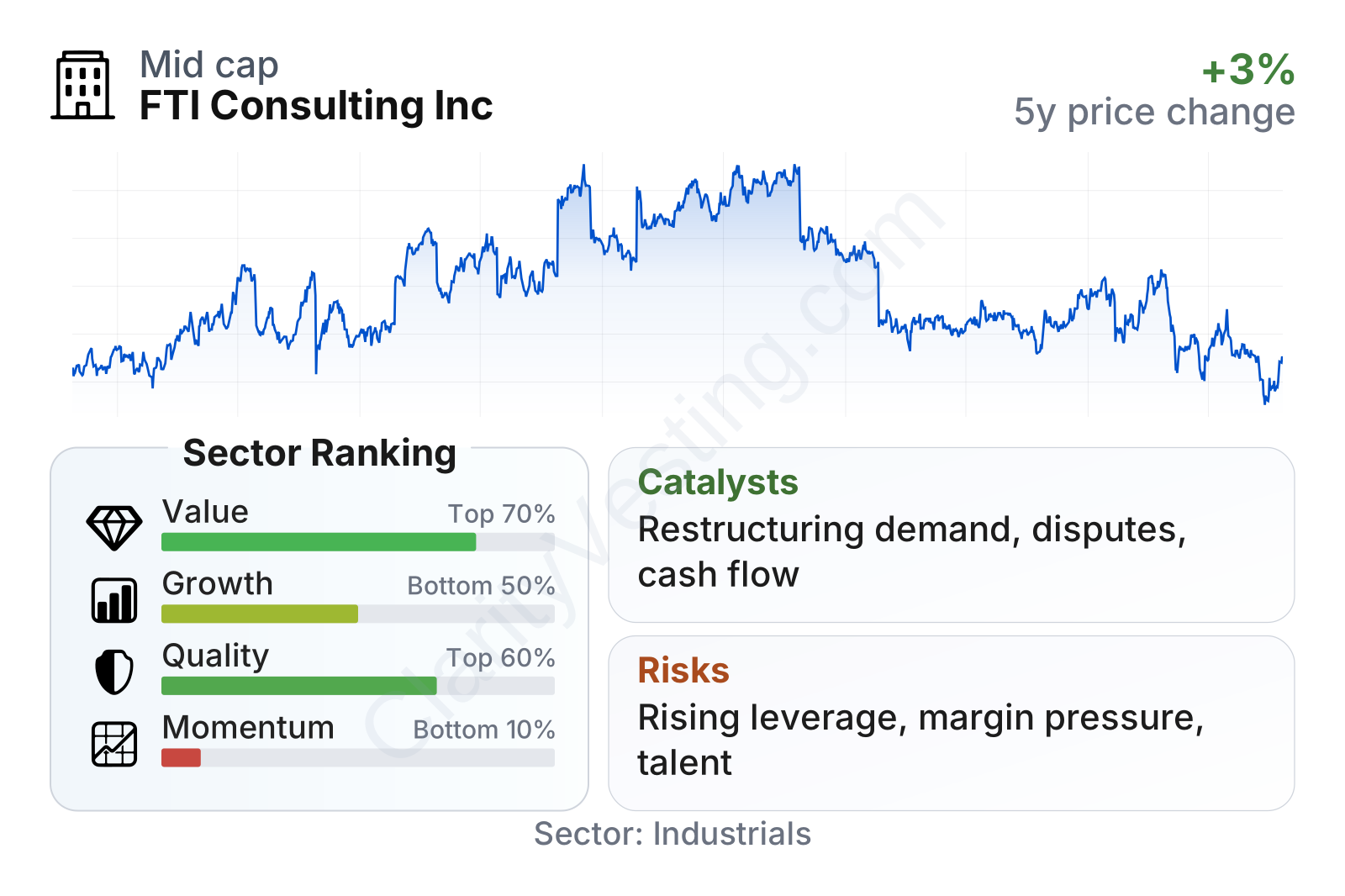
FTI looks like a mid-sized consulting and advisory firm with mixed but understandable signals. Profitability and returns on capital remain respectable relative to much of the sector, and free cash flow generation is notably strong. Growth is less impressive in the short term, and recent share-price momentum has been weak. Valuation measures appear moderate rather than stretched, especially compared with sector medians, but the market is also reflecting slower recent expansion and some balance-sheet deterioration.
The stock chart shows a strong run through 2024 followed by a meaningful pullback in 2025 and a softer 2026. That decline has compressed the earnings multiple from the mid-20s and above in earlier periods to around the high teens to low 20s more recently, changing the valuation backdrop materially.
Growth
FTI operates in areas that should remain relevant for years: restructuring, litigation support, antitrust and regulatory economics, cybersecurity-related response, data review, and strategic communications during crises or transactions. These are not temporary niches. If anything, the business environment has become more complex, more regulated, and more reputation-sensitive, which supports demand for outside specialists.
A key point for long-term analysis is that FTI does not need every part of the economy to be strong at the same time. Some practices tend to benefit when deal activity and investment are healthy, while others become more active during distress, bankruptcies, disputes, or regulatory pressure. That diversification can make the company more resilient than firms tied to only one consulting theme.
Revenue growth accelerated strongly in 2023, slowed through 2024, dipped briefly into negative territory, and then turned positive again. More recently, year-over-year growth has returned to the mid-single-digit range. That pattern suggests the business is still expanding, but not with the same momentum seen during its strongest post-2022 period. Over a five-year view, revenue per share growth has still been solid, which matters more for long-term readers than a single uneven year.
Management’s strategy has centered on adding senior professionals, expanding internationally, and building cross-segment capabilities around disputes, investigations, restructuring, and communications. That makes strategic sense because many client situations overlap. A major restructuring, for example, can require financial advisors, forensic specialists, economists, data experts, and communications support at the same time. FTI is one of the few firms with scale across all those areas.
Cash generation has improved meaningfully from earlier lows, with trailing free cash flow now back to a much stronger level. That matters because advisory firms ultimately create value through talent productivity, not through heavy capital spending. Stronger cash conversion gives the company more flexibility for hiring, acquisitions, share repurchases, and dividends.
Recent company updates have continued to emphasize demand in core areas such as restructuring, disputes, investigations, and technology-enabled legal support. A prolonged period of corporate stress, higher refinancing pressure, or heavier regulatory scrutiny would likely support activity in several of FTI’s practices at once. That is one of the clearest business catalysts in the current environment.
Risks
This article is for informational purposes only and does not constitute financial advice. Some content is AI-generated. See Disclaimer


