Stock Analysis · FirstCash Inc (FCFS)
Overview
FirstCash Inc is a specialty finance and retail company best known for pawn stores. In simple terms, it lends small amounts of money to customers who leave an item as collateral, and if the customer does not repay the loan, the company can sell that item in its stores. It also earns money by selling merchandise, especially jewelry, electronics, tools, and other goods that come from forfeited pawn collateral or direct purchases. In addition to pawn operations, FirstCash has a smaller business in point-of-sale payment solutions in Latin America through American First Finance, which helps consumers finance retail purchases.
The business is spread across the United States and Latin America, with a particularly large presence in Mexico. That geographic mix matters because pawn services tend to be resilient in periods when consumers need small-dollar liquidity quickly and may not qualify for traditional bank credit. The model is operationally intensive, but it is straightforward: make many small secured loans, manage inventory well, and keep store-level economics disciplined.
Based on recent company reporting, revenue is mainly driven by pawn-related merchandise sales, followed by pawn service charges and fees, with consumer finance making up a smaller share.
- Retail merchandise sales: approximately 65% to 75% of total revenue. This includes sales of jewelry, electronics, tools, appliances, and other general merchandise sold through pawn stores.
- Pawn loan fees and service charges: approximately 20% to 30% of total revenue. This is the income earned from customers paying to redeem pawned items.
- Consumer finance and other: approximately 5% to 10% of total revenue. This mainly reflects lease-to-own and retail point-of-sale payment activities tied to American First Finance, plus smaller ancillary items.
Over the last several years, the company has expanded meaningfully, and the operating profile shows a business where revenue and gross profit have climbed faster than overhead. Net income has also improved, although interest expense has risen as the balance sheet has carried more debt.
Key Figures
| Metric | Value | Sector ⓘ |
|---|---|---|
| Date | Oct 17, 2026 | |
| Context | ||
| Sector | Financial Services | |
| Industry | Credit Services | |
| Market Cap ⓘ | $9.39B | |
| Beta ⓘ | 0.55 | |
Value (Cheapness) | ||
| P/E Ratio ⓘ | 24.89 | 12.26 |
| P/B Ratio ⓘ | 4.13 | 1.23 |
| FCF Yield ⓘ | 6.35% | 10.40% |
| Dividend Yield ⓘ | 0.77% | 3.02% |
| EBIT / EV ⓘ | 5.61% | 8.14% |
| PEG ⓘ | 1.17 | |
Growth (Business expansion) | ||
| Revenue Growth ⓘ | 29.40% | 9.35% |
| RPS Growth (5Y CAGR) ⓘ | 18.70% | 12.19% |
| EPS Growth (5Y CAGR) ⓘ | -0.10% | -9.53% |
| BVPS Growth (5Y CAGR) ⓘ | 3.78% | 4.99% |
| Margin Growth (5Y Trend) ⓘ | 3.83% | -3.86% |
| FCF Growth (5Y CAGR) ⓘ | 30.83% | 4.81% |
| DPS Growth (5Y CAGR) ⓘ | 8.26% | 8.79% |
Quality (Business durability) | ||
| ROIC (Latest) ⓘ | N/A | 9.49% |
| ROE (Latest) ⓘ | 17.17% | 13.90% |
| ROA (Latest) ⓘ | 7.28% | 1.55% |
| ROIC (5Y Median) ⓘ | 9.16% | 7.86% |
| ROE (5Y Median) ⓘ | 12.78% | 12.17% |
| ROA (5Y Median) ⓘ | 5.90% | 1.30% |
| Net Debt / EBIT (Latest) ⓘ | 3.78 | 0.96 |
| Net Debt / EBIT (5Y Median) ⓘ | 4.65 | 0.73 |
| Net Debt / EBITDA (Latest) ⓘ | 2.30 | 0.92 |
| Operating Margin (Latest) ⓘ | 16.24% | 22.30% |
| Operating Margin (5Y Median) ⓘ | 13.22% | 24.63% |
| Debt to Equity (Latest) ⓘ | 116.42% | 58.56% |
| Profit Margin (Latest) ⓘ | 9.42% | 26.57% |
| Free Cash Flow (Latest) ⓘ | $596.25M | |
Momentum (Price trend) | ||
| 3Y Return ⓘ | +118.27% | +88.33% |
| 12M Return (excl. last month) ⓘ | +47.96% | +19.38% |
| 6M Return ⓘ | +7.38% | +4.75% |
| Price vs. 200-Day MA ⓘ | +6.14% | +3.50% |
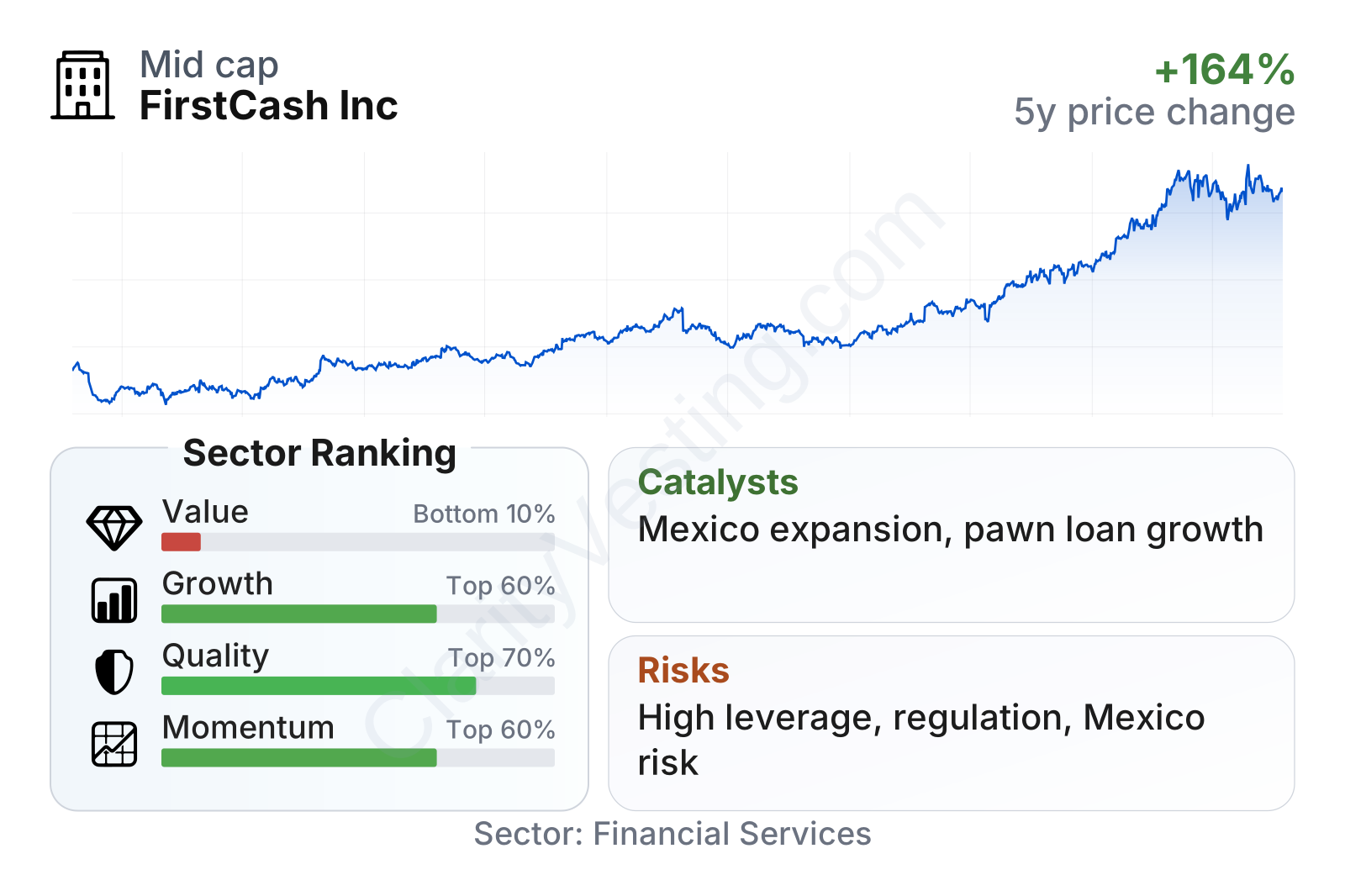
FirstCash is now a large company within its niche, with a market value around the large mid-cap range and a relatively low beta of about 0.5, which suggests the stock has historically moved less violently than the broader market. The operating profile looks mixed in a useful way for long-term analysis: growth and profitability metrics are generally stronger than much of the sector, while valuation metrics look clearly richer than the sector median.
Revenue growth stands out, with recent year-over-year expansion far above the sector median, and free cash flow generation has also been strong over a multi-year period. Returns on equity and assets are healthy, especially compared with many financial services peers. On the other hand, debt-related measures are notably higher than sector norms, and the stock trades at a materially higher earnings and book multiple than the typical company in its sector. The share price trend has also been strong over the last three years, which helps explain why the dividend yield has moved lower.
Growth
The company operates in a part of financial services that can keep growing even when the economy is uneven. Pawn lending is tied less to economic optimism and more to everyday liquidity needs. That makes it different from many lenders: demand can remain firm when lower-income and underbanked consumers need immediate access to cash, while retail merchandise sales benefit from value-oriented shopping behavior. In Latin America, especially Mexico, low banking penetration and demand for small secured loans continue to support store expansion and customer traffic.
FirstCash’s strategy for future growth is coherent. It combines new store openings, acquisitions, same-store pawn loan growth, better inventory turnover, and expansion of customer relationships in both the U.S. and Latin America. The company has spent years building scale in pawn, and that scale matters because it improves sourcing, pricing discipline, logistics, and local market knowledge. The American First Finance business adds a different growth engine, although it is smaller and has a different risk profile than pawn.
Earnings per share have shown a strong upward path over the last several years, rising from below $4 in 2021 to nearly $9 in 2025, which points to both business expansion and improved operating efficiency. Even if the shorter 5-year compounded earnings metric looks roughly flat in the factor table, the more recent annual pattern is clearly favorable.
Book value per share has also moved upward over time after some earlier volatility. That matters because it shows the company has been adding balance-sheet value while growing the business. The pace is not exceptional relative to the sector median, but the direction is constructive, especially when paired with stronger returns on that capital.
Recent company updates have continued to emphasize pawn receivable growth, Latin American store development, and disciplined capital allocation. Those are the most important catalysts to watch because they directly support revenue, earnings, and scale advantages. A strong gold price environment can also help because jewelry is a meaningful part of pawn collateral and retail inventory, supporting both loan values and merchandise economics.
Risks
This article is for informational purposes only and does not constitute financial advice. Some content is AI-generated. See Disclaimer


