Stock Analysis · FuelCell Energy Inc (FCEL)
Overview
FuelCell Energy is a U.S. company focused on stationary fuel cell power systems. In simple terms, it builds and operates equipment that can generate electricity on-site using an electrochemical process rather than traditional combustion. Its platforms are aimed at utilities, data centers, wastewater facilities, industrial users, universities, and other large energy users that want cleaner distributed power, heat, and in some cases carbon capture or hydrogen-related capabilities.
The company’s core technology is carbonate fuel cells. These systems are designed for continuous power generation and can be sold as equipment, installed under service agreements, or retained by FuelCell Energy and used to generate recurring revenue from electricity sales. Beyond power generation, management has been positioning the business around three themes: decarbonized electricity, carbon capture, and hydrogen production.
Based on the latest annual filing and recent quarterly disclosures, FuelCell Energy’s revenue mix is spread across product sales, long-term service work, generation revenue from company-owned assets, and advanced technologies. The exact mix can move meaningfully from year to year because large projects and module replacements can shift timing. For fiscal 2025, the approximate revenue sources were:
- Service agreements and license revenue: about 45%–50% — recurring and project-related service work tied to installed platforms, including maintenance, module replacements, and license-related activity.
- Product revenue: about 30%–35% — sales of fuel cell modules and plant equipment for customer projects.
- Generation revenue: about 15%–20% — electricity sold from plants that FuelCell Energy owns or partly owns.
- Advanced technologies contracts: about 3%–8% — research, development, and government or partner-funded work in areas such as carbon capture and hydrogen.
This mix matters because it shows FuelCell Energy is not only trying to sell equipment. It is also trying to build longer-duration revenue streams through service contracts and owned generation assets, which could make the business more stable if the installed base grows enough over time.
The long-term challenge is that revenue has not yet converted into healthy economics. Costs of revenue have remained above total revenue in recent years, so the business has been producing negative gross profit as it scales. That is a central issue for anyone studying the company beyond its clean-energy theme.
The income profile shows a business that has lifted revenue from its 2021 level, but not in a straight line and not with cost discipline strong enough to reach gross profitability. Research and development remains significant, which fits a company still trying to commercialize newer applications, but it also prolongs losses.
Key Figures
| Metric | Value | Sector ⓘ |
|---|---|---|
| Date | Oct 17, 2026 | |
| Context | ||
| Sector | Industrials | |
| Industry | Electrical Equipment & Parts | |
| Market Cap ⓘ | $1.24B | |
| Beta ⓘ | 2.46 | |
Value (Cheapness) | ||
| P/E Ratio ⓘ | N/A | 22.10 |
| P/B Ratio ⓘ | 1.03 | 1.97 |
| FCF Yield ⓘ | -8.64% | 6.38% |
| Dividend Yield ⓘ | N/A | 1.94% |
| EBIT / EV ⓘ | -17.83% | 4.79% |
| PEG ⓘ | 0.36 | |
Growth (Business expansion) | ||
| Revenue Growth ⓘ | -29.40% | 9.30% |
| RPS Growth (5Y CAGR) ⓘ | 25.27% | 7.81% |
| EPS Growth (5Y CAGR) ⓘ | -36.58% | -13.06% |
| BVPS Growth (5Y CAGR) ⓘ | 2.41% | 6.14% |
| Margin Growth (5Y Trend) ⓘ | N/A | 0.88% |
| FCF Growth (5Y CAGR) ⓘ | N/A | 11.01% |
| DPS Growth (5Y CAGR) ⓘ | 2.03% | 9.48% |
Quality (Business durability) | ||
| ROIC (Latest) ⓘ | -14.55% | 10.84% |
| ROA (Latest) ⓘ | -15.66% | 5.41% |
| ROIC (5Y Median) ⓘ | -14.20% | 9.38% |
| ROA (5Y Median) ⓘ | -14.44% | 4.95% |
| Net Debt / EBIT (Latest) ⓘ | N/A | 2.08 |
| Net Debt / EBIT (5Y Median) ⓘ | N/A | 2.27 |
| Net Debt / EBITDA (Latest) ⓘ | N/A | 1.39 |
| Net Debt / Assets ⓘ | -36.56% | 19.28% |
| EBITDA / Interest ⓘ | N/A | 9.58 |
| Operating Margin (Latest) ⓘ | -110.29% | 10.50% |
| Operating Margin (5Y Median) ⓘ | -114.35% | 10.29% |
| Debt to Equity (Latest) ⓘ | 18.32% | 65.48% |
| Profit Margin (Latest) ⓘ | -113.60% | 6.67% |
| Free Cash Flow (Latest) ⓘ | -$107.04M | |
Momentum (Price trend) | ||
| 3Y Return ⓘ | -63.41% | +61.68% |
| 12M Return (excl. last month) ⓘ | +122.42% | +12.58% |
| 6M Return ⓘ | +93.97% | 0.00% |
| Price vs. 200-Day MA ⓘ | -3.44% | +0.02% |
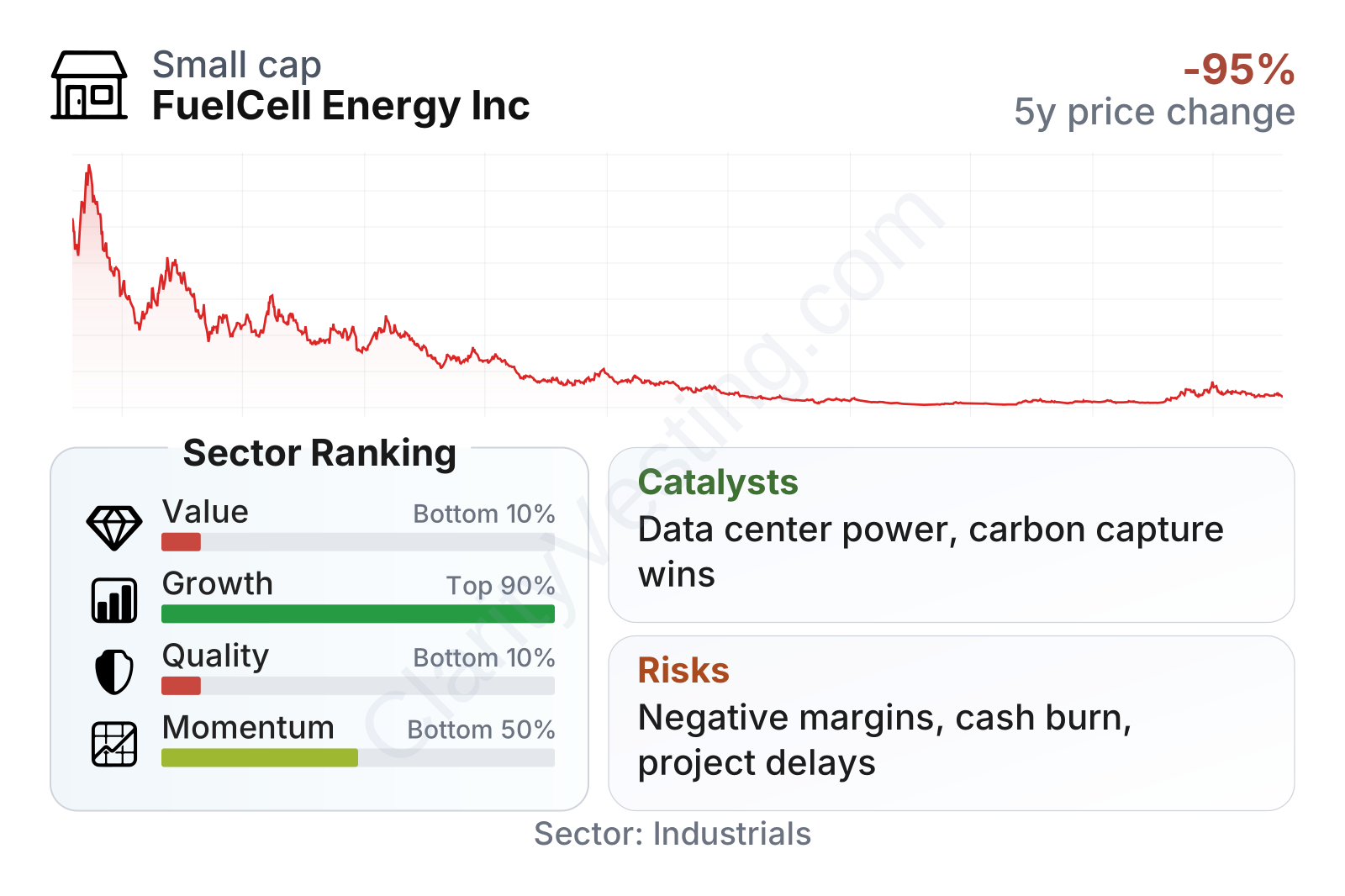
FuelCell Energy is a small-cap industrial company with a share price history marked by very large swings. The recent rebound has been strong, but the longer three-year picture remains deeply negative. On valuation measures, the stock screens as optically cheap on price-to-book, yet weak on broader value measures because the company is still unprofitable and burning cash. Growth metrics are mixed: five-year revenue per share growth has been strong, but the most recent year-over-year revenue change is negative and well below the sector median. Quality is the weakest area, with returns on capital, margins, and free cash flow all far behind typical peers.
Growth
FuelCell Energy operates in a sector with genuine long-term demand drivers. Electric grids need more resilient local power, many large facilities want lower-emission electricity, and data center growth is increasing interest in always-on power solutions. The company’s positioning around distributed baseload generation, combined heat and power, carbon capture, and hydrogen, lines up with areas that could attract infrastructure spending for years.
Its strategy also makes sense on paper. Rather than relying only on one-off equipment sales, FuelCell Energy has been trying to build a wider platform: develop and manufacture fuel cell systems, sign service agreements, operate company-owned generation assets, and use the installed base to support adjacent offerings such as carbon capture and hydrogen. If it works, that model could produce more repeat business than a pure equipment vendor.
The problem is that growth has been uneven. Revenue has shown bursts of very strong expansion followed by sharp declines, which suggests project timing and contract execution still have an outsized impact on results. The latest twelve-month comparison points to contraction rather than sustained acceleration. That does not remove the long-term opportunity, but it shows the company is still far from a smooth scaling phase.
Cash generation has improved from the deepest outflows seen earlier in the cycle, but free cash flow remains clearly negative. In practice, that means FuelCell Energy is still funding growth before proving that each dollar of additional revenue can produce durable cash returns. For a long-term business case, this is one of the main points to watch: not just whether revenue rises, but whether losses narrow in a lasting way.
Recent company updates point to several possible catalysts. FuelCell Energy has continued highlighting its backlog, its work in carbon capture, and the importance of firm clean power for data centers and utilities. The company has also been active in securing or advancing projects tied to long-duration energy infrastructure needs. If those efforts translate into larger commercial deployments, especially in North America and South Korea, the addressable market could expand meaningfully. A second catalyst would be any evidence that manufacturing utilization and service economics are improving enough to move gross margin closer to break-even.
Risks
This article is for informational purposes only and does not constitute financial advice. Some content is AI-generated. See Disclaimer


