Stock Analysis · First BanCorp (FBP)
Overview
First BanCorp is a regional bank holding company best known for FirstBank Puerto Rico. It provides traditional banking services to consumers, businesses, and commercial clients, with operations centered in Puerto Rico and additional activities in the U.S. Virgin Islands and Florida. In simple terms, it gathers deposits, makes loans, earns interest on those loans and securities, and also collects fees from services such as cards, mortgage banking, and treasury-related activities.
Like most banks, its revenue mix is dominated by net interest income, which is the spread between what it earns on loans and investments and what it pays on deposits and borrowings. Based on recent company reporting, the main sources of revenue are approximately:
- Net interest income: about 75% to 85% of total revenue. This includes income from commercial loans, residential mortgages, construction lending, consumer lending, and the securities portfolio, minus deposit and funding costs.
- Service charges and deposit account fees: about 5% to 8%. This mainly comes from checking, savings, and transaction-related banking services.
- Mortgage banking and loan-related fees: about 4% to 7%. This includes mortgage origination, servicing-related activity, and lending fees.
- Card, insurance, and other financial service fees: about 3% to 6%. This covers debit and credit card fees, insurance commissions, and other customer service income.
- Treasury, broker-dealer, and other non-interest income: a smaller remaining share. This can include gains or losses on sales of investments, treasury management, and various ancillary banking activities.
The business is relatively straightforward for a bank: attract stable deposits, lend them at attractive rates, control credit losses, and keep expenses disciplined. Over the last several years, total revenue has trended upward, while profit has remained solid even as interest expense rose sharply across the banking sector.
The operating picture shows a bank that has been expanding revenue steadily since 2021, with net income holding up well despite higher funding costs. That matters because many banks saw earnings pressure when deposit costs increased, yet First BanCorp still kept profitability at a healthy level.
Key Figures
| Metric | Value | Sector ⓘ |
|---|---|---|
| Date | Oct 03, 2026 | |
| Context | ||
| Sector | Financial Services | |
| Industry | Banks - Regional | |
| Market Cap ⓘ | $4.02B | |
| Beta ⓘ | 0.79 | |
Value (Cheapness) | ||
| P/E Ratio ⓘ | 11.11 | 12.60 |
| P/B Ratio ⓘ | 2.08 | 1.23 |
| FCF Yield ⓘ | 10.90% | 10.16% |
| Dividend Yield ⓘ | 2.88% | 2.96% |
| EBIT / EV ⓘ | N/A | 7.77% |
| PEG ⓘ | 4.15 | |
Growth (Business expansion) | ||
| Revenue Growth ⓘ | 9.40% | 9.50% |
| RPS Growth (5Y CAGR) ⓘ | 16.98% | 12.10% |
| EPS Growth (5Y CAGR) ⓘ | -7.44% | -9.45% |
| BVPS Growth (5Y CAGR) ⓘ | 5.32% | 5.01% |
| Margin Growth (5Y Trend) ⓘ | -15.34% | -4.07% |
| FCF Growth (5Y CAGR) ⓘ | 2.95% | 4.96% |
| DPS Growth (5Y CAGR) ⓘ | 22.48% | 8.79% |
Quality (Business durability) | ||
| ROIC (Latest) ⓘ | N/A | 9.60% |
| ROE (Latest) ⓘ | 19.13% | 13.84% |
| ROA (Latest) ⓘ | 1.93% | 1.53% |
| ROIC (5Y Median) ⓘ | 13.61% | 7.86% |
| ROE (5Y Median) ⓘ | 18.87% | 12.20% |
| ROA (5Y Median) ⓘ | 1.56% | 1.29% |
| Net Debt / EBIT (Latest) ⓘ | N/A | 0.91 |
| Net Debt / EBIT (5Y Median) ⓘ | -0.70 | 0.74 |
| Net Debt / EBITDA (Latest) ⓘ | -0.78 | 0.97 |
| Operating Margin (Latest) ⓘ | N/A | 22.12% |
| Operating Margin (5Y Median) ⓘ | 35.37% | 24.39% |
| Debt to Equity (Latest) ⓘ | 10.12% | 60.37% |
| Profit Margin (Latest) ⓘ | 39.04% | 26.62% |
| Free Cash Flow (Latest) ⓘ | $438.41M | |
Momentum (Price trend) | ||
| 3Y Return ⓘ | +116.45% | +89.23% |
| 12M Return (excl. last month) ⓘ | +29.55% | +17.35% |
| 6M Return ⓘ | +25.46% | +10.00% |
| Price vs. 200-Day MA ⓘ | +10.72% | +3.73% |
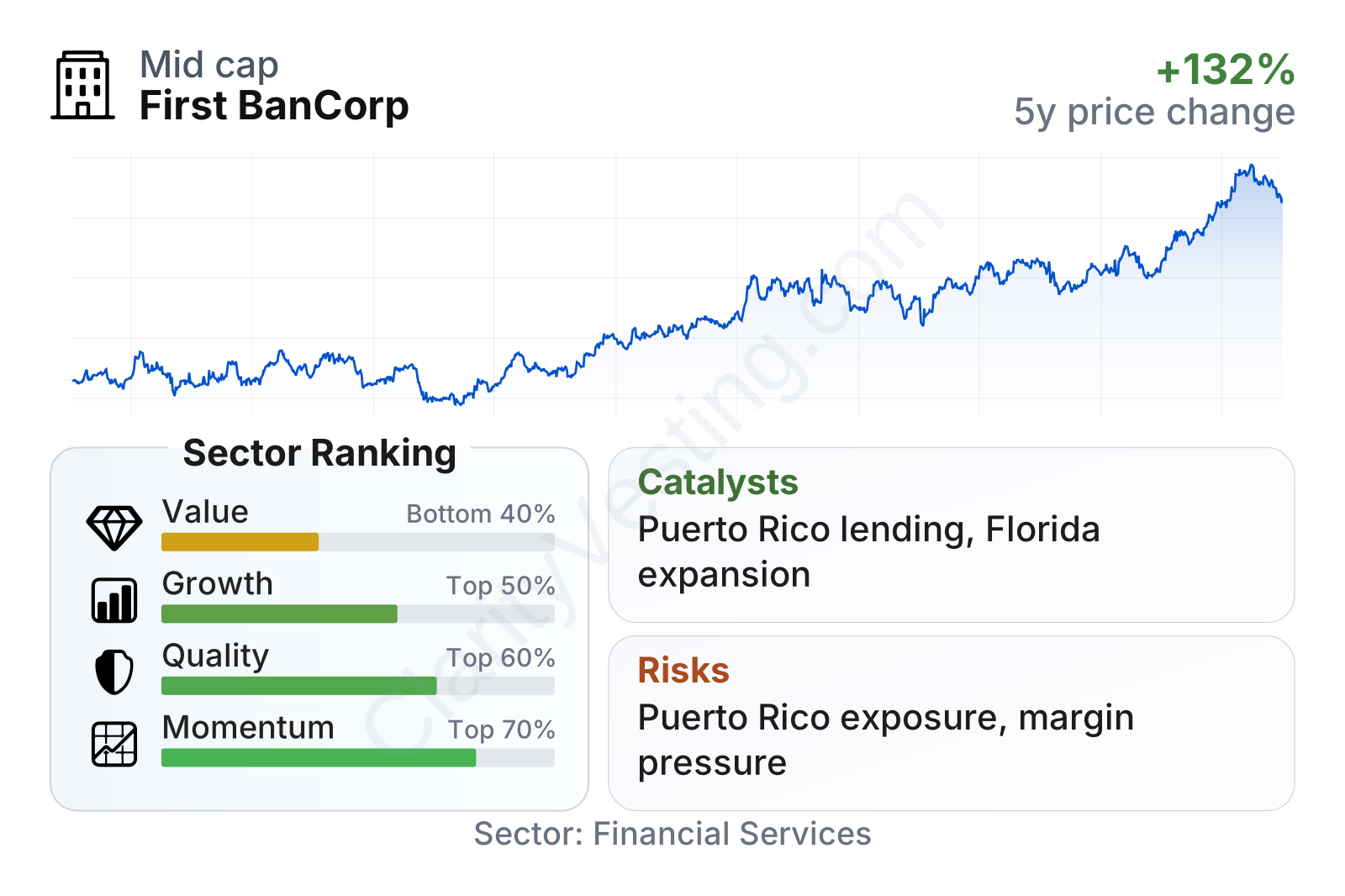
First BanCorp is a mid-sized regional bank with a market value around $4 billion and a beta below 1, which suggests the stock has been somewhat less volatile than the broader market. The company’s overall profile is mixed but generally constructive: growth ranks around the middle of the sector, quality is above average, and recent share-price momentum has been stronger than many peers. Value metrics are less favorable because the stock now trades at a premium on price-to-book versus the regional bank median, even though its earnings multiple remains close to the sector range.
The stock price trend has been especially strong since 2023, reflecting improving confidence in earnings power and balance sheet quality. At the same time, the dividend yield has moved lower as the stock advanced, so the current income component looks more ordinary than exceptional.
Growth
Banking is not a fast-growing sector in the same way as software or semiconductors, but regional banks can still grow steadily through loan expansion, disciplined pricing, market share gains, and higher fee income. First BanCorp operates in markets where local relationships matter, especially Puerto Rico, giving it a practical path to grow without needing a national footprint. Puerto Rico’s economy has also benefited in recent years from post-hurricane rebuilding, federal support, infrastructure work, and tourism activity, all of which can support credit demand and transaction volumes.
The company’s strategy appears sensible for long-term growth because it is built on core banking rather than aggressive expansion into unfamiliar businesses. Management has emphasized deposit franchise stability, commercial and consumer lending, and profitability discipline. Florida also adds a useful second engine outside Puerto Rico, helping diversify the business base over time.
Earnings per share have shown a clear upward trend from 2021 through 2025. That suggests the bank has not only benefited from a stronger rate environment but has also translated that backdrop into real bottom-line progress. While bank earnings can fluctuate with interest rates and credit costs, the recent pattern points to a business that has been compounding profit better than many people may expect from a regional lender.
Book value per share also recovered strongly after the 2022 drop and moved to a new high by 2025. For banks, book value is an especially important measure because it reflects the capital base supporting the lending franchise. Rising book value alongside rising earnings is usually a favorable sign: it suggests profit is not being achieved by hollowing out the balance sheet.
One additional growth catalyst is the sector backdrop. If U.S. interest rates stabilize or decline moderately, some banks may benefit from reduced deposit pricing pressure. That could support margins, provided loan yields remain healthy and credit quality stays under control. Another potential catalyst is continued economic normalization in Puerto Rico, where stronger household balance sheets, business activity, and construction demand can translate into more lending opportunities.
Recent company results and capital actions also support the idea that management sees the franchise as healthy. The combination of solid earnings, continued dividend support, and improving tangible value metrics suggests the bank is operating from a position of strength rather than repair.
Risks
This article is for informational purposes only and does not constitute financial advice. Some content is AI-generated. See Disclaimer