Stock Analysis · Forbo Holding AG (FBOHY)
Overview
Forbo Holding AG is a Swiss industrial company focused on products used inside commercial, institutional, and industrial buildings. Its two main activities are flooring systems and movement systems. In simple terms, the company sells floor coverings used in places such as hospitals, schools, offices, stores, and public buildings, and it also makes specialized conveyor and power transmission belts used in manufacturing and logistics.
Based on the company’s recent annual reporting structure, revenue is mainly generated from the following businesses:
- Flooring Systems: about 65% to 70% of revenue. This includes linoleum, vinyl flooring, entrance flooring systems, carpet tiles, and related installation products used in commercial and public buildings.
- Movement Systems: about 30% to 35% of revenue. This includes conveyor belts, processing belts, flat belts, timing belts, and other engineered belting products used in food processing, logistics, manufacturing, and machinery.
The flooring business is more exposed to construction, renovation, and institutional spending, while the belting business is tied more closely to industrial activity and automation. Geographically, Forbo is diversified across Europe, the Americas, and Asia-Pacific, with Europe remaining its largest region.
One visible trend in the business mix over the last several years is that revenue has gradually declined from the 2021 peak, while profitability has narrowed more sharply than sales. That points to a company that still generates healthy gross profit, but has faced pressure from volumes, pricing balance, and operating cost absorption.
The profit flow shows a resilient gross margin structure, but also a clear compression in operating income and net income since 2021. Sales have come down moderately, yet earnings have fallen faster, which suggests weaker operating leverage rather than a collapse in the core business.
Key Figures
| Metric | Value | Sector ⓘ |
|---|---|---|
| Date | Oct 03, 2026 | |
| Context | ||
| Sector | Industrials | |
| Industry | Building Products & Equipment | |
| Market Cap ⓘ | $1.50B | |
| Beta ⓘ | 0.87 | |
Value (Cheapness) | ||
| P/E Ratio ⓘ | 18.54 | 22.45 |
| P/B Ratio ⓘ | 2.26 | 1.98 |
| FCF Yield ⓘ | 11.28% | 6.31% |
| Dividend Yield ⓘ | 3.03% | 1.96% |
| EBIT / EV ⓘ | N/A | 4.81% |
| PEG ⓘ | N/A | |
Growth (Business expansion) | ||
| Revenue Growth ⓘ | -0.20% | 9.10% |
| RPS Growth (5Y CAGR) ⓘ | -2.55% | 7.75% |
| EPS Growth (5Y CAGR) ⓘ | -17.94% | -13.59% |
| BVPS Growth (5Y CAGR) ⓘ | 7.98% | 6.22% |
| Margin Growth (5Y Trend) ⓘ | -5.89% | 0.72% |
| FCF Growth (5Y CAGR) ⓘ | -34.91% | 10.98% |
| DPS Growth (5Y CAGR) ⓘ | 4.03% | 9.48% |
Quality (Business durability) | ||
| ROIC (Latest) ⓘ | 21.07% | 10.92% |
| ROA (Latest) ⓘ | 13.31% | 5.41% |
| ROIC (5Y Median) ⓘ | 19.07% | 9.21% |
| ROA (5Y Median) ⓘ | 10.31% | 4.94% |
| Net Debt / EBIT (Latest) ⓘ | -0.06 | 2.07 |
| Net Debt / EBIT (5Y Median) ⓘ | -0.49 | 2.28 |
| Net Debt / EBITDA (Latest) ⓘ | -0.04 | 1.43 |
| Net Debt / Assets ⓘ | -1.02% | 19.27% |
| EBITDA / Interest ⓘ | N/A | 9.53 |
| Operating Margin (Latest) ⓘ | 8.85% | 10.50% |
| Operating Margin (5Y Median) ⓘ | 10.99% | 10.27% |
| Debt to Equity (Latest) ⓘ | 6.64% | 65.48% |
| Profit Margin (Latest) ⓘ | 6.12% | 6.62% |
| Free Cash Flow (Latest) ⓘ | $169.34M | |
Momentum (Price trend) | ||
| 3Y Return ⓘ | -25.97% | +58.56% |
| 12M Return (excl. last month) ⓘ | +5.18% | +15.63% |
| 6M Return ⓘ | +2.92% | +4.19% |
| Price vs. 200-Day MA ⓘ | -11.26% | +0.93% |
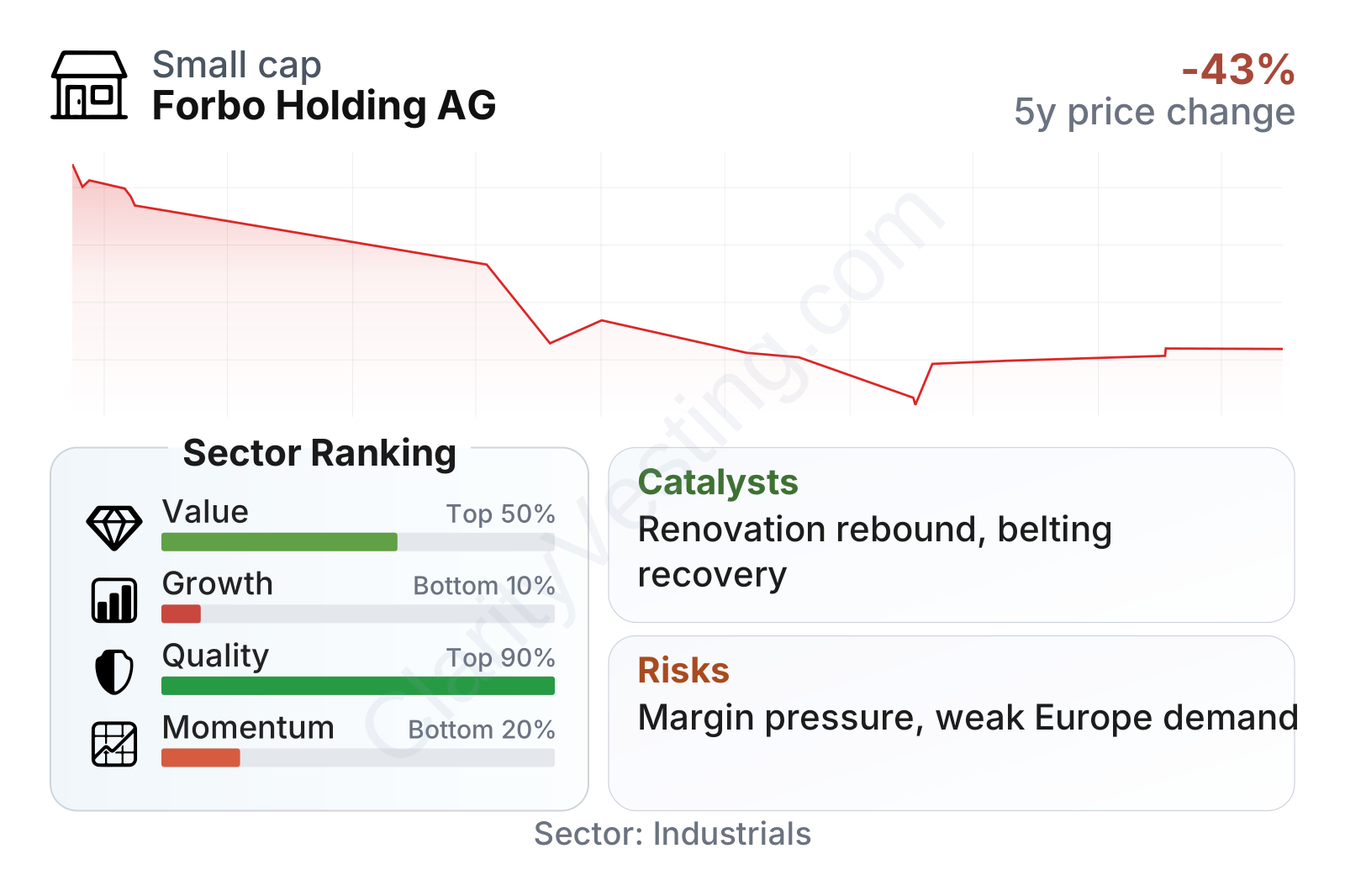
Forbo is a small-to-mid-sized industrial company with a relatively calm trading profile, as indicated by a beta below 1. Financial quality stands out much more than growth. Returns on capital and assets are well above the sector median, and the balance sheet is unusually strong for an industrial company, with very low leverage and even a net cash position on some measures.
On valuation-related metrics, the shares appear less demanding than the sector on earnings and more favorable on free cash flow yield and dividend yield. However, that needs to be weighed against weak recent growth, softer margins than the company’s own historical levels, and muted share-price momentum versus peers.
The long-term stock chart reflects this tension clearly: the share price sits far below its 2021 level and has been broadly flat more recently. That usually signals a market waiting for evidence that earnings have stabilized and that volumes can recover.
Growth
Forbo operates in end markets that are mature, but not structurally obsolete. Flooring for healthcare, education, public buildings, transportation, and commercial renovation benefits from long product cycles, recurring replacement needs, stricter sustainability standards, and demand for durable interior materials. On the movement systems side, conveyor and processing belts are linked to manufacturing efficiency, logistics, food processing, and automation trends that should remain relevant over time.
The company’s strategy is logical for these markets. Flooring Systems is positioned around commercial and institutional applications where performance, hygiene, durability, and environmental credentials matter more than pure price. That is particularly relevant for linoleum, where Forbo has a strong reputation and where natural-material positioning can benefit from green building requirements. Movement Systems adds a second growth engine that is less dependent on office construction and more exposed to industrial automation and production efficiency.
A meaningful catalyst is any recovery in non-residential renovation and public-sector building activity in Europe and other developed markets. Another is the normalization of industrial demand for belting products after a weaker period. If volumes recover while the company keeps its balance-sheet discipline, earnings can improve faster than revenue because margins have already compressed from earlier levels.
Recent company communications have also highlighted continued product development, sustainability initiatives, and targeted investments in production and commercial capabilities. None of these alone transform the growth profile, but together they support Forbo’s ability to defend pricing and remain relevant in specification-driven markets such as healthcare and education interiors.
Risks
This article is for informational purposes only and does not constitute financial advice. Some content is AI-generated. See Disclaimer