Stock Analysis · First Bancorp (FBNC)
Overview
First Bancorp is the bank holding company for First Bank, a regional bank headquartered in North Carolina. It provides traditional banking services to individuals, small businesses, and commercial clients, with a footprint centered in the Southeast. Its business is straightforward: gather deposits, make loans, earn interest on those loans and securities, and add fee income from services such as wealth management, card activity, and mortgage-related operations.
For a bank like First Bancorp, revenue is best understood through its operating mix rather than by product sales. Based on its recent annual reporting, the company’s income is dominated by net interest income, with noninterest income playing a secondary role.
- Net interest income: approximately 75% to 85% of total revenue in recent periods. This is the spread between what the bank earns on loans and securities and what it pays on deposits and borrowings. It is the core engine of the business.
- Noninterest income: approximately 15% to 25% of total revenue. This includes service charges on deposit accounts, debit and credit card income, wealth and investment services, mortgage banking income, and other banking-related fees.
On the asset side, the loan book is the main source of earning power. Commercial real estate, commercial and industrial lending, construction, residential mortgage, and consumer loans all contribute, with business-focused lending typically representing the largest share for regional banks in this model. On the funding side, customer deposits are the primary source of financing, which is important because lower-cost deposits usually support better profitability over time.
The broader earnings path over the last several years shows a familiar regional-bank pattern: revenue expanded sharply as rates rose, but higher deposit costs and funding pressure reduced how much of that revenue turned into profit. The business remains profitable and relatively simple to understand, but margin management is central to the long-term case.
Revenue has stayed at a relatively elevated level since 2023, but profitability has been more volatile because interest expense rose much faster than earlier in the cycle. That helps explain why recent earnings did not rise in line with total revenue.
Key Figures
| Metric | Value | Sector ⓘ |
|---|---|---|
| Date | Oct 24, 2026 | |
| Context | ||
| Sector | Financial Services | |
| Industry | Banks - Regional | |
| Market Cap ⓘ | $2.53B | |
| Beta ⓘ | 0.85 | |
Value (Cheapness) | ||
| P/E Ratio ⓘ | 18.96 | 12.46 |
| P/B Ratio ⓘ | 1.45 | 1.25 |
| FCF Yield ⓘ | 8.98% | 9.82% |
| Dividend Yield ⓘ | 1.53% | 2.94% |
| EBIT / EV ⓘ | 2.39% | 8.11% |
| PEG ⓘ | 1.56 | |
Growth (Business expansion) | ||
| Revenue Growth ⓘ | 16.00% | 9.10% |
| RPS Growth (5Y CAGR) ⓘ | 9.55% | 12.31% |
| EPS Growth (5Y CAGR) ⓘ | -4.34% | -6.97% |
| BVPS Growth (5Y CAGR) ⓘ | 3.74% | 5.02% |
| Margin Growth (5Y Trend) ⓘ | -10.48% | -4.00% |
| FCF Growth (5Y CAGR) ⓘ | 11.32% | 4.71% |
| DPS Growth (5Y CAGR) ⓘ | 9.64% | 8.92% |
Quality (Business durability) | ||
| ROIC (Latest) ⓘ | 2.41% | 9.18% |
| ROE (Latest) ⓘ | 9.75% | 13.93% |
| ROA (Latest) ⓘ | 1.27% | 1.57% |
| ROIC (5Y Median) ⓘ | 7.38% | 7.80% |
| ROE (5Y Median) ⓘ | 8.66% | 12.15% |
| ROA (5Y Median) ⓘ | 0.92% | 1.28% |
| Net Debt / EBIT (Latest) ⓘ | -1.13 | 1.02 |
| Net Debt / EBIT (5Y Median) ⓘ | -0.50 | 0.72 |
| Net Debt / EBITDA (Latest) ⓘ | -0.87 | 0.88 |
| Operating Margin (Latest) ⓘ | 11.13% | 22.30% |
| Operating Margin (5Y Median) ⓘ | 26.56% | 24.50% |
| Debt to Equity (Latest) ⓘ | 4.35% | 59.34% |
| Profit Margin (Latest) ⓘ | 32.44% | 26.42% |
| Free Cash Flow (Latest) ⓘ | $226.98M | |
Momentum (Price trend) | ||
| 3Y Return ⓘ | +151.64% | +95.73% |
| 12M Return (excl. last month) ⓘ | +21.25% | +17.30% |
| 6M Return ⓘ | +11.45% | +6.07% |
| Price vs. 200-Day MA ⓘ | +6.76% | +5.36% |
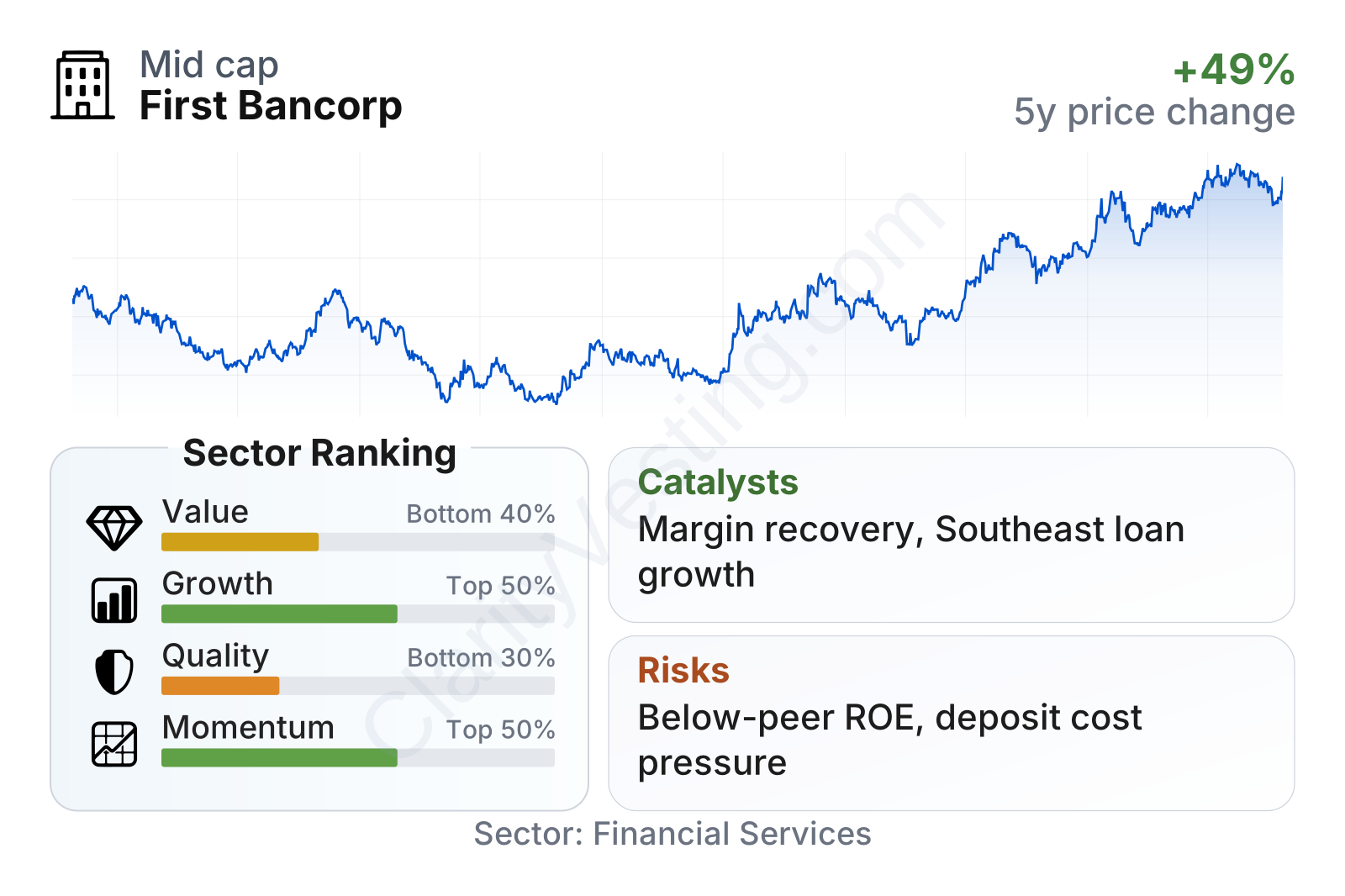
First Bancorp is a mid-sized regional bank with a market value in the low single-digit billions and a below-market beta, suggesting the shares have not been unusually volatile relative to the broader market. The stock’s multi-year price performance has been strong, but the factor mix is more mixed than the share chart alone suggests. Growth and quality rankings sit in the lower part of the regional-bank group, while momentum is closer to the middle. Value metrics also do not screen as especially cheap versus peers, with both earnings and book-based multiples running above sector medians. In short, the market is assigning a fairly solid valuation to a bank whose profitability measures still look below peer norms.
Growth
Regional banking is not a high-growth industry in the way software or semiconductors can be, but it can still compound steadily through loan growth, branch expansion, market share gains, and disciplined acquisitions. First Bancorp operates in Southeastern markets that have generally benefited from population growth, business formation, and migration from other parts of the United States. That gives the company an underlying tailwind, especially in commercial lending and deposit gathering.
The company’s strategy also makes sense in practical terms. It focuses on relationship banking in attractive local markets rather than trying to compete nationally on scale. For a regional bank, that can be a sensible route to growth because local knowledge matters in credit underwriting, small-business relationships, and commercial real estate lending. Its acquisitions in past years also helped broaden the franchise and support revenue expansion.
Earnings per share show that growth has not been linear. Results were strong in 2021 and 2022, then weakened in 2023 and 2024 as funding costs rose and industry conditions became less favorable, before improving again in 2025. That pattern suggests the franchise still has earning power, but its profitability remains sensitive to the interest-rate cycle.
Book value per share has moved upward over time despite the pressure on earnings, which is an encouraging sign for a bank. It indicates that capital has continued to build, even if not at an especially fast rate compared with many peers. For long-term analysis, book value matters because it reflects how much balance-sheet value is being accumulated behind each share.
A meaningful catalyst is the possibility of improved net interest margin if deposit costs stabilize or decline faster than loan yields. Another support factor is that recent year-over-year revenue growth has been better than the sector median, showing that business volume and asset yields have held up reasonably well. If management can convert that revenue strength into better returns, earnings growth could become more durable rather than simply cyclical.
Recent company communications and filings have also pointed to continued focus on loan production, deposit mix, capital strength, and expense control. For a bank in this position, those are the right levers: protect credit quality, defend the deposit base, and let a more normal funding environment do some of the work.
Risks
This article is for informational purposes only and does not constitute financial advice. Some content is AI-generated. See Disclaimer


