Stock Analysis · Fortune Brands Innovations Inc (FBIN)
Overview
Fortune Brands Innovations is a building products company focused on the home. Its brands are concentrated in areas that homeowners use every day: water, outdoor space, and security. In practical terms, the company sells products such as kitchen and bath fixtures, pipes and connectors, decking and railings, and locks and access systems. Its business is tied closely to residential construction, remodeling, repair activity, and to a lesser extent commercial demand.
The company reports revenue through three main segments. Based on its recent annual reporting mix, the business is broadly divided as follows:
- Water Innovations: about 42% to 45% of revenue. This includes faucets, sinks, waste disposals, showering products, sanitaryware, and connected water-management products, largely under brands such as Moen and House of Rohl.
- Outdoors: about 30% to 33% of revenue. This segment includes composite decking, railing, trim, pergolas, and related outdoor-living products, led by the Fiberon brand.
- Security: about 24% to 27% of revenue. This includes locks, safety and security products, and connected access solutions, including Master Lock and SentrySafe.
This mix matters because it gives the company exposure to both repair-and-remodel spending and new housing construction. It also reduces dependence on a single product category, even though all three segments still depend on the broader health of the housing and home-improvement cycle.
Over the last several years, total revenue has drifted lower from roughly $4.8 billion in 2021 to about $4.5 billion in 2025. At the same time, gross profit has held up better than sales, which suggests the company still has pricing power and recognizable brands, but operating profit and net income have become more pressured as overhead and interest costs absorbed a larger share of revenue.
Key Figures
| Metric | Value | Sector ⓘ |
|---|---|---|
| Date | Oct 24, 2026 | |
| Context | ||
| Sector | Industrials | |
| Industry | Building Products & Equipment | |
| Market Cap ⓘ | $4.87B | |
| Beta ⓘ | 1.39 | |
Value (Cheapness) | ||
| P/E Ratio ⓘ | 32.90 | 22.29 |
| P/B Ratio ⓘ | 2.12 | 1.98 |
| FCF Yield ⓘ | 8.23% | 6.26% |
| Dividend Yield ⓘ | 2.54% | 1.92% |
| EBIT / EV ⓘ | 3.70% | 4.83% |
| PEG ⓘ | 1.37 | |
Growth (Business expansion) | ||
| Revenue Growth ⓘ | -4.10% | 9.30% |
| RPS Growth (5Y CAGR) ⓘ | 1.71% | 7.76% |
| EPS Growth (5Y CAGR) ⓘ | -27.67% | -13.17% |
| BVPS Growth (5Y CAGR) ⓘ | -2.68% | 6.13% |
| Margin Growth (5Y Trend) ⓘ | -5.23% | 0.74% |
| FCF Growth (5Y CAGR) ⓘ | -6.23% | 10.79% |
| DPS Growth (5Y CAGR) ⓘ | -0.74% | 9.41% |
Quality (Business durability) | ||
| ROIC (Latest) ⓘ | 4.18% | 10.75% |
| ROA (Latest) ⓘ | 2.32% | 5.41% |
| ROIC (5Y Median) ⓘ | 10.73% | 9.37% |
| ROA (5Y Median) ⓘ | 7.19% | 4.95% |
| Net Debt / EBIT (Latest) ⓘ | 9.65 | 2.04 |
| Net Debt / EBIT (5Y Median) ⓘ | 3.37 | 2.27 |
| Net Debt / EBITDA (Latest) ⓘ | 5.81 | 1.39 |
| Net Debt / Assets ⓘ | 40.84% | 19.27% |
| EBITDA / Interest ⓘ | 5.36 | 9.58 |
| Operating Margin (Latest) ⓘ | 6.11% | 10.49% |
| Operating Margin (5Y Median) ⓘ | 15.75% | 10.30% |
| Debt to Equity (Latest) ⓘ | 121.29% | 64.82% |
| Profit Margin (Latest) ⓘ | 3.39% | 6.67% |
| Free Cash Flow (Latest) ⓘ | $400.50M | |
Momentum (Price trend) | ||
| 3Y Return ⓘ | -24.86% | +67.77% |
| 12M Return (excl. last month) ⓘ | -27.31% | +12.05% |
| 6M Return ⓘ | +2.69% | 0.00% |
| Price vs. 200-Day MA ⓘ | -9.24% | +0.67% |
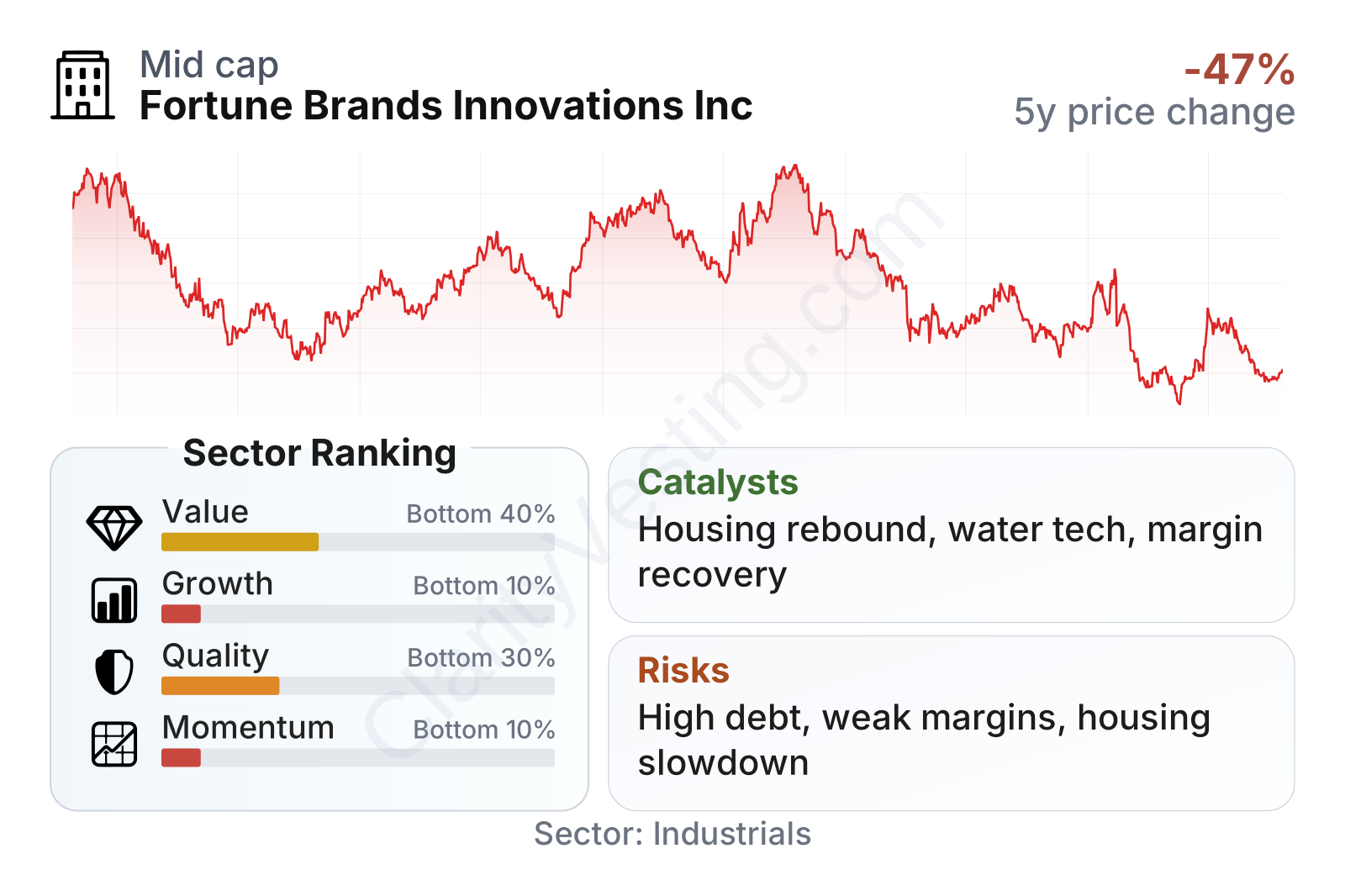
Fortune Brands is a mid-sized company in its sector, and the recent factor profile is mixed. Income generation for shareholders is supported by a free cash flow yield and dividend yield that are both above the sector median, but growth, quality, and market momentum rank weaker relative to peers. The stock has also shown above-average volatility, with a beta around 1.37, meaning it has tended to move more than the broader market.
The market’s recent view has been cautious. The share price is well below its 2024 high and remains much weaker than many industry peers over the last three years. That weak performance reflects a combination of slower sales, lower margins, and concerns about leverage rather than a collapse in the underlying business franchise.
Growth
Fortune Brands operates in a sector with long-term demand drivers, but near-term conditions have been difficult. Housing turnover, affordability pressure, and softer discretionary spending can weigh on products tied to remodeling and home purchases. Over a longer horizon, however, the company still sits in markets supported by aging housing stock, renovation demand, water management needs, outdoor living upgrades, and the gradual shift toward connected home products.
Its strategy broadly makes sense for future growth because it focuses on branded categories where design, reliability, distribution, and product ecosystems matter. Water products and connected solutions are especially important because they can carry better margins and create repeat demand across repair, replacement, and premium upgrade cycles. Outdoor living also remains an attractive category over time, particularly in composite materials that can take share from traditional wood.
The main issue is that recent growth has been weak. Revenue has been negative year over year in the latest periods, including a decline of roughly 4% most recently, while the broader sector median has been positive. That does not necessarily mean the end markets are structurally unattractive; it suggests the company is still working through a cyclical slowdown and has not yet re-established consistent expansion.
Cash generation remains an important support. Free cash flow is still solid in absolute terms, near $400 million on a trailing basis, even though it has come down from stronger levels seen in 2023 and 2024. This matters because cash flow can fund dividends, debt reduction, and selective investment even when earnings are under pressure.
One meaningful catalyst is any improvement in the U.S. housing and remodeling environment. Lower financing pressure, stabilization in existing-home transactions, or a better repair-and-remodel cycle could help all three segments at once. Another potential opportunity is the continued push into connected and water-management products, where Fortune Brands can combine physical hardware with higher-value features rather than competing only on price.
Recent company updates have also emphasized portfolio simplification, productivity actions, and brand-led innovation. Those are not overnight growth engines, but they can support a future rebound if volumes recover.
Risks
This article is for informational purposes only and does not constitute financial advice. Some content is AI-generated. See Disclaimer


