Stock Analysis · First National Bank Alaska (FBAK)
Overview
First National Bank Alaska is a regional bank headquartered in Alaska. It provides traditional banking services to individuals, businesses, and public-sector customers across the state. Its activities include taking deposits, making loans, processing payments, and offering related financial services such as trust and wealth management. Because it operates in a relatively concentrated geographic market, its results are closely tied to Alaska’s local economy, including commercial activity, real estate, government-related flows, and consumer finances.
Like most banks, its revenue is mainly driven by the spread between what it earns on loans and securities and what it pays on deposits and other funding. Based on the company’s annual filings and the structure typical of regional banks, the main sources of revenue are approximately:
- Net interest income: about 75% to 85% of total revenue. This is the core banking engine and includes interest earned on commercial loans, residential real estate lending, consumer loans, and the investment portfolio, minus interest paid on deposits and borrowings.
- Service charges and fees: about 5% to 10%. This generally includes deposit account fees, transaction-related charges, and other routine banking service income.
- Trust, brokerage, and wealth-related fees: about 3% to 8%. These activities add non-interest income and diversify the business beyond lending.
- Other non-interest income: about 3% to 8%. This can include bank card fees, mortgage banking-related items, gains or losses on securities and other smaller revenue streams.
The revenue mix still points to a straightforward banking model rather than a highly diversified financial group. That simplicity can be a strength when credit quality is sound and local relationships are durable, but it also means earnings remain sensitive to interest rates, deposit costs, and conditions in Alaska.
The business has shown a favorable earnings trend over the last several years. Total revenue moved up steadily from 2021 through 2025, while net income also improved overall. One notable feature is that funding costs rose sharply in 2023 and 2024 before easing in 2025, which helps explain some of the volatility in bank profitability during this period. Even with that pressure, the bank preserved solid earnings and then expanded them meaningfully.
Key Figures
| Metric | Value | Sector ⓘ |
|---|---|---|
| Date | Oct 17, 2026 | |
| Context | ||
| Sector | Financial Services | |
| Industry | Banks - Regional | |
| Market Cap ⓘ | $1.01B | |
| Beta ⓘ | 0.23 | |
Value (Cheapness) | ||
| P/E Ratio ⓘ | 12.12 | 12.26 |
| P/B Ratio ⓘ | 1.76 | 1.23 |
| FCF Yield ⓘ | N/A | 10.40% |
| Dividend Yield ⓘ | 2.48% | 3.02% |
| EBIT / EV ⓘ | N/A | 8.14% |
| PEG ⓘ | N/A | |
Growth (Business expansion) | ||
| Revenue Growth ⓘ | 8.40% | 9.35% |
| RPS Growth (5Y CAGR) ⓘ | 5.89% | 12.19% |
| EPS Growth (5Y CAGR) ⓘ | N/A | -9.53% |
| BVPS Growth (5Y CAGR) ⓘ | 0.66% | 4.99% |
| Margin Growth (5Y Trend) ⓘ | N/A | -3.86% |
| FCF Growth (5Y CAGR) ⓘ | -1.73% | 4.81% |
| DPS Growth (5Y CAGR) ⓘ | 5.74% | 8.79% |
Quality (Business durability) | ||
| ROIC (Latest) ⓘ | N/A | 9.49% |
| ROE (Latest) ⓘ | 14.38% | 13.90% |
| ROA (Latest) ⓘ | 1.62% | 1.55% |
| ROIC (5Y Median) ⓘ | N/A | 7.86% |
| ROE (5Y Median) ⓘ | 13.66% | 12.17% |
| ROA (5Y Median) ⓘ | 1.14% | 1.30% |
| Net Debt / EBIT (Latest) ⓘ | N/A | 0.96 |
| Net Debt / EBIT (5Y Median) ⓘ | N/A | 0.73 |
| Net Debt / EBITDA (Latest) ⓘ | N/A | 0.92 |
| Operating Margin (Latest) ⓘ | N/A | 22.30% |
| Operating Margin (5Y Median) ⓘ | N/A | 24.63% |
| Debt to Equity (Latest) ⓘ | N/A | 58.56% |
| Profit Margin (Latest) ⓘ | 37.14% | 26.57% |
| Free Cash Flow (Latest) ⓘ | N/A | |
Momentum (Price trend) | ||
| 3Y Return ⓘ | +117.68% | +88.33% |
| 12M Return (excl. last month) ⓘ | +32.17% | +19.38% |
| 6M Return ⓘ | +3.70% | +4.75% |
| Price vs. 200-Day MA ⓘ | +2.32% | +3.50% |
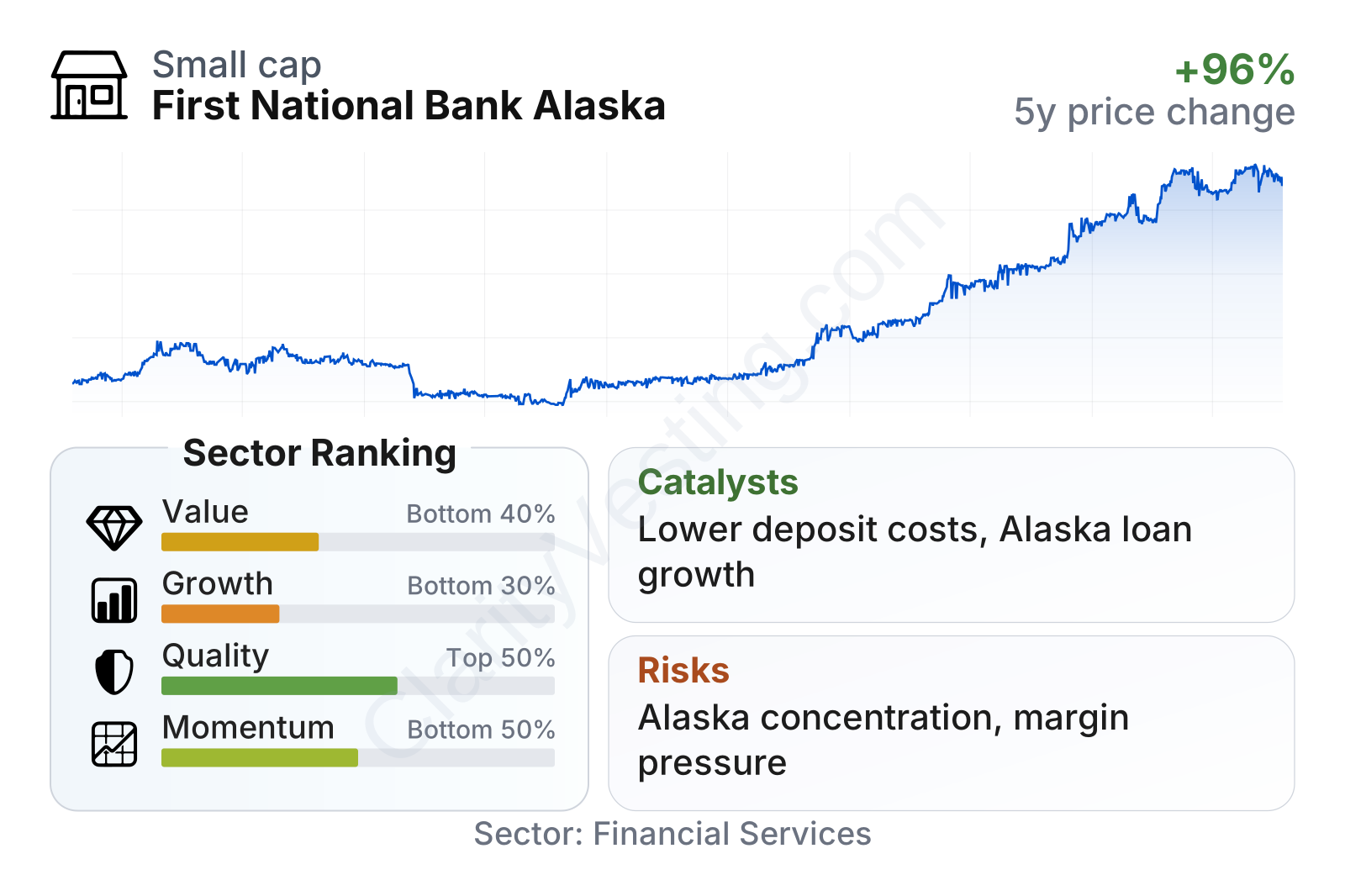
First National Bank Alaska is a small-cap regional bank with unusually low share-price volatility, as reflected by its very low beta. On quality measures, it stands around the middle to better side of the regional bank universe, supported by profitability that is slightly above sector medians. Growth metrics are less impressive, with slower expansion in revenue per share and book value per share than many peers. Valuation is more demanding than the sector average on price-to-book, while the earnings multiple is roughly in line with peers. Price momentum has been favorable, with the stock outperforming many regional banks over the last one to three years.
Growth
Banking is not a high-growth industry in the same way as software or semiconductors, but well-run regional banks can still grow steadily through loan expansion, deposit gathering, fee income, and disciplined cost control. In First National Bank Alaska’s case, the growth opportunity is tied less to disruptive industry change and more to local market position, balance-sheet discipline, and the ability to deepen relationships in a state where scale and reputation matter.
Its strategy appears coherent for that kind of environment. A bank with a longstanding presence in Alaska can benefit from local knowledge, established commercial relationships, and customer stickiness that may be harder for outside competitors to replicate. That is particularly relevant in business lending and municipal or community banking, where relationship depth often matters as much as price.
Earnings per share have been uneven, with a sharp drop in 2023 followed by a strong recovery in 2024 and a much stronger level in 2025. That pattern suggests the business is capable of producing solid profits, but not in a perfectly smooth line. The rebound is important because it indicates that the earnings pressure seen during the period of higher funding costs did not permanently impair the franchise.
Book value per share has also recovered after a large decline in 2022 and has been trending upward since then. For a bank, book value matters because it reflects the capital base supporting future lending and earnings. The improvement since 2023 is a constructive sign, even if the five-year growth pace remains modest compared with many peers.
One practical catalyst is the changing interest-rate environment. If deposit cost pressure continues to moderate while asset yields stay healthy, net interest income can improve. Another is continued economic activity in Alaska, especially in areas such as infrastructure, energy, transportation, and commercial real estate that can support business borrowing and treasury services. The company’s recent financial progression, including stronger revenue and net income in 2025, points to operating momentum rather than stagnation.
Recent developments visible in the company’s reported numbers support that idea: revenue reached a new high in 2025, net income also improved materially, and profitability metrics remain firm into early 2026. For a traditional bank, that combination is a meaningful indicator that core operations are functioning well.
Risks
This article is for informational purposes only and does not constitute financial advice. Some content is AI-generated. See Disclaimer


