Stock Analysis · Fastenal Company (FAST)
Overview
Fastenal Company is an industrial distributor. In simple terms, it helps businesses keep factories, construction sites, warehouses, and maintenance operations running by supplying the parts and consumables they use every day. Its catalog includes fasteners, safety products, tools, cutting tools, electrical supplies, janitorial items, and many other maintenance, repair, and operations products. The company also provides inventory management services through on-site locations, vending machines, and digital ordering tools placed close to customer workflows.
Its business model is built around being a reliable supply partner rather than just a seller of individual items. That matters because many of the products Fastenal distributes are low-cost items individually, but they are critical when a customer needs them immediately. A missing bolt, glove, drill bit, or safety component can slow production lines or delay field work. Fastenal’s value comes from product availability, local service, and systems that reduce stockouts for customers.
Revenue is diversified across product categories, customer types, and service models. Based on company reporting, the main sources of revenue are approximately:
- Safety supplies: about 22% of sales. This includes personal protective equipment and related workplace safety products.
- Fasteners: about 19% of sales. These are bolts, nuts, screws, anchors, and other fastening products, which remain a core category even though the mix has broadened over time.
- Other product categories combined: about 59% of sales. This broad group includes tools, cutting tools, abrasives, fluid transfer products, electrical supplies, janitorial and sanitation products, welding items, material handling, and other industrial consumables.
Fastenal also increasingly organizes the business around how it serves customers:
- Weighted toward larger business customers in manufacturing and non-residential construction.
- On-site locations inside or near customer facilities, where Fastenal manages supply access directly.
- Vending and installed inventory devices, which automate replenishment and strengthen customer retention.
The broad picture is that Fastenal has evolved from a fastener-focused distributor into a scaled industrial supply platform with a large recurring consumables base and embedded customer relationships.
The long-term pattern shows a business that has expanded revenue steadily while keeping a large share of gross profit and converting a meaningful portion into operating income and net income. Interest expense remains very small relative to earnings, which reflects a conservative balance sheet.
Key Figures
| Metric | Value | Sector ⓘ |
|---|---|---|
| Date | Oct 19, 2026 | |
| Context | ||
| Sector | Industrials | |
| Industry | Industrial Distribution | |
| Market Cap ⓘ | $58.55B | |
| Beta ⓘ | 0.69 | |
Value (Cheapness) | ||
| P/E Ratio ⓘ | 41.48 | 22.10 |
| P/B Ratio ⓘ | 14.14 | 1.97 |
| FCF Yield ⓘ | 1.80% | 6.42% |
| Dividend Yield ⓘ | 1.91% | 1.94% |
| EBIT / EV ⓘ | 3.18% | 4.79% |
| PEG ⓘ | 3.39 | |
Growth (Business expansion) | ||
| Revenue Growth ⓘ | 15.50% | 9.30% |
| RPS Growth (5Y CAGR) ⓘ | 8.17% | 7.81% |
| EPS Growth (5Y CAGR) ⓘ | 0.55% | -13.06% |
| BVPS Growth (5Y CAGR) ⓘ | 6.79% | 6.14% |
| Margin Growth (5Y Trend) ⓘ | 0.00% | 0.88% |
| FCF Growth (5Y CAGR) ⓘ | 14.39% | 11.01% |
| DPS Growth (5Y CAGR) ⓘ | 11.85% | 9.41% |
Quality (Business durability) | ||
| ROIC (Latest) ⓘ | 32.91% | 10.84% |
| ROA (Latest) ⓘ | 26.89% | 5.41% |
| ROIC (5Y Median) ⓘ | 31.14% | 9.38% |
| ROA (5Y Median) ⓘ | 25.12% | 4.95% |
| Net Debt / EBIT (Latest) ⓘ | 0.13 | 2.08 |
| Net Debt / EBIT (5Y Median) ⓘ | 0.21 | 2.27 |
| Net Debt / EBITDA (Latest) ⓘ | 0.12 | 1.40 |
| Net Debt / Assets ⓘ | 4.36% | 19.29% |
| EBITDA / Interest ⓘ | 553.46 | 9.56 |
| Operating Margin (Latest) ⓘ | 20.58% | 10.50% |
| Operating Margin (5Y Median) ⓘ | 20.26% | 10.29% |
| Debt to Equity (Latest) ⓘ | 10.89% | 65.48% |
| Profit Margin (Latest) ⓘ | 15.62% | 6.67% |
| Free Cash Flow (Latest) ⓘ | $1.05B | |
Momentum (Price trend) | ||
| 3Y Return ⓘ | +82.57% | +61.68% |
| 12M Return (excl. last month) ⓘ | +6.02% | +12.58% |
| 6M Return ⓘ | +15.32% | 0.00% |
| Price vs. 200-Day MA ⓘ | +9.97% | 0.00% |
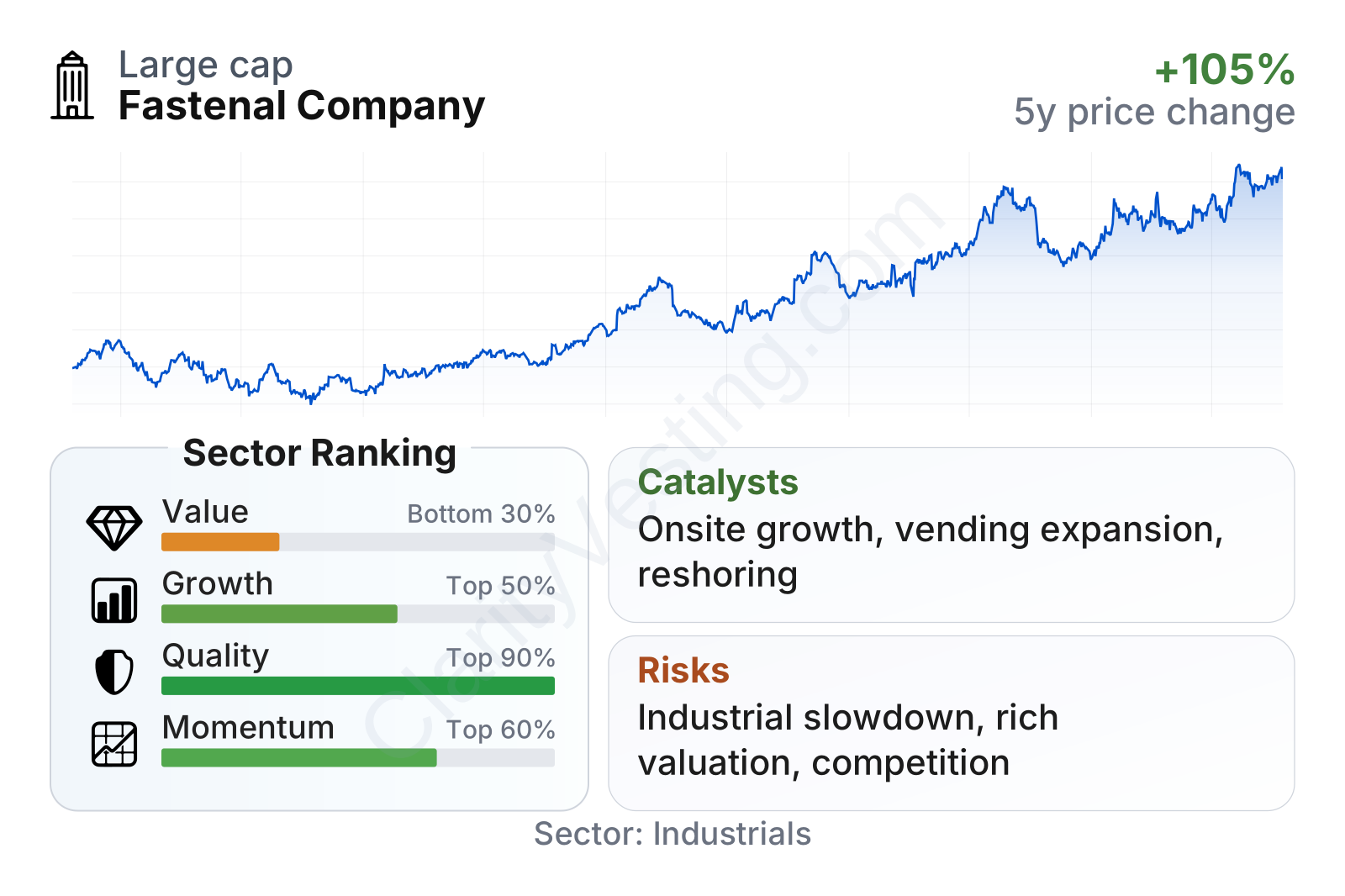
Fastenal stands out most on business quality. Profitability, returns on capital, and balance sheet strength are well above typical industrial peers, with very low leverage and unusually strong interest coverage. Growth metrics are solid rather than explosive, while the weakest area is valuation: the shares trade at clearly higher earnings and book multiples than the sector median, meaning the market is already placing a premium on the company’s consistency and efficiency.
Growth
Fastenal operates in a sector that should remain relevant for a very long time. Industrial distribution is not a flashy market, but it sits close to everyday economic activity. Factories, infrastructure projects, energy sites, repair operations, and logistics networks all need a constant flow of parts and consumables. That creates a durable baseline of demand, even if orders can fluctuate with the business cycle.
The company’s strategy for future expansion is coherent. Rather than chasing growth only through opening traditional branches, Fastenal has spent years deepening customer relationships through on-site programs, digital procurement links, and device-based inventory management. Those services make Fastenal harder to replace because they become part of the customer’s operating process. When a distributor manages inventory inside the workflow, the relationship is usually stickier than a simple catalog sale.
Recent revenue growth has re-accelerated after a slower stretch in 2023 and 2024. The latest year-over-year trend has moved back into the mid-teens, which is notably better than the broader sector median. That suggests the company is not only benefiting from end-market demand, but also continuing to capture share through its service model and product breadth.
Cash generation also supports the growth case. Free cash flow has moved above the $1 billion range again after some variability, showing that Fastenal is not depending on aggressive borrowing to expand. This matters because industrial distributors need working capital to support inventory, and strong cash generation gives the company flexibility to invest in technology, local service capacity, and shareholder returns without weakening the balance sheet.
A meaningful catalyst is the ongoing shift toward supply-chain simplification by large industrial customers. Many manufacturers want fewer vendors, better inventory visibility, and less downtime risk. Fastenal is well positioned for that trend because its vending devices, bin-stock programs, and on-site service solve operational problems, not just purchasing needs. Another catalyst is the company’s exposure to manufacturing activity in North America, including plant upgrades, automation, and industrial reshoring trends that can increase demand for maintenance and production supplies over time.
Recent company updates have also pointed to continued momentum in large customer accounts and technology-enabled supply programs. That does not guarantee a straight-line outcome, but it supports the view that Fastenal’s expansion is coming from repeatable operating initiatives rather than one-off events.
Risks
This article is for informational purposes only and does not constitute financial advice. Some content is AI-generated. See Disclaimer


