Stock Analysis · FirstRand Ltd (FANDY)
Overview
FirstRand Ltd is one of the largest banking groups in South Africa. It operates through a portfolio of well-known financial brands, mainly First National Bank (FNB), Rand Merchant Bank (RMB), WesBank, Aldermore in the United Kingdom, and Ashburton Investments. In simple terms, the group serves households, small businesses, large corporations, and institutional clients across everyday banking, lending, insurance-related products, wealth services, and investment banking.
The company makes most of its money from core banking activities: collecting deposits, lending money, charging banking fees, and earning income from corporate and investment banking services. Based on the group’s latest annual reporting structure, revenue is primarily tied to net interest income and non-interest revenue, with South Africa remaining the dominant earnings base and the rest coming from selected operations in the U.K. and other African markets.
The main revenue sources can be summarized as follows:
- Net interest income — approximately 55% to 65%: income earned from loans and advances after paying interest on deposits and funding. This includes mortgages, vehicle finance, business lending, and corporate credit.
- Fees and commissions — approximately 20% to 30%: account fees, card-related charges, transaction banking fees, advisory fees, and service charges across retail and commercial banking.
- Trading, investment, and capital markets income — approximately 10% to 15%: activity mainly linked to RMB, including markets, advisory, structuring, and treasury-related services.
- Insurance, wealth, and asset management income — less than 10%: contributions from investment products, wealth platforms, and related financial services.
Business mix matters here. FNB gives the group a large, recurring retail and commercial banking base, while RMB adds exposure to higher-value corporate and investment banking. WesBank expands the lending franchise through vehicle and asset finance, and Aldermore gives FirstRand a foothold in the U.K. specialist banking market. That combination makes the group more diversified than a traditional domestic retail bank, although South Africa still drives the overall picture.
The long-term pattern in the business remains broadly favorable: revenue and profit expanded meaningfully from 2022 through 2025, while 2026 appears softer on a reported basis. Even so, profitability stayed solid rather than collapsing, which suggests a business with meaningful earnings resilience despite a less supportive period.
The flow of income shows a business that has grown materially over the last several years, with net income rising from the low-30-billion-rand range to the mid-40-billion-rand range before easing in the latest year. The recent pullback looks more like moderation after strong growth than a break in the franchise.
Key Figures
| Metric | Value | Sector ⓘ |
|---|---|---|
| Date | Oct 17, 2026 | |
| Context | ||
| Sector | Financial Services | |
| Industry | Banks - Diversified | |
| Market Cap ⓘ | $29.08B | |
| Beta ⓘ | 0.56 | |
Value (Cheapness) | ||
| P/E Ratio ⓘ | 12.88 | 12.26 |
| P/B Ratio ⓘ | 0.15 | 1.23 |
| FCF Yield ⓘ | -238.58% | 10.40% |
| Dividend Yield ⓘ | 6.28% | 3.02% |
| EBIT / EV ⓘ | N/A | 8.14% |
| PEG ⓘ | N/A | |
Growth (Business expansion) | ||
| Revenue Growth ⓘ | 9.90% | 9.35% |
| RPS Growth (5Y CAGR) ⓘ | 3.87% | 12.19% |
| EPS Growth (5Y CAGR) ⓘ | 48.24% | -9.53% |
| BVPS Growth (5Y CAGR) ⓘ | 4.36% | 4.99% |
| Margin Growth (5Y Trend) ⓘ | -2.91% | -3.86% |
| FCF Growth (5Y CAGR) ⓘ | 71.58% | 4.81% |
| DPS Growth (5Y CAGR) ⓘ | N/A | 8.79% |
Quality (Business durability) | ||
| ROIC (Latest) ⓘ | 21.16% | 9.49% |
| ROE (Latest) ⓘ | 37.52% | 13.90% |
| ROA (Latest) ⓘ | 3.05% | 1.55% |
| ROIC (5Y Median) ⓘ | 12.27% | 7.86% |
| ROE (5Y Median) ⓘ | 19.77% | 12.17% |
| ROA (5Y Median) ⓘ | 1.73% | 1.30% |
| Net Debt / EBIT (Latest) ⓘ | -0.31 | 0.96 |
| Net Debt / EBIT (5Y Median) ⓘ | 0.96 | 0.73 |
| Net Debt / EBITDA (Latest) ⓘ | -0.27 | 0.92 |
| Operating Margin (Latest) ⓘ | 28.56% | 22.30% |
| Operating Margin (5Y Median) ⓘ | 38.58% | 24.63% |
| Debt to Equity (Latest) ⓘ | 33.50% | 58.56% |
| Profit Margin (Latest) ⓘ | 28.19% | 26.57% |
| Free Cash Flow (Latest) ⓘ | -$69.38B | |
Momentum (Price trend) | ||
| 3Y Return ⓘ | +101.96% | +88.33% |
| 12M Return (excl. last month) ⓘ | +50.76% | +19.38% |
| 6M Return ⓘ | +5.98% | +4.75% |
| Price vs. 200-Day MA ⓘ | +34.03% | +3.50% |
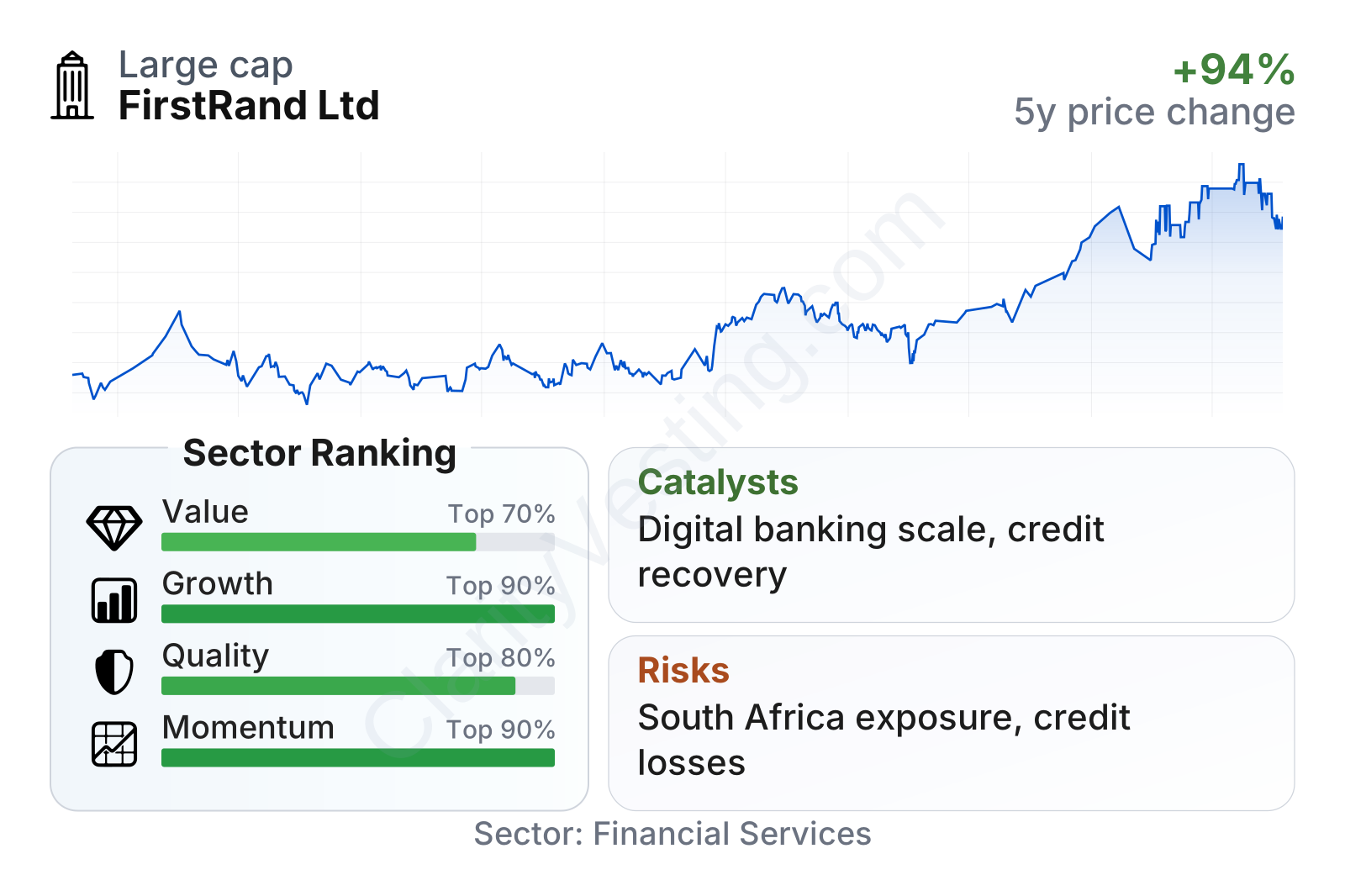
FirstRand stands out more on quality and shareholder returns than on fast expansion. Profitability ratios are comfortably above sector medians, the balance sheet appears conservatively positioned relative to many financial peers, and the dividend yield is notably stronger than the sector median. Growth is more mixed: recent year-over-year revenue growth is healthy, but the longer five-year revenue-per-share trend is less impressive. Market performance has been strong, with the shares materially outperforming the broader sector over the last 12 months and over three years, while volatility remains relatively moderate.
Growth
FirstRand operates in a sector that is mature in its home market but still capable of steady long-term expansion. Banking growth in South Africa is linked to household credit demand, business investment, payments activity, and economic confidence. That does not usually create rapid growth, but it can support durable earnings when a bank has strong customer franchises, pricing discipline, and broad product coverage.
The company’s strategy makes sense for that environment. FNB has continued to build digital banking and deepen client relationships, which is important because modern banking growth is not just about opening new branches or writing more loans. It is increasingly about keeping customers active across payments, lending, savings, insurance, and wealth products. RMB adds another engine through corporate and investment banking, while Aldermore gives FirstRand exposure to a different market and a specialist lending platform outside South Africa.
Earnings momentum should be read with some caution because the latest chart includes a zero value that is unlikely to represent the underlying economics of the business. The broader picture from reported annual results is that FirstRand delivered a strong earnings climb over several years before a more recent slowdown. That profile points to a bank with expansion capacity, but not one currently delivering uninterrupted acceleration.
Book value per share has generally trended upward over time, which is important for banks because book value reflects the capital base supporting future lending and earnings. One reading in the series appears distorted, but outside that anomaly the long-term direction still suggests value creation through retained profits and disciplined capital management.
One of the clearest catalysts is digital scale. Banks with large customer ecosystems can raise fee income, lower servicing costs, and improve retention when customers use more products in one platform. Another support factor is the company’s broad reach across consumer, commercial, corporate, and specialist lending niches. If South African rates ease over time and credit demand improves, that could also support loan growth and asset quality. In addition, FirstRand has room to keep benefiting from cross-selling between its large retail franchise and its business banking and wealth operations.
Recent company reporting also points to continued investment in digital capabilities, transaction banking, and customer acquisition. Those are not overnight drivers, but they matter for a long-duration banking franchise because they can strengthen market share and reduce dependence on purely cyclical lending growth.
Risks
This article is for informational purposes only and does not constitute financial advice. Some content is AI-generated. See Disclaimer


