Stock Analysis · Experian plc PK (EXPGY)
Overview
Experian is a global data and analytics company best known for credit reporting, credit scoring, identity verification, fraud prevention, and consumer credit services. Banks, lenders, insurers, retailers, telecom companies, health-care organizations, automotive businesses, and governments use its information tools to assess risk, verify identities, market products, and make faster decisions. On the consumer side, Experian also sells credit monitoring, identity protection, and related subscription services.
The business is built around large proprietary databases, software platforms, and analytics models. That combination makes Experian more than a simple credit bureau: it is also a recurring-revenue technology and decisioning company with a meaningful presence in financial services, digital identity, and fraud prevention.
Based on the latest annual reporting, revenue is spread across several operating areas and geographies rather than one single product. The broad mix is important because it reduces dependence on any single lending market.
- Business-to-Business data, analytics, and decisioning services: approximately 80% to 85% of revenue. This includes credit bureau services, decisioning software, fraud and identity tools, marketing services, and industry-specific analytics sold to enterprises.
- Consumer Services: approximately 15% to 20% of revenue. This mainly includes direct-to-consumer credit monitoring, credit score access, identity protection, and subscription products.
By geography, the company is heavily exposed to North America, with meaningful contributions from Latin America, the United Kingdom and Ireland, and EMEA/Asia-Pacific. In practice, the United States remains the economic core of the group, especially in consumer credit, identity, and decisioning.
Recent financial flow trends point to a business that has been expanding steadily. Revenue has increased from roughly $6.3 billion in fiscal 2022 to about $8.4 billion in fiscal 2026, while operating income and net income have also moved higher. The cost base has grown, but profitability has remained solid, showing that scale is still working in Experian’s favor.
Key Figures
| Metric | Value | Sector ⓘ |
|---|---|---|
| Date | Oct 22, 2026 | |
| Context | ||
| Sector | Industrials | |
| Industry | Consulting Services | |
| Market Cap ⓘ | $34.94B | |
| Beta ⓘ | 0.90 | |
Value (Cheapness) | ||
| P/E Ratio ⓘ | 24.47 | 22.29 |
| P/B Ratio ⓘ | 6.51 | 1.98 |
| FCF Yield ⓘ | N/A | 6.26% |
| Dividend Yield ⓘ | 1.74% | 1.92% |
| EBIT / EV ⓘ | 3.44% | 4.83% |
| PEG ⓘ | 1.22 | |
Growth (Business expansion) | ||
| Revenue Growth ⓘ | 12.30% | 9.30% |
| RPS Growth (5Y CAGR) ⓘ | 8.33% | 7.76% |
| EPS Growth (5Y CAGR) ⓘ | 1.75% | -13.17% |
| BVPS Growth (5Y CAGR) ⓘ | 8.96% | 6.13% |
| Margin Growth (5Y Trend) ⓘ | 2.43% | 0.74% |
| FCF Growth (5Y CAGR) ⓘ | 4.09% | 10.79% |
| DPS Growth (5Y CAGR) ⓘ | 8.14% | 9.41% |
Quality (Business durability) | ||
| ROIC (Latest) ⓘ | N/A | 10.75% |
| ROA (Latest) ⓘ | N/A | 5.41% |
| ROIC (5Y Median) ⓘ | 15.98% | 9.37% |
| ROA (5Y Median) ⓘ | 10.62% | 4.95% |
| Net Debt / EBIT (Latest) ⓘ | 4.03 | 2.04 |
| Net Debt / EBIT (5Y Median) ⓘ | 2.54 | 2.27 |
| Net Debt / EBITDA (Latest) ⓘ | N/A | 1.39 |
| Net Debt / Assets ⓘ | 35.72% | 19.27% |
| EBITDA / Interest ⓘ | N/A | 9.58 |
| Operating Margin (Latest) ⓘ | N/A | 10.49% |
| Operating Margin (5Y Median) ⓘ | 23.36% | 10.30% |
| Debt to Equity (Latest) ⓘ | N/A | 64.82% |
| Profit Margin (Latest) ⓘ | 17.79% | 6.67% |
| Free Cash Flow (Latest) ⓘ | N/A | |
Momentum (Price trend) | ||
| 3Y Return ⓘ | +30.27% | +67.77% |
| 12M Return (excl. last month) ⓘ | -28.09% | +12.05% |
| 6M Return ⓘ | +3.38% | 0.00% |
| Price vs. 200-Day MA ⓘ | +9.51% | +0.67% |
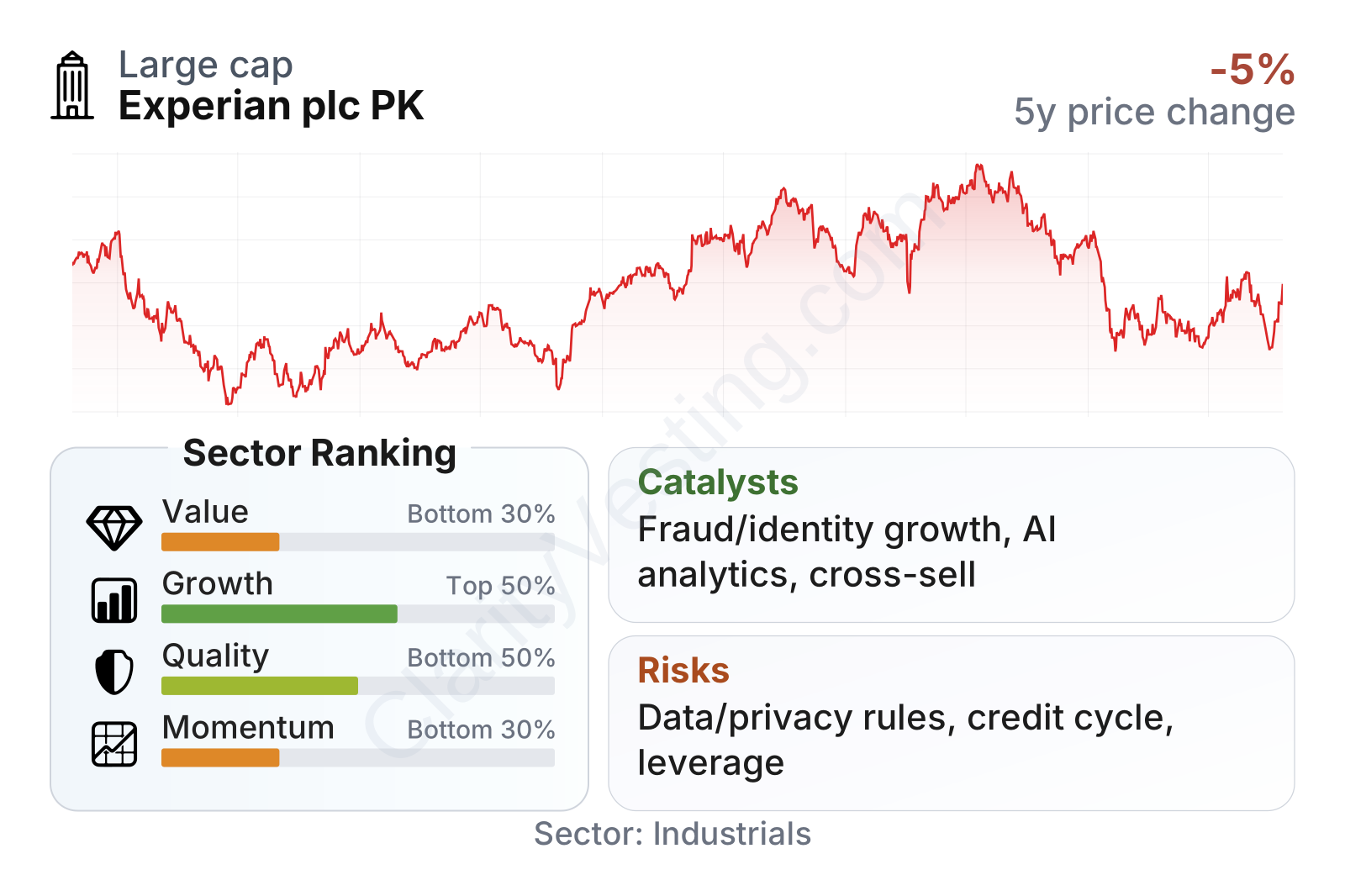
Experian stands out as a large, established company with relatively steady operating characteristics. Growth metrics are generally better than the sector median, helped by double-digit recent revenue growth, solid five-year revenue-per-share expansion, and improving margins over time. Profitability is also stronger than many peers, with a profit margin well above the sector median and a long-term operating margin profile that looks unusually resilient.
Valuation is less conservative. The earnings multiple is somewhat above the sector median, while the price-to-book ratio is much higher, which usually reflects the market placing a premium on data assets, recurring revenue, and durable market positions. Balance sheet leverage is the main weak spot in the table: net debt relative to earnings is elevated versus the sector median, and that matters more in a higher-interest-rate environment.
On market behavior, the shares have been uneven. The stock is still above its long-term moving average, which suggests some recent stabilization, but medium-term momentum remains weaker than much of the sector after a meaningful pullback from prior highs. That mix often signals a business the market still respects fundamentally, but no longer prices as generously as before.
Growth
Experian operates in markets with favorable long-term demand. Credit data, identity verification, fraud detection, and decision automation have become increasingly important as more commerce and lending move online. Banks and other institutions need to make decisions faster, with lower fraud losses and tighter compliance. That trend supports ongoing demand for exactly the kind of information infrastructure Experian provides.
The strategy also makes sense for future expansion because the company is not relying only on traditional credit bureau activity. Management has spent years building adjacent capabilities in fraud prevention, digital identity, open-data tools, health-care data services, and cloud-based decisioning. These areas are attractive because they tend to have higher switching costs, recurring usage, and relevance even when credit volumes are soft.
A particularly important catalyst is the growth of identity and fraud solutions. As digital account opening, e-commerce, and real-time payments expand, organizations need stronger tools to verify customers and detect synthetic identity and account takeover risks. This market need is structural rather than cyclical, which gives Experian a runway beyond the normal credit cycle.
Another support for growth is product cross-selling. Experian already has deep relationships with lenders, insurers, dealers, and other enterprises. That installed base makes it easier to add decisioning software, fraud tools, and marketing analytics to existing customers rather than winning every contract from scratch. For a data company, this can be a powerful source of efficient growth.
Recent company updates have also emphasized continued investment in innovation, including AI-enabled analytics and broader platform capabilities. For Experian, artificial intelligence is not a separate business line as much as a margin and product-strength enhancer: better models can improve underwriting, reduce fraud, and increase the value of existing data assets. If execution remains strong, that can deepen customer reliance on the platform.
Risks
This article is for informational purposes only and does not constitute financial advice. Some content is AI-generated. See Disclaimer


