Stock Analysis · Experian PLC (EXPGF)
Overview
Experian is a global data and technology company best known for credit reporting, but its business is broader than consumer credit scores. It collects and analyzes large amounts of consumer and business information, then sells services that help lenders make decisions, help companies market and verify customers, and help individuals monitor and improve their financial profile. Its operations are organized across North America, Latin America, the United Kingdom and Ireland, and EMEA/Asia Pacific.
For long-term readers, the important point is that Experian sits at the intersection of several durable needs: lending, identity verification, fraud prevention, compliance, and consumer financial management. These are recurring activities for banks, fintechs, insurers, telecom companies, retailers, and public-sector clients. That gives the company a business model with a large amount of repeat demand rather than one-time project work.
Based on the latest annual reporting, revenue is spread across several business lines and regions. The most useful way to think about the company is by its core operating activities:
- Business-to-business credit and decisioning services: approximately 55% to 60% of revenue. This includes credit bureau services, lending data, analytics, software for underwriting and collections, and decisioning tools used by financial institutions and other enterprises.
- Identity, fraud, and verification: approximately 20% to 25% of revenue. This includes identity resolution, fraud detection, customer onboarding checks, and related compliance tools, an area that has become more important as transactions move online.
- Consumer services: approximately 10% to 15% of revenue. This includes direct-to-consumer subscriptions and services such as credit monitoring, score access, alerts, and identity protection.
- Marketing and other data services: approximately 10% to 15% of revenue. This includes targeting, segmentation, and customer insight tools, although this part is smaller and generally less central to the investment case than credit and identity.
Geographically, North America is the largest contributor, followed by Latin America and then the U.K./Ireland and EMEA/Asia Pacific. That regional mix matters because the U.S. credit market and identity ecosystem remain the company’s biggest earnings engine, while Latin America adds expansion potential through still-developing credit and financial inclusion markets.
Over the last five fiscal years, revenue has risen from roughly $6.3 billion to about $8.4 billion, while net income has also moved higher despite some year-to-year volatility. The broad pattern is a company with steadily expanding sales, good profitability, and a cost structure that still leaves substantial earnings after servicing operations, taxes, and interest.
The long-term picture is favorable: sales have trended upward consistently, gross profit has expanded materially, and earnings have recovered well after a softer fiscal 2023. Interest expense has also moved up over time, which is worth remembering when judging the balance between growth and financial leverage.
Key Figures
| Metric | Value | Sector ⓘ |
|---|---|---|
| Date | Oct 17, 2026 | |
| Context | ||
| Sector | Industrials | |
| Industry | Consulting Services | |
| Market Cap ⓘ | $31.75B | |
| Beta ⓘ | 0.90 | |
Value (Cheapness) | ||
| P/E Ratio ⓘ | 22.94 | 22.10 |
| P/B Ratio ⓘ | 5.92 | 1.97 |
| FCF Yield ⓘ | N/A | 6.38% |
| Dividend Yield ⓘ | 1.97% | 1.94% |
| EBIT / EV ⓘ | 3.44% | 4.79% |
| PEG ⓘ | 1.25 | |
Growth (Business expansion) | ||
| Revenue Growth ⓘ | 12.30% | 9.30% |
| RPS Growth (5Y CAGR) ⓘ | 8.33% | 7.81% |
| EPS Growth (5Y CAGR) ⓘ | 1.55% | -13.06% |
| BVPS Growth (5Y CAGR) ⓘ | 8.96% | 6.14% |
| Margin Growth (5Y Trend) ⓘ | 2.43% | 0.88% |
| FCF Growth (5Y CAGR) ⓘ | 4.09% | 11.01% |
| DPS Growth (5Y CAGR) ⓘ | 8.14% | 9.48% |
Quality (Business durability) | ||
| ROIC (Latest) ⓘ | N/A | 10.84% |
| ROA (Latest) ⓘ | N/A | 5.41% |
| ROIC (5Y Median) ⓘ | 15.98% | 9.38% |
| ROA (5Y Median) ⓘ | 10.62% | 4.95% |
| Net Debt / EBIT (Latest) ⓘ | 4.03 | 2.08 |
| Net Debt / EBIT (5Y Median) ⓘ | 2.54 | 2.27 |
| Net Debt / EBITDA (Latest) ⓘ | N/A | 1.39 |
| Net Debt / Assets ⓘ | 35.72% | 19.28% |
| EBITDA / Interest ⓘ | N/A | 9.58 |
| Operating Margin (Latest) ⓘ | N/A | 10.50% |
| Operating Margin (5Y Median) ⓘ | 23.36% | 10.29% |
| Debt to Equity (Latest) ⓘ | N/A | 65.48% |
| Profit Margin (Latest) ⓘ | 17.79% | 6.67% |
| Free Cash Flow (Latest) ⓘ | N/A | |
Momentum (Price trend) | ||
| 3Y Return ⓘ | +9.59% | +61.68% |
| 12M Return (excl. last month) ⓘ | -26.05% | +12.58% |
| 6M Return ⓘ | +6.09% | 0.00% |
| Price vs. 200-Day MA ⓘ | -8.87% | +0.02% |
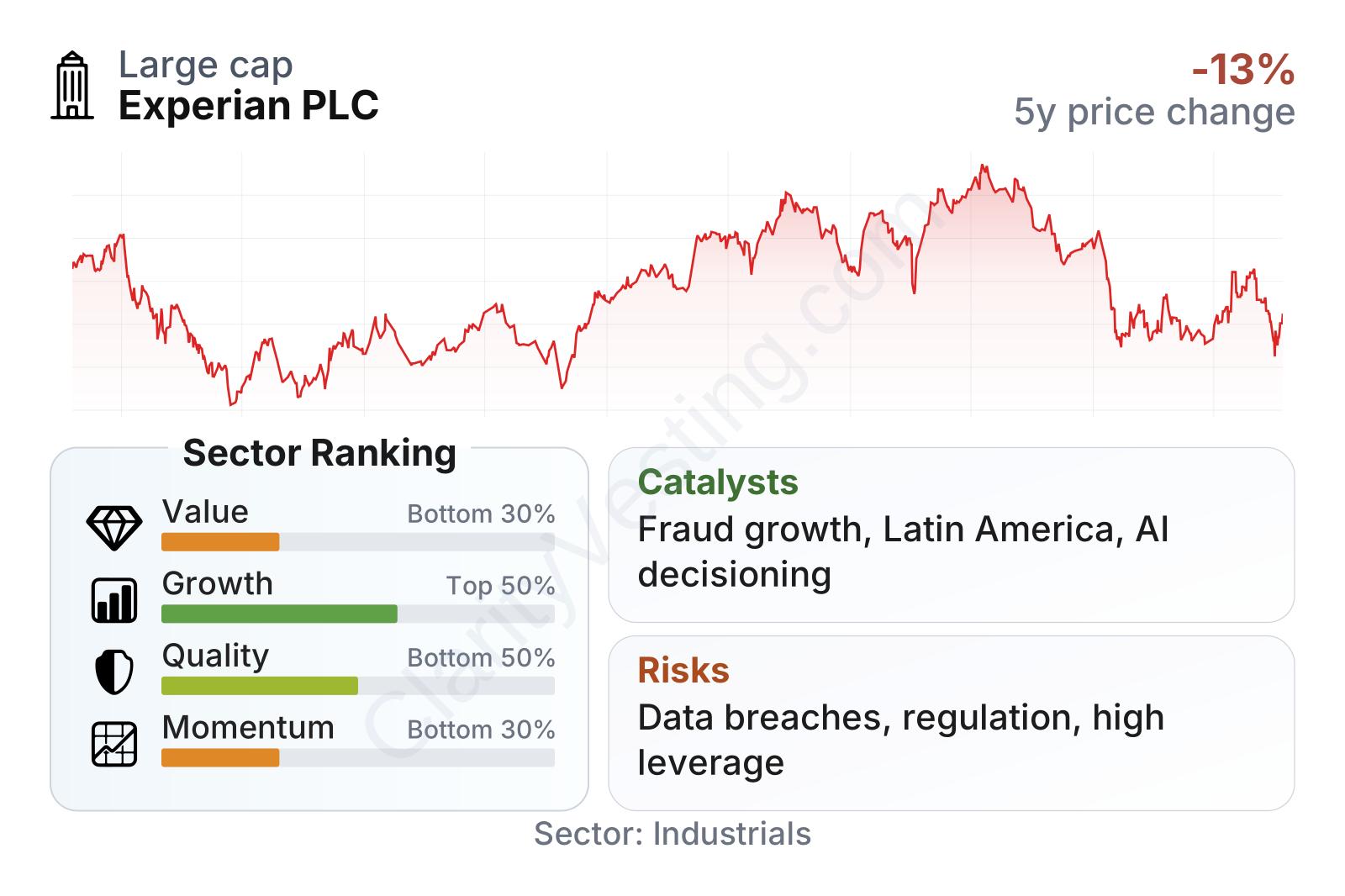
Experian is a large, established company with a market value around the low-$30 billion range and a share price that has been less volatile than the broader market, as reflected by a beta below 1. On valuation, its earnings multiple is close to the sector median, but other measures suggest the stock is not obviously cheap. The price-to-book ratio is well above the sector median, and operating earnings relative to enterprise value are below the typical level for peers.
Growth metrics are more mixed than the company’s reputation might suggest. Recent revenue growth has been ahead of the sector median, and five-year revenue per share growth has also been slightly better than average. Earnings per share growth over five years remains positive, which is notable in a sector where the median has been weak. However, free cash flow growth has been slower than the sector median, so the business looks stronger on revenue expansion than on cash generation momentum.
Profitability is a clear strength in some areas. Net margin is far above the sector median, and five-year return on assets is also materially stronger than typical peers. At the same time, leverage is elevated: net debt relative to EBIT is a little above 4x, versus a sector median below 2x, and net debt as a share of assets is also higher than average. In other words, this is a high-quality business in several operating respects, but not a conservatively financed one.
Share-price momentum has been weak relative to the sector. The stock has lagged over one year and three years and has traded below its 200-day average. That does not say much about the company’s long-term economics by itself, but it does show that the market has become less enthusiastic recently, which often happens when a good business is viewed as fully valued or when investors worry about growth durability.
Growth
Experian operates in markets that should remain structurally relevant for many years. Credit decisioning, identity verification, and fraud prevention are not cyclical fads; they are basic infrastructure for modern finance and digital commerce. As more consumer activity moves online, more lending decisions become automated, and more regulation requires stronger verification and monitoring, demand for trusted data and analytics should continue to expand.
The company’s strategy also makes sense for that backdrop. Management has been emphasizing higher-value software, analytics, decisioning, fraud, and consumer services rather than relying only on traditional credit bureau revenue. That shift matters because software-led products and embedded decisioning tools can deepen customer relationships and create more recurring revenue. It also reduces the risk of being seen as only a repository of credit files in a world where clients increasingly want workflow tools and real-time insights.
Recent revenue growth has been solid, with year-over-year expansion around the low-teens level, ahead of the sector median. That aligns with the broader financial picture: revenue has compounded steadily over the last several years, helped by acquisitions, product development, and continued demand for fraud and identity solutions. The strongest long-term catalyst is likely the combination of increasing digital transactions and rising fraud complexity. Every additional digital account opening, payment flow, or credit application creates another opportunity for Experian’s data and verification tools to be used.
Another meaningful opportunity is Latin America. Experian already has a strong presence in Brazil through Serasa, and the region offers room for further growth as credit markets mature, consumer participation broadens, and businesses invest more in analytics and risk tools. Consumer services are also a useful growth layer because they turn a historically business-facing company into a more direct participant in personal finance and identity protection.
Recent company communications have also highlighted continued investment in generative AI and advanced analytics capabilities. For Experian, AI is less about headline excitement and more about making existing products better: improving fraud detection, automating decisions, and extracting more value from very large proprietary data assets. If executed well, that can support stronger pricing power and wider product adoption.
Risks
This article is for informational purposes only and does not constitute financial advice. Some content is AI-generated. See Disclaimer


