Stock Analysis · Expeditors International of Washington Inc (EXPD)
Overview
Expeditors International of Washington is a global logistics company. In simple terms, it helps businesses move goods across borders and through supply chains. The company does not operate as a traditional asset-heavy carrier with large fleets of ships or aircraft. Instead, it mainly organizes transportation, customs clearance, warehousing, and related services for customers that need reliable global shipping support.
Its business is built around arranging freight for customers and earning revenue from the spread between what it charges clients and what it pays transportation providers, along with fees for related services. This model gives Expeditors flexibility, but it also means results can move up and down with global trade volumes and freight pricing.
Based on the company’s recent annual reporting, revenue is concentrated in a few core service lines.
- Airfreight services: approximately 37% of revenue. This includes arranging air cargo transportation and related handling for time-sensitive shipments.
- Ocean freight and ocean services: approximately 35% of revenue. This covers international seaborne shipping, forwarding, and shipment management.
- Customs brokerage and other services: approximately 28% of revenue. This includes customs clearance, warehousing and distribution, order management, cargo insurance, and other supply chain support services.
Geographically, Expeditors is broadly diversified, with operations across the Americas, North Asia, South Asia, Europe, and other international markets. That wide footprint matters because customers often want one provider that can coordinate shipments across many countries rather than dealing with separate local operators.
One notable feature of the business is how much of each sales dollar flows back out as purchased transportation. Even after the sharp post-pandemic reset in freight markets, the company still converts a meaningful share of gross profit into operating income and net income, showing a disciplined cost structure for a logistics middleman.
Key Figures
| Metric | Value | Sector ⓘ |
|---|---|---|
| Date | Oct 17, 2026 | |
| Context | ||
| Sector | Industrials | |
| Industry | Integrated Freight & Logistics | |
| Market Cap ⓘ | $25.37B | |
| Beta ⓘ | 1.06 | |
Value (Cheapness) | ||
| P/E Ratio ⓘ | 28.40 | 22.10 |
| P/B Ratio ⓘ | 12.32 | 1.97 |
| FCF Yield ⓘ | 3.64% | 6.38% |
| Dividend Yield ⓘ | 0.82% | 1.94% |
| EBIT / EV ⓘ | 5.02% | 4.79% |
| PEG ⓘ | 2.98 | |
Growth (Business expansion) | ||
| Revenue Growth ⓘ | 32.10% | 9.30% |
| RPS Growth (5Y CAGR) ⓘ | -4.21% | 7.81% |
| EPS Growth (5Y CAGR) ⓘ | -19.05% | -13.06% |
| BVPS Growth (5Y CAGR) ⓘ | -4.06% | 6.14% |
| Margin Growth (5Y Trend) ⓘ | -1.77% | 0.88% |
| FCF Growth (5Y CAGR) ⓘ | 3.46% | 11.01% |
| DPS Growth (5Y CAGR) ⓘ | 7.43% | 9.48% |
Quality (Business durability) | ||
| ROIC (Latest) ⓘ | 40.08% | 10.84% |
| ROA (Latest) ⓘ | 18.54% | 5.41% |
| ROIC (5Y Median) ⓘ | 35.47% | 9.38% |
| ROA (5Y Median) ⓘ | 17.46% | 4.95% |
| Net Debt / EBIT (Latest) ⓘ | -0.39 | 2.08 |
| Net Debt / EBIT (5Y Median) ⓘ | -0.68 | 2.27 |
| Net Debt / EBITDA (Latest) ⓘ | -0.37 | 1.39 |
| Net Debt / Assets ⓘ | -9.04% | 19.28% |
| EBITDA / Interest ⓘ | N/A | 9.58 |
| Operating Margin (Latest) ⓘ | 10.01% | 10.50% |
| Operating Margin (5Y Median) ⓘ | 10.89% | 10.29% |
| Debt to Equity (Latest) ⓘ | 26.78% | 65.48% |
| Profit Margin (Latest) ⓘ | 7.63% | 6.67% |
| Free Cash Flow (Latest) ⓘ | $923.86M | |
Momentum (Price trend) | ||
| 3Y Return ⓘ | +74.67% | +61.68% |
| 12M Return (excl. last month) ⓘ | +58.39% | +12.58% |
| 6M Return ⓘ | +36.22% | 0.00% |
| Price vs. 200-Day MA ⓘ | +19.75% | +0.02% |
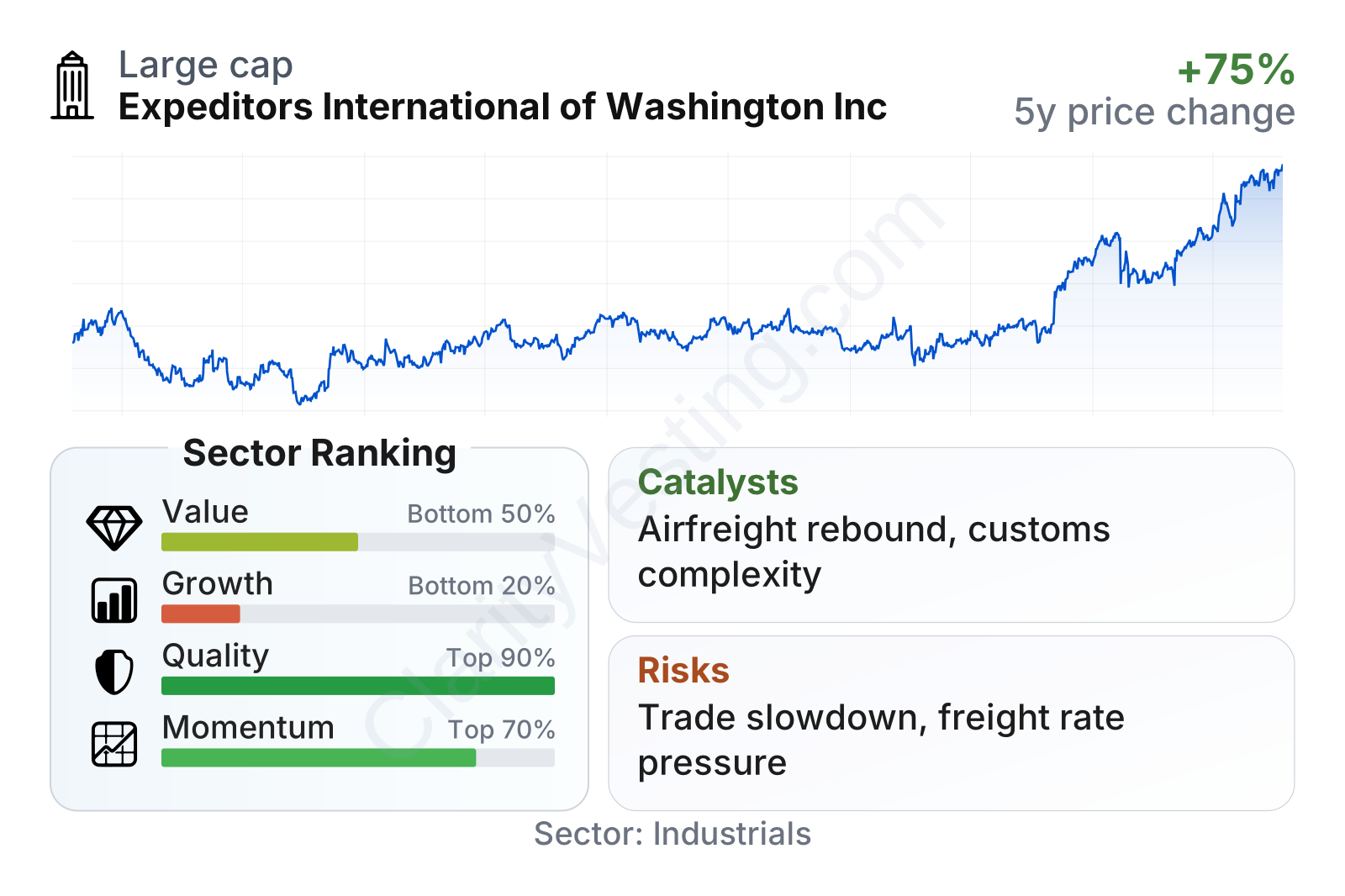
Expeditors stands out for business quality more than for classic value or long-term growth rankings. Profitability on capital remains far above most peers, and the balance sheet is unusually conservative, with low leverage and net cash rather than heavy debt. At the same time, the stock trades above the sector median on earnings and far above it on book value, while income yield metrics such as dividend yield and free cash flow yield are less generous than many industrial peers. The recent share price trend has been strong, but the longer five-year growth record still reflects the industry’s post-pandemic normalization.
Growth
Expeditors operates in a sector that should remain structurally important over the long run. Global trade is not a straight line, but businesses still need international freight coordination, customs support, and increasingly sophisticated supply chain planning. E-commerce, nearshoring, supply chain diversification, and tighter customs and compliance requirements all support demand for capable logistics partners.
The company’s strategy is sensible for that environment. Because it is less asset-heavy than shipping lines or airlines, it can stay flexible when freight conditions change. Management has historically focused on service quality, local operating autonomy, and disciplined execution rather than chasing volume at any price. That approach can be frustrating during boom periods when asset owners benefit more directly from surging rates, but it tends to protect returns when markets cool.
Recent revenue patterns show that the business has been recovering from the steep industry downturn that followed the extraordinary pandemic-era freight spike. Year-over-year sales growth turned strongly positive again in parts of 2024 and has remained positive more recently, with the latest reading well ahead of the sector median. That said, this rebound needs to be read carefully: part of it reflects normalization from a depressed base rather than a clean long-term acceleration.
Cash generation remains an important support. Free cash flow has been positive through the cycle, although it has been volatile from year to year. The latest trailing figure sits around the $0.9 billion range, which shows the business can still produce solid cash even without the unusually favorable freight conditions seen earlier in the decade.
Potential catalysts are mostly operational rather than transformational. A continued recovery in air and ocean freight demand, better shipment volumes from large multinational customers, and more complex customs and compliance needs could all help. Expeditors also benefits when customers want resilient supply chains spread across multiple regions, since the company already has a global network and established local offices.
In recent company communications, management has emphasized demand improvement in several trade lanes and continued investment in technology and service capabilities. None of that changes the basic reality that this is still a cyclical business, but it does support the idea that Expeditors is positioned to capture business when freight activity strengthens.
Risks
This article is for informational purposes only and does not constitute financial advice. Some content is AI-generated. See Disclaimer


