Stock Analysis · Eagle Materials Inc (EXP)
Overview
Eagle Materials is a U.S. manufacturer of heavy construction products used in residential, commercial, industrial, and public infrastructure projects. The company operates in basic building materials rather than finished construction services. Its products are essential inputs for homes, roads, warehouses, data centers, schools, and other structures, which makes the business closely tied to construction activity and repair demand across the United States.
The company’s business is organized around a small number of large product categories. Based on the latest annual reporting for fiscal 2026, revenue is mainly generated from the following segments:
- Heavy Materials as the largest source, at roughly 60% to 65% of revenue. This includes cement and concrete and aggregates, products used in highways, infrastructure, commercial buildings, and broader construction activity.
- Light Materials at roughly 35% to 40% of revenue. This includes gypsum wallboard and recycled paperboard. Wallboard is used in interior walls and ceilings, while paperboard is a key input in wallboard manufacturing.
Within those categories, cement and wallboard are generally the most important earnings drivers because they benefit from scale, logistics advantages, and pricing discipline in regional markets. The company’s footprint is concentrated in U.S. markets with exposure to faster-growing Sun Belt states, which has been an important part of its strategy.
Over the last several years, revenue has risen from about $1.9 billion in fiscal 2022 to about $2.3 billion in fiscal 2026. At the same time, profitability stayed strong even as margins eased from earlier peaks. That combination suggests a business that has kept pricing power and operational discipline, but is now operating in a more normal part of the construction cycle than the unusually strong environment seen earlier in the decade.
The business still converts a large share of revenue into operating profit and net income, which is unusual for many cyclical materials companies. However, the recent pattern also shows some pressure from higher costs, rising interest expense, and a modest slowdown in margin expansion.
Key Figures
| Metric | Value | Sector ⓘ |
|---|---|---|
| Date | Oct 24, 2026 | |
| Context | ||
| Sector | Basic Materials | |
| Industry | Building Materials | |
| Market Cap ⓘ | $5.30B | |
| Beta ⓘ | 1.33 | |
Value (Cheapness) | ||
| P/E Ratio ⓘ | 13.61 | 16.92 |
| P/B Ratio ⓘ | 3.63 | 1.66 |
| FCF Yield ⓘ | 3.22% | 5.83% |
| Dividend Yield ⓘ | 0.59% | 2.07% |
| EBIT / EV ⓘ | 8.20% | 6.38% |
| PEG ⓘ | 2.09 | |
Growth (Business expansion) | ||
| Revenue Growth ⓘ | 2.60% | 11.25% |
| RPS Growth (5Y CAGR) ⓘ | 12.69% | 4.49% |
| EPS Growth (5Y CAGR) ⓘ | -31.63% | -15.24% |
| BVPS Growth (5Y CAGR) ⓘ | 14.05% | 5.49% |
| Margin Growth (5Y Trend) ⓘ | -1.22% | -1.54% |
| FCF Growth (5Y CAGR) ⓘ | -18.30% | 0.37% |
| DPS Growth (5Y CAGR) ⓘ | 8.16% | 5.91% |
Quality (Business durability) | ||
| ROIC (Latest) ⓘ | 14.33% | 9.59% |
| ROA (Latest) ⓘ | 11.00% | 4.92% |
| ROIC (5Y Median) ⓘ | 19.48% | 7.91% |
| ROA (5Y Median) ⓘ | 14.92% | 3.92% |
| Net Debt / EBIT (Latest) ⓘ | 2.71 | 1.36 |
| Net Debt / EBIT (5Y Median) ⓘ | 1.89 | 1.69 |
| Net Debt / EBITDA (Latest) ⓘ | 2.11 | 0.93 |
| Net Debt / Assets ⓘ | 39.96% | 13.69% |
| EBITDA / Interest ⓘ | 11.65 | 12.38 |
| Operating Margin (Latest) ⓘ | 24.79% | 13.24% |
| Operating Margin (5Y Median) ⓘ | 28.03% | 11.82% |
| Debt to Equity (Latest) ⓘ | 120.75% | 40.30% |
| Profit Margin (Latest) ⓘ | 17.32% | 6.38% |
| Free Cash Flow (Latest) ⓘ | $170.51M | |
Momentum (Price trend) | ||
| 3Y Return ⓘ | +13.39% | +73.47% |
| 12M Return (excl. last month) ⓘ | -22.14% | +27.59% |
| 6M Return ⓘ | -15.52% | -4.02% |
| Price vs. 200-Day MA ⓘ | -14.91% | -0.65% |
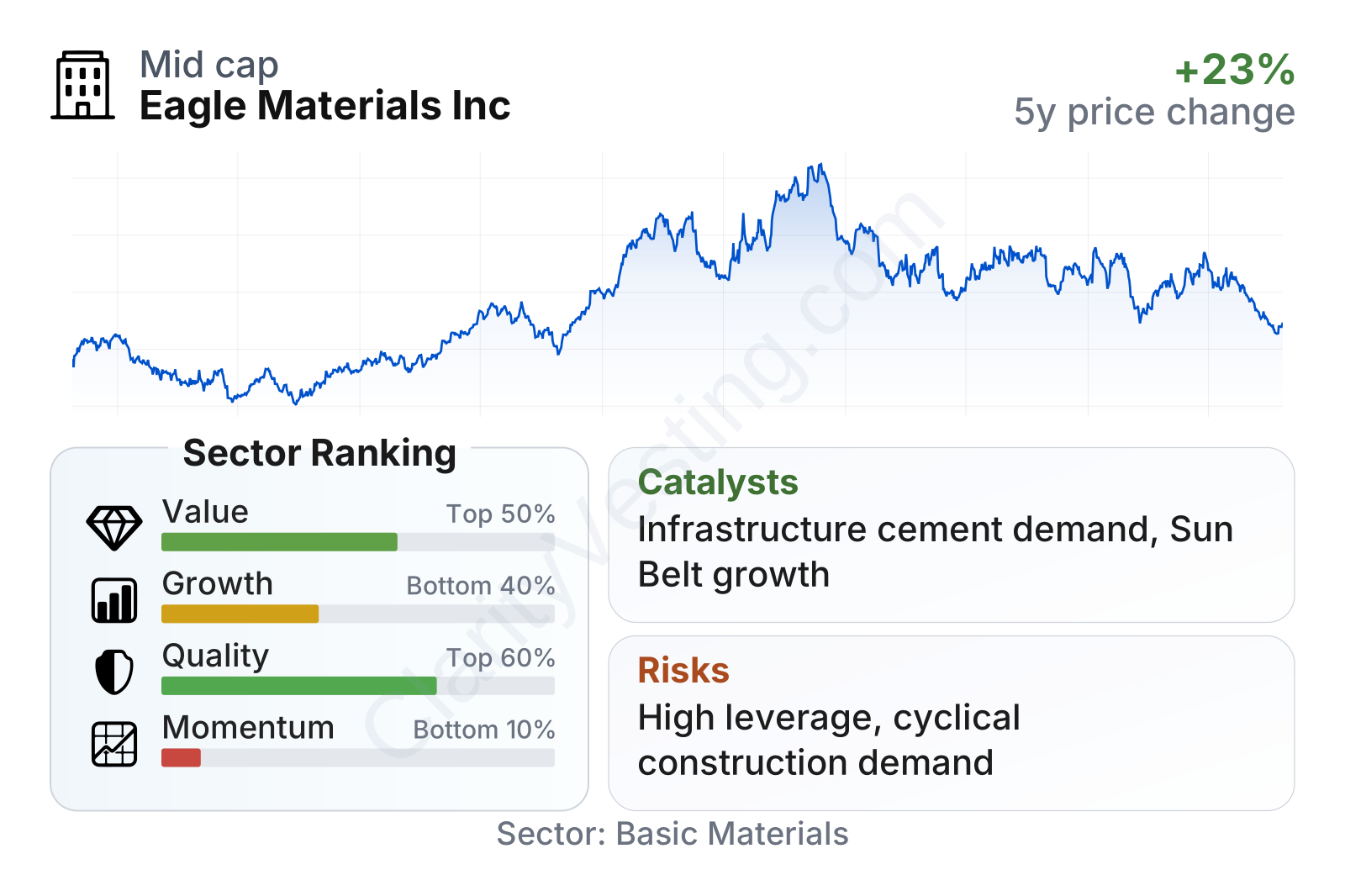
Eagle Materials stands out for profitability and capital efficiency more than for fast near-term growth or market momentum. Returns on capital and asset profitability are comfortably above sector medians, and operating margins remain well ahead of many peers. Valuation looks mixed: earnings multiples are lower than the sector median, but the price-to-book ratio is higher and free cash flow yield is less generous than many materials names. The stock’s recent trading trend has been weak relative to the sector, which usually reflects concern about the current cycle rather than the quality of the underlying assets.
The share price history has been volatile, which is normal for a construction-linked company. After a strong climb through 2023 and much of 2024, the stock pulled back during 2025 and remained softer into 2026. That pattern fits a market reassessment of demand, margins, and leverage rather than a collapse in the business itself.
Growth
Eagle Materials operates in a sector with long-term support from several durable themes: housing shortages in many U.S. regions, public infrastructure spending, industrial reshoring, and continued population migration toward Southern and Western states. These are favorable conditions for cement, aggregates, and wallboard demand, even if quarterly results move up and down with the construction cycle.
The company’s strategy is straightforward and generally sensible for a mature materials business. It focuses on products with high transportation costs and regional supply limits, where local scale matters and new capacity is difficult or expensive to build. That can protect pricing in good markets. Eagle has also used acquisitions and capacity investments to deepen its presence in selected regions instead of chasing national scale in every product.
Recent growth has clearly slowed from the stronger pace seen in 2022 and 2023. Revenue increases were once running in the low-teens to near 20% range, but more recently they have been much closer to flat-to-low-single-digit growth, with some quarters dipping slightly negative before returning to modest expansion. That points to a company moving from post-pandemic pricing and volume strength into a steadier, less favorable comparison period.
Free cash flow has also come down meaningfully from earlier highs. The business still produces cash, but the decline shows that higher capital spending, softer margins, or working capital needs are reducing the amount of excess cash left after operations. For a long-term assessment, this matters because materials companies often rely on strong cash generation to fund expansion, repay debt, and return capital to shareholders.
A meaningful catalyst is the continuing need for U.S. infrastructure and heavy construction materials, especially cement. Domestic cement supply can be tight in some regions, and permitting new capacity takes time and capital. That can support pricing for established producers. Another positive factor is Eagle’s exposure to gypsum wallboard, which gives it a second major earnings engine tied more directly to housing and interior construction. If residential demand improves alongside infrastructure activity, the company has two major businesses that can contribute at the same time.
Recent company communications also point to continued investment in operational efficiency and expansion projects, including efforts aimed at increasing throughput in core businesses. For a company of Eagle’s size, disciplined capacity additions in strong regional markets can have an outsized impact if demand remains healthy.
Risks
This article is for informational purposes only and does not constitute financial advice. Some content is AI-generated. See Disclaimer


