Stock Analysis · Expand Energy Corporation (EXE)
Overview
Expand Energy Corporation is a U.S. natural gas producer focused on exploration and production. The company was formed through the combination of Chesapeake Energy and Southwestern Energy, creating one of the largest independent natural gas producers in the country. Its business is straightforward: it drills wells, produces natural gas and related hydrocarbons, and sells that production into energy markets.
The company’s asset base is centered on large shale regions in the United States, especially the Haynesville and Appalachian areas, which are important supply basins for domestic gas demand and liquefied natural gas export growth. That makes Expand Energy more tied to natural gas pricing than to oil, which is a key point for long-term readers because the stock’s economics can move sharply with commodity cycles.
Revenue mainly comes from selling produced volumes rather than from many different business lines. Based on company reporting structure and the typical mix disclosed in recent filings, the business is largely split as follows:
- Natural gas: approximately 70% to 80% of revenue. This is the company’s core product and the main driver of earnings and cash flow.
- Natural gas liquids (NGLs): approximately 10% to 20% of revenue. This includes products such as ethane, propane, and butane extracted during production.
- Oil: approximately 5% to 10% of revenue. Oil is a smaller contributor than gas but can still support margins depending on prices.
- Other revenue: a small share tied to marketing, transportation-related items, and hedging-related impacts depending on the period.
The financial flow over recent years shows how cyclical this business is. Revenue and profit surged when gas markets were strong, fell sharply during the 2024 downturn, and then recovered materially in 2025. Costs have remained comparatively controlled, which helped the company return to positive profitability as the market improved.
Key Figures
| Metric | Value | Sector ⓘ |
|---|---|---|
| Date | Oct 24, 2026 | |
| Context | ||
| Sector | Energy | |
| Industry | Oil & Gas E&P | |
| Market Cap ⓘ | $21.45B | |
| Beta ⓘ | 0.40 | |
Value (Cheapness) | ||
| P/E Ratio ⓘ | 8.01 | 15.40 |
| P/B Ratio ⓘ | 1.14 | 1.71 |
| FCF Yield ⓘ | 11.85% | 8.24% |
| Dividend Yield ⓘ | 3.43% | 3.52% |
| EBIT / EV ⓘ | 15.93% | 7.45% |
| PEG ⓘ | 0.82 | |
Growth (Business expansion) | ||
| Revenue Growth ⓘ | -10.60% | 26.85% |
| RPS Growth (5Y CAGR) ⓘ | -5.94% | 6.78% |
| EPS Growth (5Y CAGR) ⓘ | -27.52% | -14.41% |
| BVPS Growth (5Y CAGR) ⓘ | 12.59% | 6.08% |
| Margin Growth (5Y Trend) ⓘ | -64.76% | 0.55% |
| FCF Growth (5Y CAGR) ⓘ | 14.96% | 2.75% |
| DPS Growth (5Y CAGR) ⓘ | 33.26% | 16.79% |
Quality (Business durability) | ||
| ROIC (Latest) ⓘ | 12.34% | 11.30% |
| ROA (Latest) ⓘ | 10.00% | 6.00% |
| ROIC (5Y Median) ⓘ | N/A | 10.35% |
| ROA (5Y Median) ⓘ | 16.21% | 5.46% |
| Net Debt / EBIT (Latest) ⓘ | 0.80 | 1.64 |
| Net Debt / EBIT (5Y Median) ⓘ | 0.57 | 1.82 |
| Net Debt / EBITDA (Latest) ⓘ | 0.45 | 1.08 |
| Net Debt / Assets ⓘ | 10.57% | 17.29% |
| EBITDA / Interest ⓘ | 30.42 | 9.53 |
| Operating Margin (Latest) ⓘ | 27.66% | 16.21% |
| Operating Margin (5Y Median) ⓘ | 33.30% | 20.55% |
| Debt to Equity (Latest) ⓘ | 19.21% | 52.27% |
| Profit Margin (Latest) ⓘ | 21.97% | 8.79% |
| Free Cash Flow (Latest) ⓘ | $2.54B | |
Momentum (Price trend) | ||
| 3Y Return ⓘ | +14.76% | +68.93% |
| 12M Return (excl. last month) ⓘ | -9.01% | +42.90% |
| 6M Return ⓘ | -0.33% | +9.18% |
| Price vs. 200-Day MA ⓘ | -3.64% | +9.87% |
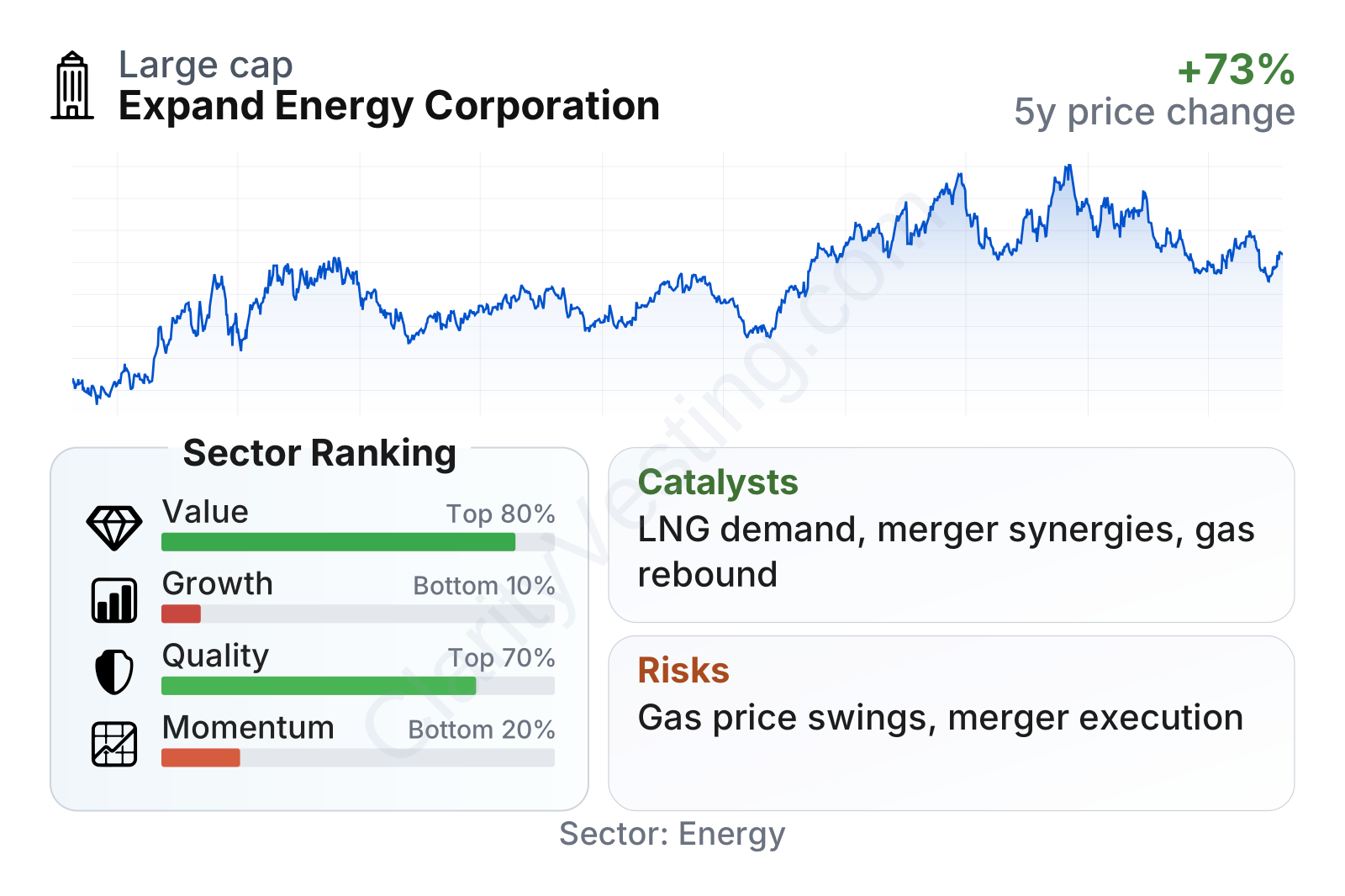
Expand Energy is a large-cap energy producer with a market value around $20 billion, but its stock behavior has been less volatile than many energy names, with a beta well below 1. On valuation and balance-sheet strength, the company looks stronger than much of the sector: earnings and book multiples are below sector median levels, free cash flow yield is above the median, and debt metrics are clearly more conservative. The weaker area is growth and share-price momentum. Recent revenue trends have lagged the sector, and the stock has underperformed many peers even as operating fundamentals have improved.
Growth
Expand Energy operates in a sector that has an important long-term role, even if it is not a smooth growth market every year. Natural gas remains a critical fuel for electricity generation, industrial use, heating, petrochemicals, and LNG exports. In the United States, one of the biggest structural demand drivers is LNG capacity expansion, which can raise demand for low-cost domestic gas over time. That backdrop is more supportive for gas-focused producers than it was when the industry relied mostly on domestic consumption alone.
The company’s strategy makes sense in that context. Scale matters in shale production because it can improve drilling efficiency, lower operating costs, increase infrastructure access, and give management more flexibility to shift capital between basins. The merger that created Expand Energy appears designed around exactly that logic: build a larger gas platform with a broader inventory of drilling locations and stronger leverage to a recovery in gas pricing.
Revenue growth has been extremely uneven, which is normal in upstream energy but still important. The pattern shows dramatic swings rather than steady expansion, with a strong rebound through much of 2025 followed by a weaker year-over-year reading in mid-2026. That does not necessarily signal operational weakness by itself; in this industry, changes in realized prices and production mix can overwhelm volume growth. For long-term analysis, the more relevant question is whether the company can convert its scale into durable cash generation across the cycle.
Free cash flow gives a more constructive picture. After dropping sharply during the weak part of the cycle, cash generation recovered strongly and recently moved back into the multibillion-dollar range. That matters because shale producers need to keep spending capital to sustain production. A company that can still generate substantial free cash flow after that spending is in a better position to reduce debt, return capital, or invest selectively when market conditions improve.
A meaningful catalyst is any sustained increase in U.S. natural gas prices driven by LNG export growth, colder weather, power demand, or tighter supply. Another is execution on merger-related synergies and operating efficiencies. Recent company communications and filings around the business combination have emphasized larger scale, inventory depth, and efficiency opportunities, all of which could strengthen margins and cash generation if management delivers as planned.
Risks
This article is for informational purposes only and does not constitute financial advice. Some content is AI-generated. See Disclaimer


