Stock Analysis · Edgewise Therapeutics Inc (EWTX)
Overview
Edgewise Therapeutics is a clinical-stage biotechnology company focused on developing medicines for serious muscle disorders. Its research is centered on small-molecule therapies designed to act directly on muscle proteins, with the goal of improving muscle function in diseases where current treatment options remain limited. The company’s two most visible programs target Duchenne muscular dystrophy and hypertrophic cardiomyopathy, two conditions with significant unmet medical need and potentially large commercial markets if late-stage development is successful.
At this stage, Edgewise is still in development mode rather than commercial mode. That means its financial profile looks very different from a mature healthcare company: spending is driven mainly by research and clinical trials, while recurring product sales have not yet started.
Main sources of revenue currently appear to be:
- Product revenue: approximately 0%. Edgewise has not yet launched an approved product.
- Collaboration, license, or milestone revenue: approximately 0% in recent annual results, based on available reported totals.
- Other revenue: immaterial at this stage.
The cost structure is much more informative than revenue for understanding the business today. Research and development is by far the largest use of cash, rising from roughly low-$30 million levels in 2021 to more than $150 million in 2025, while general and administrative costs have also climbed as the pipeline has advanced. In other words, Edgewise is investing heavily in clinical progress and organizational scale before any commercial income arrives.
The operating profile shows a familiar biotech pattern: essentially no revenue, growing research expense, and widening net losses as more programs move deeper into development. For a long-term reader, the key takeaway is that the company’s value depends primarily on whether its pipeline can produce strong clinical results and eventually reach the market.
Key Figures
| Metric | Value | Sector ⓘ |
|---|---|---|
| Date | Oct 03, 2026 | |
| Context | ||
| Sector | Healthcare | |
| Industry | Biotechnology | |
| Market Cap ⓘ | $4.41B | |
| Beta ⓘ | 0.33 | |
Value (Cheapness) | ||
| P/E Ratio ⓘ | N/A | 24.06 |
| P/B Ratio ⓘ | 9.73 | 3.08 |
| FCF Yield ⓘ | -3.62% | 3.07% |
| Dividend Yield ⓘ | N/A | 2.05% |
| EBIT / EV ⓘ | -4.93% | 0.63% |
| PEG ⓘ | N/A | |
Growth (Business expansion) | ||
| Revenue Growth ⓘ | N/A | 7.50% |
| RPS Growth (5Y CAGR) ⓘ | N/A | 8.70% |
| EPS Growth (5Y CAGR) ⓘ | -6.43% | -18.20% |
| BVPS Growth (5Y CAGR) ⓘ | -2.19% | 3.95% |
| Margin Growth (5Y Trend) ⓘ | N/A | -0.58% |
| FCF Growth (5Y CAGR) ⓘ | N/A | 0.88% |
| DPS Growth (5Y CAGR) ⓘ | N/A | 6.80% |
Quality (Business durability) | ||
| ROIC (Latest) ⓘ | -30.43% | 3.29% |
| ROA (Latest) ⓘ | -37.10% | 3.02% |
| ROIC (5Y Median) ⓘ | -26.67% | 4.75% |
| ROA (5Y Median) ⓘ | -28.33% | 1.93% |
| Net Debt / EBIT (Latest) ⓘ | N/A | 1.33 |
| Net Debt / EBIT (5Y Median) ⓘ | N/A | 1.83 |
| Net Debt / EBITDA (Latest) ⓘ | N/A | 0.99 |
| Net Debt / Assets ⓘ | -14.33% | 5.33% |
| EBITDA / Interest ⓘ | N/A | 9.63 |
| Operating Margin (Latest) ⓘ | N/A | 9.25% |
| Operating Margin (5Y Median) ⓘ | N/A | 7.80% |
| Debt to Equity (Latest) ⓘ | 0.80% | 28.99% |
| Profit Margin (Latest) ⓘ | N/A | 3.60% |
| Free Cash Flow (Latest) ⓘ | -$159.62M | |
Momentum (Price trend) | ||
| 3Y Return ⓘ | +601.56% | +37.48% |
| 12M Return (excl. last month) ⓘ | +194.43% | +20.85% |
| 6M Return ⓘ | +22.15% | +9.73% |
| Price vs. 200-Day MA ⓘ | +16.61% | +4.69% |
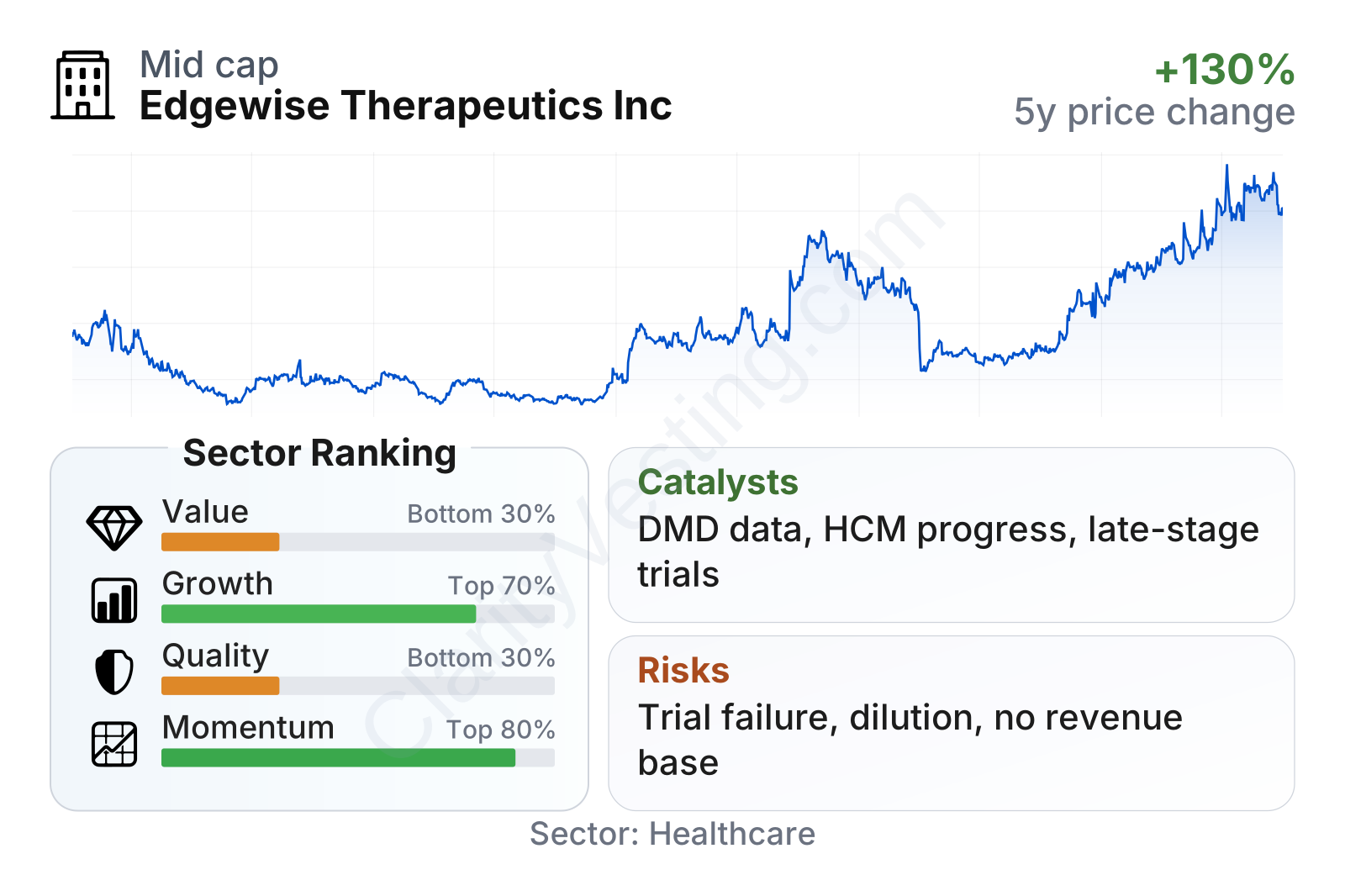
Edgewise is now a mid-sized biotechnology company by market value, and its share price has been very strong over the last three years despite meaningful volatility along the way. The metrics table points to a business with weak traditional value and profitability characteristics, which is normal for a pre-revenue drug developer, but unusually strong momentum compared with much of the healthcare sector. The low beta suggests the stock has not moved in lockstep with the broader market, while the high price-to-book ratio shows that the market is placing a large value on future pipeline potential rather than current earnings power.
The growth ranking sits around the upper part of the sector even though reported revenue growth is still zero. That is mostly because the market is looking ahead to development progress rather than current sales. Quality metrics remain weak on conventional measures such as return on assets and return on invested capital, reflecting sustained losses and heavy R&D spending.
Growth
Edgewise operates in one of the most active areas of healthcare: rare disease and genetically defined muscle disorders. This is a sector with durable long-term interest because successful therapies can command premium pricing, benefit from orphan drug incentives, and face urgent medical demand. The strategic logic is clear. If a company can show meaningful improvement in diseases with few good options, it can create substantial value even with a relatively focused product portfolio.
Its strategy also makes sense from a scientific and commercial perspective. Rather than spreading itself across many unrelated disease areas, Edgewise is concentrating on muscle biology and building expertise around a narrower set of targets. That focus can help in clinical design, regulatory positioning, and physician outreach if products eventually reach approval.
A major catalyst is continued advancement of its lead candidates, especially sevasemten in Duchenne muscular dystrophy and the company’s cardiovascular muscle program in hypertrophic cardiomyopathy. In biotech, each positive clinical readout can materially change the commercial outlook because it reduces uncertainty around whether a drug can work, how large the addressable patient population may be, and how quickly a partner or acquirer might become interested.
Recent company updates have highlighted ongoing clinical progress, including continued development activity across these lead programs. For a company with no approved products, the most significant opportunities usually come from trial data, regulatory alignment, and the expansion of studies into later-stage development. Those are the events that can move a company from research platform to future commercial contender.
Free cash flow has remained deeply negative and has become more negative over time, which reflects pipeline expansion rather than business deterioration in the usual sense. In a clinical-stage biotech, rising cash burn often means more trials, more patients enrolled, and more manufacturing and regulatory work ahead of potential launches. The important question is not whether cash flow is currently positive, but whether the spending is moving the pipeline toward value-creating milestones.
Risks
This article is for informational purposes only and does not constitute financial advice. Some content is AI-generated. See Disclaimer