Stock Analysis · East West Bancorp Inc (EWBC)
Overview
East West Bancorp is the parent company of East West Bank, a regional bank headquartered in California. Its business is centered on traditional banking activities: taking deposits, making loans, helping customers move money, and providing treasury and foreign-exchange services. What makes the company stand out is its long-built franchise connecting the United States and Greater China, while also serving commercial and consumer clients more broadly across major U.S. markets.
In simple terms, East West Bancorp earns most of its money from the spread between what it receives on loans and securities and what it pays on deposits and other funding. It also earns fees from customer services. Based on its recent annual mix, the main revenue sources are approximately:
- Net interest income: about 75% to 85% of total revenue. This is the core banking engine and includes interest collected on commercial and industrial loans, commercial real estate loans, residential mortgages, trade finance, and investment securities, minus interest paid on deposits and borrowings.
- Fee and other noninterest income: about 15% to 25% of total revenue. This includes foreign exchange income, deposit account service charges, lending-related fees, wealth and treasury management fees, and other customer service income.
The business mix is still primarily commercial banking. East West Bank has historically focused on middle-market commercial customers, cross-border business clients, and communities tied to Asian-American commerce. That niche is important because it gives the bank a more distinctive identity than many regional peers.
The multi-year operating picture shows a business that has generally expanded revenue and earnings despite the rate-driven volatility that affected the whole banking sector. Profitability has remained strong, and expense growth has stayed more controlled than revenue growth over time, which helps explain why margins remain well above many regional-bank peers.
The broad trend is that revenue and net income have grown meaningfully over the last several years, even though annual banking revenue can look uneven because interest costs and accounting items move with the rate cycle. The key takeaway is that East West has kept a large share of revenue flowing through to profit, which is a positive sign for the durability of its model.
Key Figures
| Metric | Value | Sector ⓘ |
|---|---|---|
| Date | Oct 03, 2026 | |
| Context | ||
| Sector | Financial Services | |
| Industry | Banks - Regional | |
| Market Cap ⓘ | $16.98B | |
| Beta ⓘ | 0.93 | |
Value (Cheapness) | ||
| P/E Ratio ⓘ | 11.90 | 12.60 |
| P/B Ratio ⓘ | 1.87 | 1.23 |
| FCF Yield ⓘ | 10.97% | 10.16% |
| Dividend Yield ⓘ | 2.23% | 2.96% |
| EBIT / EV ⓘ | 11.73% | 7.77% |
| PEG ⓘ | 5.58 | |
Growth (Business expansion) | ||
| Revenue Growth ⓘ | 16.30% | 9.50% |
| RPS Growth (5Y CAGR) ⓘ | 26.08% | 12.10% |
| EPS Growth (5Y CAGR) ⓘ | -10.62% | -9.45% |
| BVPS Growth (5Y CAGR) ⓘ | 11.92% | 5.01% |
| Margin Growth (5Y Trend) ⓘ | -18.73% | -4.07% |
| FCF Growth (5Y CAGR) ⓘ | 6.61% | 4.96% |
| DPS Growth (5Y CAGR) ⓘ | 16.17% | 8.79% |
Quality (Business durability) | ||
| ROIC (Latest) ⓘ | 12.08% | 9.60% |
| ROE (Latest) ⓘ | 16.22% | 13.84% |
| ROA (Latest) ⓘ | 1.77% | 1.53% |
| ROIC (5Y Median) ⓘ | 19.75% | 7.86% |
| ROE (5Y Median) ⓘ | 15.94% | 12.20% |
| ROA (5Y Median) ⓘ | 1.69% | 1.29% |
| Net Debt / EBIT (Latest) ⓘ | 0.00 | 0.91 |
| Net Debt / EBIT (5Y Median) ⓘ | -1.04 | 0.74 |
| Net Debt / EBITDA (Latest) ⓘ | 0.00 | 0.97 |
| Operating Margin (Latest) ⓘ | 39.38% | 22.12% |
| Operating Margin (5Y Median) ⓘ | 54.41% | 24.39% |
| Debt to Equity (Latest) ⓘ | 43.18% | 60.37% |
| Profit Margin (Latest) ⓘ | 50.06% | 26.62% |
| Free Cash Flow (Latest) ⓘ | $1.86B | |
Momentum (Price trend) | ||
| 3Y Return ⓘ | +165.05% | +89.23% |
| 12M Return (excl. last month) ⓘ | +23.67% | +17.35% |
| 6M Return ⓘ | +15.79% | +10.00% |
| Price vs. 200-Day MA ⓘ | +3.63% | +3.73% |
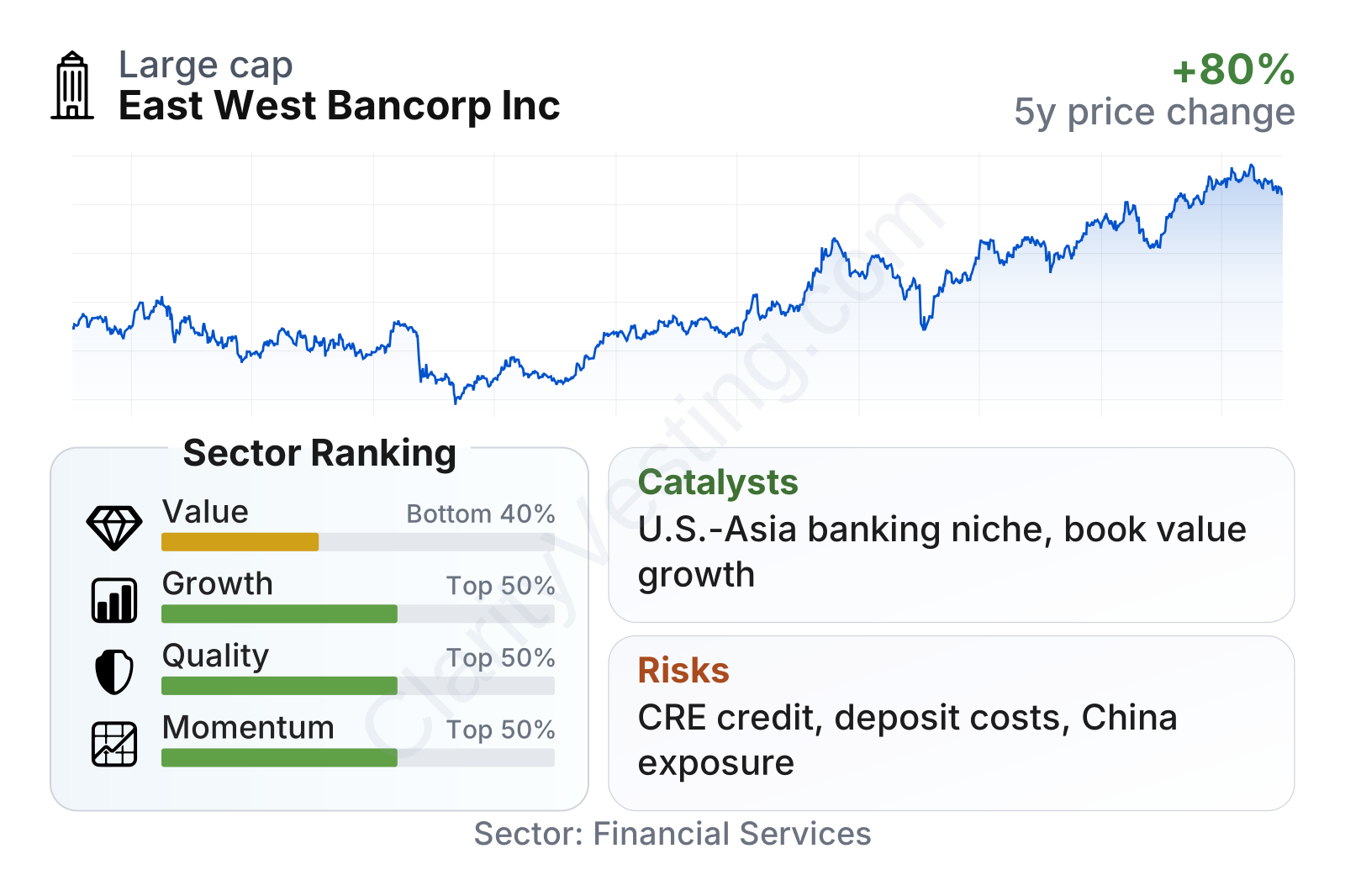
East West Bancorp is a large regional bank by market value, but still much smaller than the biggest U.S. banking groups. The stock’s recent trading history shows that it has recovered strongly from the 2023 regional-bank stress and has moved well above its level from a few years ago. On fundamental measures, the picture is mixed but generally favorable: profitability and balance-sheet quality rank better than many peers, growth is around the upper half of the sector, while valuation is not especially cheap on book value even though the earnings multiple remains close to the sector median.
Growth
Banking is not a high-growth industry in the same way as software or semiconductors, but well-run banks can still compound value steadily over long periods. East West operates in parts of the market that remain relevant for future expansion: commercial lending, treasury services, cross-border payments, trade-related banking, and affluent customer relationships in large metropolitan areas. Those are attractive niches because they can support both loan growth and fee income.
Its strategy also makes practical sense. Instead of competing head-on with the largest national banks on scale alone, East West focuses on relationships where cultural ties, language capabilities, and cross-border expertise matter. That positioning can help customer retention and can support pricing power in specialized services, especially foreign exchange and international commercial banking.
Earnings per share have trended upward over the last several years, with some pauses along the way rather than a perfectly smooth climb. That is typical for banks, whose results move with interest rates, funding costs, credit provisions, and loan demand. The broader pattern still points to a business that has expanded profit per share over time.
Book value per share has increased at a healthy pace, which matters for banks because book value is a rough measure of the capital base supporting future lending and earnings. East West’s growth in book value has been stronger than the sector median over five years, suggesting that value creation has not relied only on favorable rates but also on retained earnings and disciplined capital management.
A meaningful catalyst is the normalization of the banking environment after the deposit panic that hit regional banks in 2023. As customers regain confidence and funding conditions stabilize, banks with strong deposit franchises and consistent credit performance can regain valuation premiums. East West appears to fit that profile better than many smaller peers.
Another growth driver is its continued role in U.S.-Asia business flows. Even when geopolitical headlines create uncertainty, companies still need trade finance, payments, cash management, and foreign-exchange services. East West’s long-established network in this area gives it a practical route to grow beyond plain loan balances.
Recent company updates have also highlighted solid capital levels, ongoing loan production, and continued shareholder distributions through dividends and repurchases. None of that guarantees faster growth, but it does reinforce the idea that management sees the franchise as healthy enough to keep expanding while returning excess capital.
Risks
This article is for informational purposes only and does not constitute financial advice. Some content is AI-generated. See Disclaimer