Stock Analysis · Edwards Lifesciences Corp (EW)
Overview
Edwards Lifesciences is a medical technology company focused mainly on structural heart disease and critical care. Its best-known products are replacement heart valves delivered through minimally invasive procedures, especially for patients with aortic stenosis, a serious narrowing of the aortic valve. The company also sells surgical heart valves, repair products for the mitral and tricuspid valves, and advanced monitoring systems used in hospitals.
Its business is concentrated in a few specialized areas rather than spread across many unrelated products. That focus helps make the company easier to understand: it is largely a heart-device specialist with a growing position in less invasive treatment and hospital monitoring.
Based on the company’s recent annual reporting, revenue is mainly generated from the following segments:
- Transcatheter Aortic Valve Replacement (TAVR): approximately 65% to 70%. This is the company’s core business. It includes catheter-based replacement valves used instead of open-heart surgery for many aortic stenosis patients.
- Transcatheter Mitral and Tricuspid Therapies (TMTT): approximately 5% to 10%. This area includes newer therapies for mitral and tricuspid valve disease and is still much smaller, but strategically important.
- Surgical Structural Heart: approximately 15% to 20%. This includes surgical tissue valves and related surgical products used in open procedures.
- Critical Care: approximately 15% to 20%. This segment includes hemodynamic monitoring systems and sensors used in intensive care and surgical settings.
Geographically, Edwards is broadly international, with the United States as its largest market and meaningful sales across Europe, Japan, and other developed healthcare systems where structural heart procedures are well established.
The company’s financial profile shows a business that keeps a large share of revenue after manufacturing costs, while continuing to spend heavily on research, clinical trials, and commercialization. Revenue has grown over the last several years, but profit has been more uneven because newer product launches and expansion efforts have increased operating costs.
The long-term pattern is still favorable: revenue has moved upward overall since 2021, while research and selling expenses have also risen as Edwards invests in new heart-valve categories beyond its core aortic franchise.
Key Figures
| Metric | Value | Sector ⓘ |
|---|---|---|
| Date | Oct 17, 2026 | |
| Context | ||
| Sector | Healthcare | |
| Industry | Medical Devices | |
| Market Cap ⓘ | $49.83B | |
| Beta ⓘ | 0.86 | |
Value (Cheapness) | ||
| P/E Ratio ⓘ | 50.85 | 24.79 |
| P/B Ratio ⓘ | 4.84 | 3.08 |
| FCF Yield ⓘ | 2.88% | 3.15% |
| Dividend Yield ⓘ | N/A | 1.94% |
| EBIT / EV ⓘ | 3.05% | 0.57% |
| PEG ⓘ | 1.85 | |
Growth (Business expansion) | ||
| Revenue Growth ⓘ | 13.60% | 7.45% |
| RPS Growth (5Y CAGR) ⓘ | 5.73% | 8.61% |
| EPS Growth (5Y CAGR) ⓘ | -11.63% | -17.81% |
| BVPS Growth (5Y CAGR) ⓘ | 17.54% | 3.72% |
| Margin Growth (5Y Trend) ⓘ | -12.02% | -0.62% |
| FCF Growth (5Y CAGR) ⓘ | -1.22% | 1.04% |
| DPS Growth (5Y CAGR) ⓘ | 75.05% | 6.77% |
Quality (Business durability) | ||
| ROIC (Latest) ⓘ | 8.92% | 3.24% |
| ROA (Latest) ⓘ | 7.41% | 3.01% |
| ROIC (5Y Median) ⓘ | 19.68% | 4.60% |
| ROA (5Y Median) ⓘ | 18.12% | 1.89% |
| Net Debt / EBIT (Latest) ⓘ | -1.55 | 1.34 |
| Net Debt / EBIT (5Y Median) ⓘ | -0.29 | 1.84 |
| Net Debt / EBITDA (Latest) ⓘ | -1.39 | 1.00 |
| Net Debt / Assets ⓘ | -15.88% | 5.45% |
| EBITDA / Interest ⓘ | N/A | 9.64 |
| Operating Margin (Latest) ⓘ | 21.76% | 9.27% |
| Operating Margin (5Y Median) ⓘ | 28.82% | 7.38% |
| Debt to Equity (Latest) ⓘ | 6.63% | 28.58% |
| Profit Margin (Latest) ⓘ | 15.43% | 3.59% |
| Free Cash Flow (Latest) ⓘ | $1.43B | |
Momentum (Price trend) | ||
| 3Y Return ⓘ | +23.61% | +42.80% |
| 12M Return (excl. last month) ⓘ | +12.74% | +18.50% |
| 6M Return ⓘ | +12.66% | +7.57% |
| Price vs. 200-Day MA ⓘ | +3.48% | +5.12% |
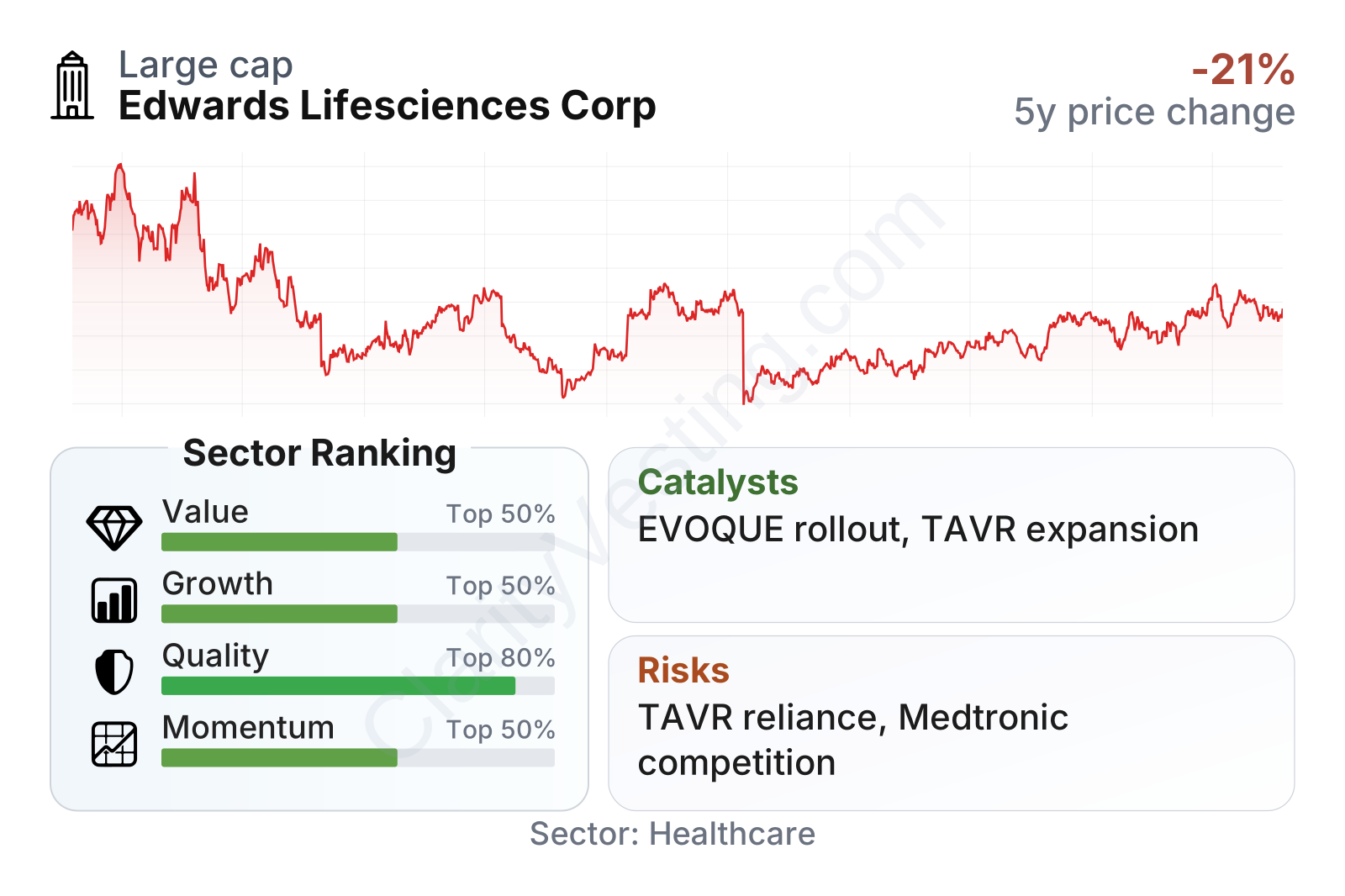
Edwards is a large medical device company with relatively low share-price volatility compared with the broader stock market. The quality profile stands out: profitability and returns on assets have been stronger than much of the healthcare equipment sector, and balance-sheet leverage is very low. Growth metrics are mixed but still above the sector median overall, helped by recent revenue acceleration. The weaker areas are valuation and recent share-price momentum. In simple terms, the business looks financially solid, but the stock still trades at a premium and has not been one of the sector’s strongest recent performers.
Growth
Edwards operates in an attractive long-term market. Structural heart disease treatment benefits from several durable trends: aging populations, broader diagnosis of valve disease, physician preference for less invasive procedures, and the expansion of treatment into patients who were previously untreated or managed later in disease progression. These are not short-lived themes. They are tied to demographics and to steady medical adoption.
The company’s strategy also makes sense. Its TAVR franchise already has deep clinical evidence, hospital relationships, and specialist training networks. Edwards is trying to use that installed base to expand into adjacent valve categories, especially mitral and tricuspid therapies. If successful, that would matter because those diseases affect large patient populations and have historically had fewer effective minimally invasive options.
Recent revenue growth has clearly improved. After a weaker stretch in 2023 and early 2024, year-over-year growth rebounded into high-single-digit and then low-to-mid-teen percentages, with recent readings well above the healthcare sector median. That suggests the core business has regained momentum, even if growth is not perfectly smooth from quarter to quarter.
Cash generation has also recovered from a temporary dip. Free cash flow fell sharply around 2024, then moved back above the $1 billion level. That matters because a company funding large clinical programs and product launches ideally does so from internally generated cash rather than relying on debt.
A major catalyst is Edwards’ push into the tricuspid valve market, particularly with its EVOQUE system. Regulatory progress and expanding physician adoption in this category could open an important new leg of growth because tricuspid regurgitation has been historically underdiagnosed and undertreated. Another catalyst is continued TAVR adoption in lower-risk and broader patient populations as evidence and guideline support develop further.
Recent company communications have also emphasized ongoing innovation in structural heart therapy platforms and imaging-guided procedure improvement. In practical terms, Edwards is not only trying to sell more valves; it is trying to deepen its role in the full treatment pathway for structural heart patients.
Risks
This article is for informational purposes only and does not constitute financial advice. Some content is AI-generated. See Disclaimer


