Stock Analysis · Evercore Partners Inc (EVR)
Overview
Evercore Partners Inc. is an independent investment banking and wealth management firm. In simple terms, it advises large companies, financial sponsors, governments, and wealthy clients on major financial decisions. Its best-known activity is corporate advisory work, especially mergers and acquisitions, restructurings, capital raises, and other strategic transactions. Unlike large universal banks, Evercore is focused on advice rather than balance-sheet-heavy lending and trading, which gives it a more specialized business model.
The company reports its business in two main segments: Investment Banking and Wealth Management. Investment Banking is by far the core profit engine. Within that segment, advisory fees are the dominant source of revenue, while underwriting fees are a much smaller contributor. Wealth Management adds recurring fee-based revenue from advising high-net-worth clients and managing assets.
Based on recent company reporting, Evercore’s revenue mix can be summarized approximately as follows:
- Investment Banking Advisory: about 80% to 90% of total revenue. This includes advice on mergers and acquisitions, strategic reviews, restructurings, shareholder matters, and capital structure decisions.
- Wealth Management: about 10% to 20% of total revenue. This mainly includes fees based on client assets, portfolio advice, and related services for affluent individuals and families.
- Underwriting and other investment banking revenue: generally less than 10% of total revenue. This includes equity and debt capital markets activity, which is more cyclical and less central than advisory.
That mix matters for long-term analysis because advisory-led firms usually have less balance-sheet risk than large banks, but their revenue can move sharply with corporate deal activity. Evercore’s recent financial path reflects exactly that pattern: revenue and earnings dipped when transactions slowed, then recovered strongly as activity improved.
The company’s revenue has been cyclical rather than steadily linear. After a decline from the 2021 peak into 2023, total revenue rebounded strongly through 2024 and 2025, while operating income and net income also recovered. Costs remain dominated by compensation and other operating expenses, which is typical for an advisory business where talent is the main asset.
Key Figures
| Metric | Value | Sector ⓘ |
|---|---|---|
| Date | Oct 24, 2026 | |
| Context | ||
| Sector | Financial Services | |
| Industry | Capital Markets | |
| Market Cap ⓘ | $9.69B | |
| Beta ⓘ | 1.51 | |
Value (Cheapness) | ||
| P/E Ratio ⓘ | 14.19 | 12.46 |
| P/B Ratio ⓘ | 6.83 | 1.25 |
| FCF Yield ⓘ | 16.78% | 9.82% |
| Dividend Yield ⓘ | 1.37% | 2.94% |
| EBIT / EV ⓘ | 10.43% | 8.11% |
| PEG ⓘ | 1.15 | |
Growth (Business expansion) | ||
| Revenue Growth ⓘ | 18.80% | 9.10% |
| RPS Growth (5Y CAGR) ⓘ | 3.45% | 12.31% |
| EPS Growth (5Y CAGR) ⓘ | -3.56% | -6.97% |
| BVPS Growth (5Y CAGR) ⓘ | 14.06% | 5.02% |
| Margin Growth (5Y Trend) ⓘ | -13.31% | -4.00% |
| FCF Growth (5Y CAGR) ⓘ | -3.38% | 4.71% |
| DPS Growth (5Y CAGR) ⓘ | 4.38% | 8.92% |
Quality (Business durability) | ||
| ROIC (Latest) ⓘ | 33.84% | 9.18% |
| ROE (Latest) ⓘ | 48.51% | 13.93% |
| ROA (Latest) ⓘ | 16.33% | 1.57% |
| ROIC (5Y Median) ⓘ | 27.26% | 7.80% |
| ROE (5Y Median) ⓘ | 36.80% | 12.15% |
| ROA (5Y Median) ⓘ | 12.42% | 1.28% |
| Net Debt / EBIT (Latest) ⓘ | -0.16 | 1.02 |
| Net Debt / EBIT (5Y Median) ⓘ | -0.03 | 0.72 |
| Net Debt / EBITDA (Latest) ⓘ | -0.16 | 0.88 |
| Operating Margin (Latest) ⓘ | 21.66% | 22.30% |
| Operating Margin (5Y Median) ⓘ | 20.46% | 24.50% |
| Debt to Equity (Latest) ⓘ | 58.82% | 59.34% |
| Profit Margin (Latest) ⓘ | 15.82% | 26.42% |
| Free Cash Flow (Latest) ⓘ | $1.63B | |
Momentum (Price trend) | ||
| 3Y Return ⓘ | +103.02% | +95.73% |
| 12M Return (excl. last month) ⓘ | -24.92% | +17.30% |
| 6M Return ⓘ | -27.04% | +6.07% |
| Price vs. 200-Day MA ⓘ | -19.51% | +5.36% |
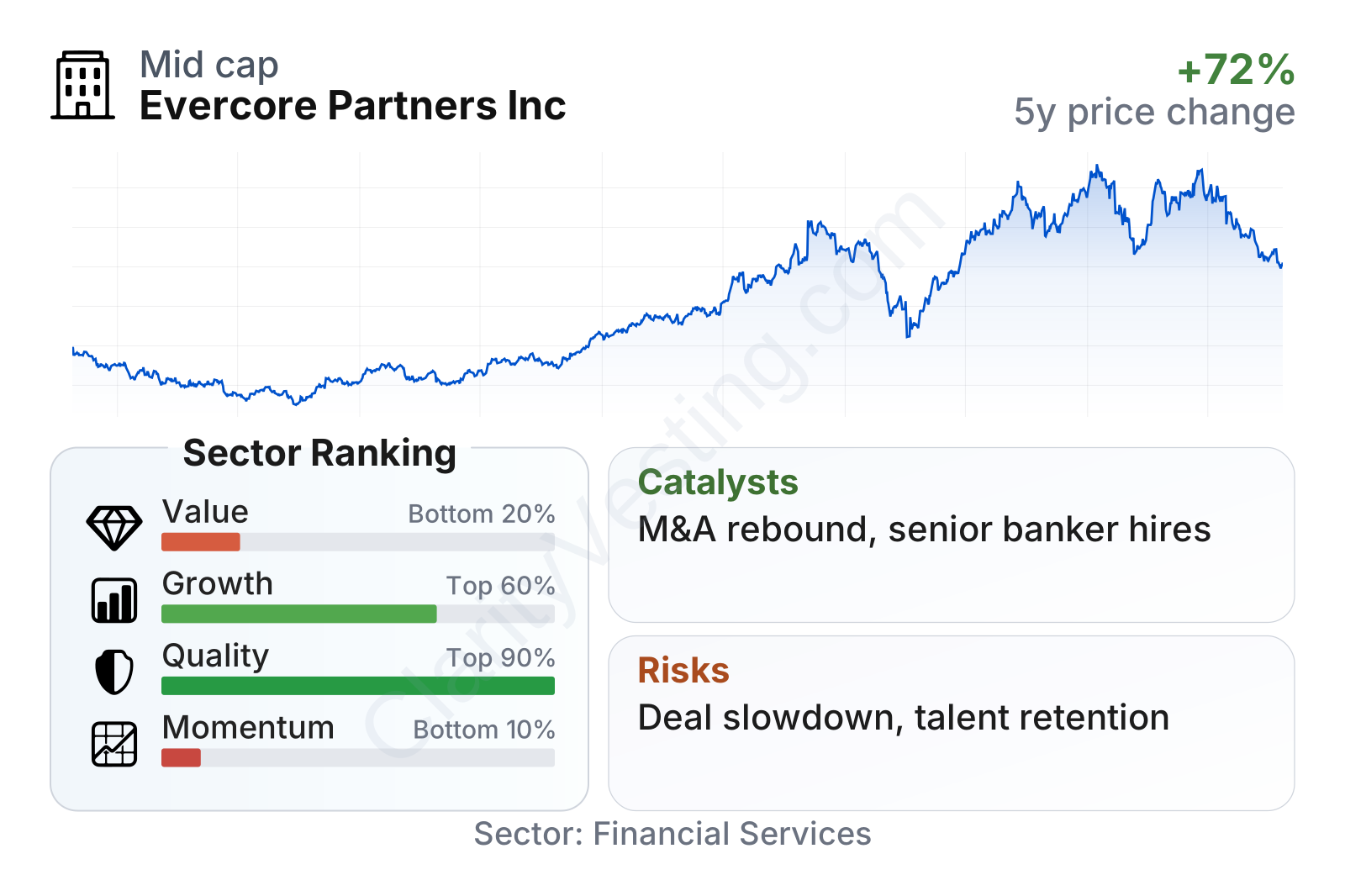
Evercore looks like a high-quality but not statistically cheap company. Profitability metrics stand far above most of the financial sector, helped by a strong advisory franchise and a balance sheet that carries net cash rather than heavy leverage. Growth is mixed: recent year-over-year revenue improvement has been strong, but the longer five-year record is less smooth because dealmaking activity moves in cycles. On valuation, the company screens as expensive on book value and somewhat above the sector on earnings multiples, while free cash flow generation remains solid. Share-price momentum has recently been weak even though the longer multi-year return has been strong.
In market terms, Evercore is a mid-sized financial company with above-average volatility. Its beta is elevated, which fits a stock tied to market sentiment, M&A activity, and confidence in corporate executives’ willingness to transact.
Growth
Evercore operates in a sector with long-term structural relevance but short-term cyclicality. Corporate advisory is not a fading business. Large companies continue to reshape themselves through acquisitions, divestitures, spin-offs, restructurings, activism defense, and capital structure work. As businesses become more global and industries consolidate, independent strategic advice remains valuable. That supports the long-term demand backdrop, even if annual revenue can swing sharply.
The company’s strategy for growth is coherent. Evercore has spent years building a reputation as a conflict-light advisor, hiring senior bankers in industry and product niches, and expanding selectively in areas such as restructuring, capital markets support, and private capital advisory. This matters because elite advisory firms tend to win business based on relationships and credibility, not scale alone. In that kind of market, recruiting and retaining top rainmakers can directly translate into future revenue.
Earnings per share show how cyclical the business can be: a very strong 2021 was followed by weaker 2022 and 2023 results, then a meaningful recovery in 2024 and 2025. That pattern suggests Evercore is highly sensitive to industry deal volumes, but also capable of strong rebound economics when conditions improve.
Book value per share has moved upward steadily over the last several years, which is a healthier signal than the earnings volatility alone might suggest. It indicates that the firm has continued to build shareholder capital over time even through a tougher advisory environment. The five-year growth rate in book value per share is also well ahead of the sector median, showing that the business has created value through the cycle.
A key catalyst is the potential normalization of global deal activity. When interest rates stabilize, financing markets remain open, and boards regain confidence, M&A and strategic advisory demand can recover quickly. Evercore is well positioned for that because it is concentrated in advisory, where fee pools can expand significantly in stronger markets. The firm has also highlighted continued senior banker hiring and franchise expansion in recent periods, which can support future market share if those hires become productive.
Another favorable element is the company’s wealth management operation. It is much smaller than advisory, but it provides a steadier fee stream that can modestly reduce reliance on large episodic transactions. Over time, that segment can help smooth the overall business mix, even if it does not change the firm’s core identity.
Risks
This article is for informational purposes only and does not constitute financial advice. Some content is AI-generated. See Disclaimer


