Stock Analysis · Evergrande Property Services Group Limited (EVGPF)
Overview
Evergrande Property Services Group Limited is a Chinese property management company. In simple terms, it helps manage residential communities and other properties after they are built. Its work includes basic services such as security, cleaning, repairs, landscaping, and community operations, along with a range of add-on services for residents and developers.
The business was originally built around projects developed by China Evergrande Group, but over time it has also expanded to properties developed by third parties. That matters because long-term durability in property services usually depends on recurring management contracts, resident retention, and the ability to win projects beyond a single parent developer.
Based on the company’s annual reporting structure in recent years, revenue mainly comes from three areas.
- Property management services: approximately 55% to 65% of revenue. This is the core recurring activity and typically includes security, cleaning, maintenance, landscaping, and day-to-day management fees collected from property owners or residents.
- Community value-added services: approximately 15% to 25% of revenue. This usually includes home-living and resident-oriented services such as repair support, community retail-related offerings, and other services sold to people already living in managed communities.
- Value-added services to non-property owners: approximately 15% to 25% of revenue. This area generally includes services provided to developers or other parties, such as pre-delivery support, consulting, and related project services.
The broad picture is that Evergrande Property Services operates in a business that can be steadier than homebuilding itself, because property management tends to generate repeat fees once a project is occupied. However, in this specific case, the company’s identity is still heavily shaped by its historical connection to the Evergrande ecosystem, which remains central to how the market views it.
Over the last several years, revenue has been relatively stable to slightly higher, but profitability has been much more uneven. After a loss in 2021, operating and net profit recovered in 2022 and remained positive through 2025, although earnings have trended below the post-rebound peak. That suggests the company still generates real operating income, but with pressure on margins and a business mix that appears less lucrative than before.
Key Figures
| Metric | Value | Sector ⓘ |
|---|---|---|
| Date | Oct 17, 2026 | |
| Context | ||
| Sector | Real Estate | |
| Industry | Real Estate Services | |
| Market Cap ⓘ | $1.41B | |
| Beta ⓘ | 1.09 | |
Value (Cheapness) | ||
| P/E Ratio ⓘ | 13.08 | 17.38 |
| P/B Ratio ⓘ | 0.08 | 0.85 |
| FCF Yield ⓘ | 178.63% | 7.38% |
| Dividend Yield ⓘ | N/A | 4.85% |
| EBIT / EV ⓘ | N/A | 3.78% |
| PEG ⓘ | N/A | |
Growth (Business expansion) | ||
| Revenue Growth ⓘ | 4.50% | 5.30% |
| RPS Growth (5Y CAGR) ⓘ | 67.56% | 6.02% |
| EPS Growth (5Y CAGR) ⓘ | 13.25% | -11.37% |
| BVPS Growth (5Y CAGR) ⓘ | N/A | 0.45% |
| Margin Growth (5Y Trend) ⓘ | 12.11% | -0.22% |
| FCF Growth (5Y CAGR) ⓘ | -28.60% | 5.40% |
| DPS Growth (5Y CAGR) ⓘ | -78.88% | 5.02% |
Quality (Business durability) | ||
| ROIC (Latest) ⓘ | N/A | 5.69% |
| ROE (Latest) ⓘ | 178.29% | 7.56% |
| ROA (Latest) ⓘ | 21.79% | 2.85% |
| ROIC (5Y Median) ⓘ | 64.15% | 4.22% |
| ROE (5Y Median) ⓘ | N/A | 6.03% |
| ROA (5Y Median) ⓘ | 12.04% | 2.44% |
| Net Debt / EBIT (Latest) ⓘ | -1.28 | 7.59 |
| Net Debt / EBIT (5Y Median) ⓘ | -1.33 | 8.40 |
| Net Debt / EBITDA (Latest) ⓘ | -1.19 | 5.27 |
| Net Debt / Assets ⓘ | -38.09% | 37.76% |
| EBITDA / Interest ⓘ | 15.35 | 4.10 |
| Operating Margin (Latest) ⓘ | 10.72% | 35.29% |
| Operating Margin (5Y Median) ⓘ | 11.12% | 37.31% |
| Debt to Equity (Latest) ⓘ | 4.24% | 88.87% |
| Profit Margin (Latest) ⓘ | 7.38% | 19.61% |
| Free Cash Flow (Latest) ⓘ | $2.53B | |
Momentum (Price trend) | ||
| 3Y Return ⓘ | -0.98% | +30.75% |
| 12M Return (excl. last month) ⓘ | +79.42% | +4.36% |
| 6M Return ⓘ | -10.10% | -2.52% |
| Price vs. 200-Day MA ⓘ | -9.89% | -2.34% |
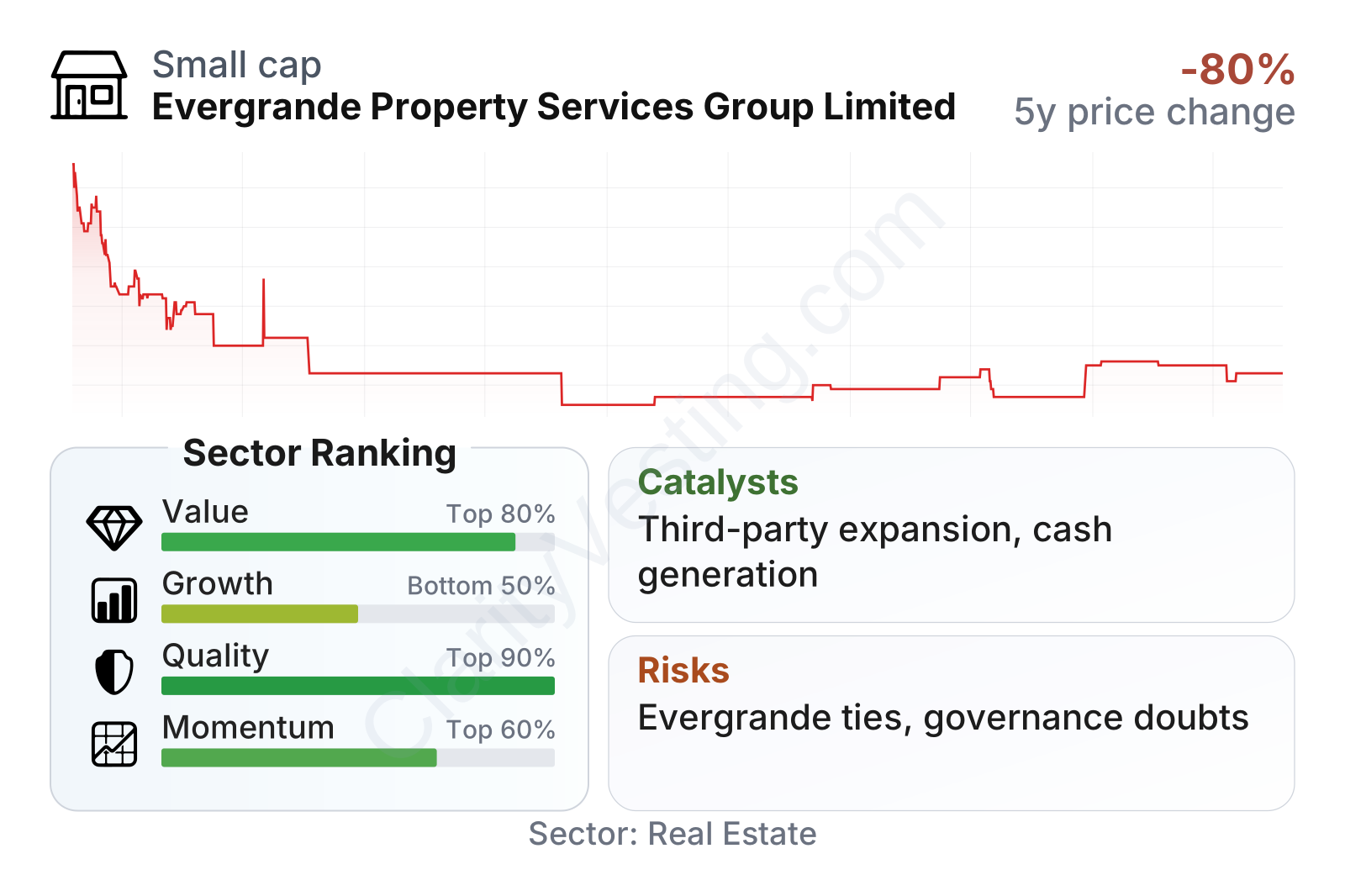
The company screens as unusually strong on balance-sheet quality and headline returns, while looking weaker on growth consistency. Debt is very low relative to equity, and net cash metrics are better than the sector median. Profitability ratios are also far above typical real estate service peers, although readers should treat very high return figures carefully because they can be amplified by a depressed equity base. On valuation, the stock trades at a much lower price-to-book multiple than the sector median and a lower earnings multiple as well. Momentum has been mixed: there was a strong rebound over the past year excluding the most recent month, but the longer share-price record remains highly volatile.
The share-price history reflects that contrast. The stock fell sharply from 2021 levels, then partially recovered from a very low base. That pattern usually signals that the market still sees meaningful uncertainty around the business, even though reported earnings and cash generation have improved from the worst period.
Growth
Property management is still an important sector in China because the installed base of residential communities is enormous, and buildings need ongoing maintenance regardless of whether new home sales are booming. That gives the industry a recurring-service foundation. Over the long run, the better-positioned operators can grow by increasing managed area, cross-selling services to residents, and winning contracts from independent developers or public-sector clients.
For Evergrande Property Services, the strategic logic is clear: reduce dependence on the troubled developer network it came from and lean more on third-party projects and recurring management income. In theory, that is the right direction. A property services company usually becomes more resilient when its customer base broadens and when more of its revenue comes from occupied communities rather than one-off services tied to new project delivery.
Recent revenue trends show modest year-over-year growth rather than a rapid expansion phase. The longer-term revenue-per-share profile looks distorted by a very large jump in the latest period, so the more useful reading is that the business has stabilized after earlier disruption, but it has not yet established a clean, predictable growth track comparable to the strongest names in the sector. Operating margin trend over five years has improved, which is a constructive sign, even if current margins remain below the sector median.
A potential catalyst is simple but important: if the company keeps demonstrating that it can sustain profits, collect cash, and operate independently from the broader Evergrande crisis, the market may gradually place more weight on its standalone property-management economics and less on its legacy association. Another possible support factor is policy stabilization in China’s property market. Even modest improvement in housing completions, resident sentiment, or developer funding conditions could help demand for related services and reduce counterparty stress.
There is no obvious high-powered growth catalyst visible today such as a major new market, transformative acquisition, or breakthrough technology. The opportunity is more about normalization, contract retention, and credibility rebuilding than about explosive expansion.
Risks
This article is for informational purposes only and does not constitute financial advice. Some content is AI-generated. See Disclaimer


