Stock Analysis · eToro Group Ltd (ETOR)
Overview
eToro Group Ltd operates an online investing and trading platform aimed mainly at retail customers. The company lets users trade or invest in assets such as stocks, cryptocurrencies, commodities, currencies, and exchange-traded funds through a single app-based experience. A central part of its brand is “social investing”: users can view other investors’ portfolios, discuss markets, and in some cases copy the trading strategies of other participants. That combination of brokerage, crypto access, and community features is what makes eToro different from a traditional online broker.
Its revenue is mostly transaction-driven, which means results depend heavily on customer trading activity and market conditions. Based on the company’s public filings, the main revenue streams are broadly the following:
- Trading-related revenue from cryptoassets, equities, commodities, currencies, and other instruments: this is the dominant source and accounts for the large majority of revenue. It includes spreads, fees, and other income generated when users trade on the platform.
- Net interest and financing-related income: a smaller but still meaningful source, generated from client balances, margin activity, and interest earned within the platform ecosystem.
- Non-trading service income: a limited share of revenue, including items such as withdrawal, conversion, and other platform-related fees.
Because eToro reports revenue around trading activity rather than in the same segmented way as many banks or exchanges, precise percentages by stream are not always disclosed in a stable format. The broad takeaway is that trading activity is by far the main earnings engine, while interest and service fees play supporting roles. This also means revenue can expand quickly in strong market periods and slow sharply when activity cools.
The financial flow over the last several years shows a business that moved from losses in 2021 and 2022 to clear profitability in 2024 and 2025. Gross profit and operating income improved materially, while research and development spending stayed meaningful, suggesting eToro continued investing in the platform even as profitability recovered.
Key Figures
| Metric | Value | Sector ⓘ |
|---|---|---|
| Date | Oct 24, 2026 | |
| Context | ||
| Sector | Financial Services | |
| Industry | Capital Markets | |
| Market Cap ⓘ | $1.93B | |
| Beta ⓘ | N/A | |
Value (Cheapness) | ||
| P/E Ratio ⓘ | 8.97 | 12.46 |
| P/B Ratio ⓘ | 1.63 | 1.25 |
| FCF Yield ⓘ | 15.68% | 9.82% |
| Dividend Yield ⓘ | N/A | 2.94% |
| EBIT / EV ⓘ | 33.43% | 8.11% |
| PEG ⓘ | N/A | |
Growth (Business expansion) | ||
| Revenue Growth ⓘ | -24.00% | 9.10% |
| RPS Growth (5Y CAGR) ⓘ | 28.04% | 12.31% |
| EPS Growth (5Y CAGR) ⓘ | N/A | -6.97% |
| BVPS Growth (5Y CAGR) ⓘ | -18.49% | 5.02% |
| Margin Growth (5Y Trend) ⓘ | 5.16% | -4.00% |
| FCF Growth (5Y CAGR) ⓘ | N/A | 4.71% |
| DPS Growth (5Y CAGR) ⓘ | N/A | 8.92% |
Quality (Business durability) | ||
| ROIC (Latest) ⓘ | 20.12% | 9.18% |
| ROE (Latest) ⓘ | 19.07% | 13.93% |
| ROA (Latest) ⓘ | 14.45% | 1.57% |
| ROIC (5Y Median) ⓘ | N/A | 7.80% |
| ROE (5Y Median) ⓘ | 2.74% | 12.15% |
| ROA (5Y Median) ⓘ | 0.95% | 1.28% |
| Net Debt / EBIT (Latest) ⓘ | -2.77 | 1.02 |
| Net Debt / EBIT (5Y Median) ⓘ | -6.30 | 0.72 |
| Net Debt / EBITDA (Latest) ⓘ | -2.66 | 0.88 |
| Operating Margin (Latest) ⓘ | 3.88% | 22.30% |
| Operating Margin (5Y Median) ⓘ | 1.79% | 24.50% |
| Debt to Equity (Latest) ⓘ | 2.57% | 59.34% |
| Profit Margin (Latest) ⓘ | 2.18% | 26.42% |
| Free Cash Flow (Latest) ⓘ | $303.22M | |
Momentum (Price trend) | ||
| 3Y Return ⓘ | N/A | +95.73% |
| 12M Return (excl. last month) ⓘ | -37.41% | +17.30% |
| 6M Return ⓘ | -35.46% | +6.07% |
| Price vs. 200-Day MA ⓘ | -26.38% | +5.36% |
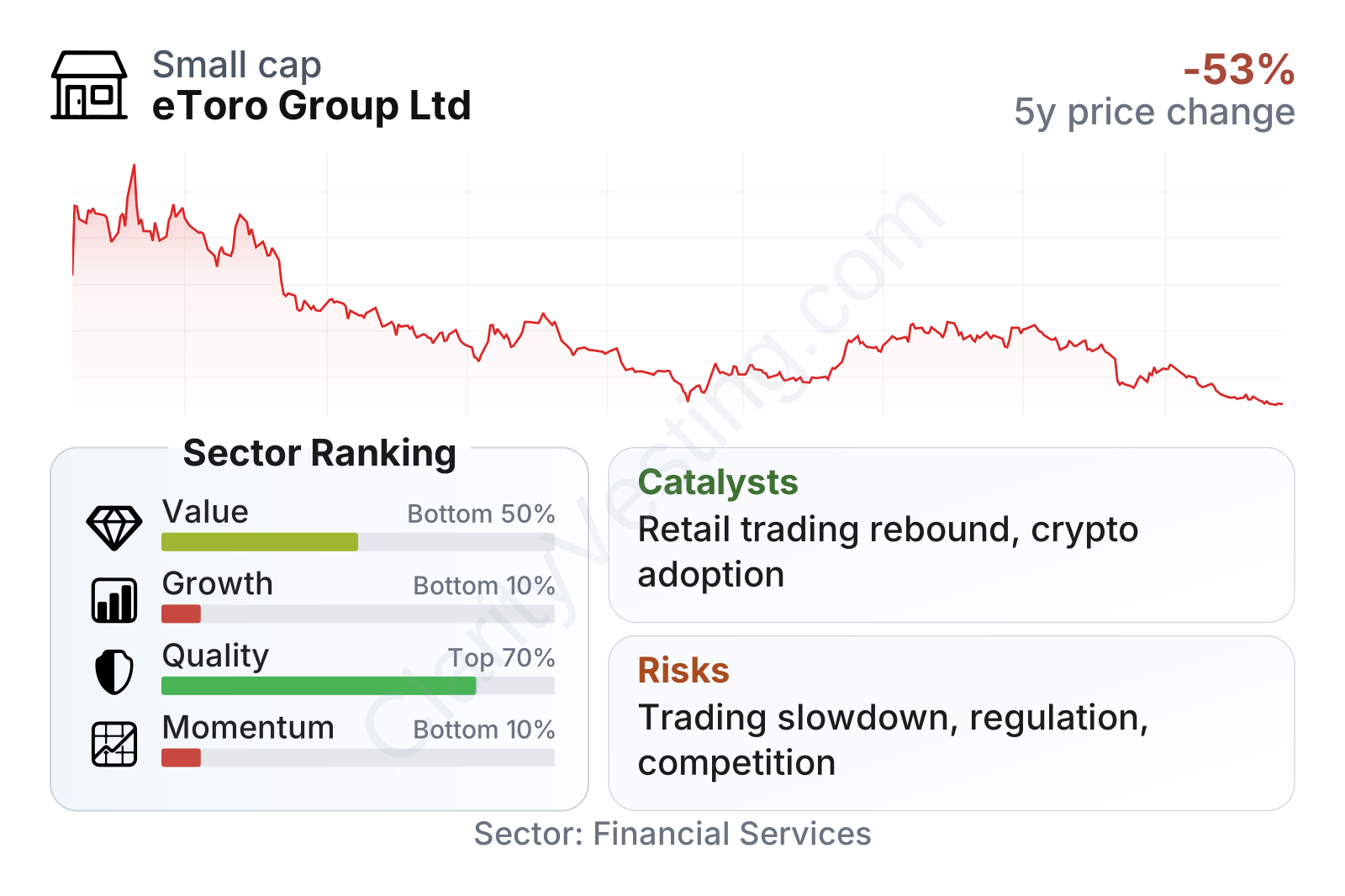
eToro is a mid-sized financial platform by market value. The latest profile is mixed: valuation ratios such as earnings multiple look lower than the sector median, and free cash flow generation appears strong, but growth and market momentum rank near the bottom of the sector. Quality is more favorable, with high recent returns on capital, equity, and assets, plus a very light balance-sheet debt load and net cash characteristics. In short, the market appears to be recognizing current profitability and cash generation, while remaining skeptical about the durability of growth.
The stock chart shows that the shares have been highly volatile since listing, with a steep drop followed by a partial rebound and another pullback. That pattern fits the company’s business model: sentiment can shift quickly when retail trading volumes, crypto activity, or market enthusiasm change.
Growth
eToro operates in a sector with real long-term tailwinds. Retail participation in financial markets has increased over the past decade, mobile-first investing has become mainstream, and younger users are more open to managing money through apps rather than traditional advisors. The continued expansion of exchange-traded products, fractional investing, and digital assets also supports demand for simple multi-asset platforms.
Its strategy is coherent for that environment. eToro is trying to be more than a low-cost broker: it combines investing, active trading, crypto access, and social features in one ecosystem. That can help customer acquisition because the product feels more approachable to beginners than a professional trading platform, while still offering enough range to keep more active users engaged. The social layer can also reduce customer churn if users become attached to the community rather than just the transaction pricing.
Profitability has improved sharply from the earlier loss-making period. Earnings per share moved from deeply negative levels in 2021 to clearly positive territory in 2024 and 2025, showing that operating leverage can be significant when activity rises and costs are kept under control.
That said, growth is not perfectly smooth. The latest year-over-year revenue trend is negative, even though the five-year revenue-per-share trend remains strong. This suggests the company has already shown it can scale over a cycle, but it is still exposed to short-term swings in client activity. Long-term expansion likely depends on broadening revenue beyond the most volatile forms of trading and increasing wallet share from existing users.
Book value per share has been uneven, with a large decline followed by a partial recovery. That pattern reflects the company’s earlier losses, capital structure changes, and the cyclical nature of the business. It does not erase the recent improvement, but it does show that value creation has not been linear.
Recent company developments point to opportunity in three areas. First, eToro’s public listing increased its visibility and access to capital markets. Second, the company continues to position itself around regulated digital-asset access, which could become more attractive if mainstream adoption broadens further. Third, its geographic diversification gives it exposure to multiple retail-investing markets rather than a single country. If management executes well, the platform could benefit from another wave of retail engagement without needing to build an entirely new business model.
Risks
This article is for informational purposes only and does not constitute financial advice. Some content is AI-generated. See Disclaimer


