Stock Analysis · Eaton Corporation PLC (ETN)
Overview
Eaton Corporation plc is a diversified industrial company focused on power management. In simple terms, it makes products and systems that help electricity move safely and efficiently, while also supplying components used in vehicles, aircraft, and industrial equipment. Its business is closely tied to long-term needs such as grid modernization, electrification, data center expansion, factory automation, commercial construction, and aerospace demand.
Eaton reports revenue across several operating segments. Based on its latest annual reporting structure, the main sources of revenue are approximately:
- Electrical Americas: about 46% of revenue. This includes electrical components, power distribution systems, circuit protection, wiring devices, industrial controls, utility power solutions, and services sold mainly in North and South America.
- Electrical Global: about 28% of revenue. This covers similar electrical products and services outside the Americas, including power quality, switchgear, backup power, and industrial electrical systems.
- Aerospace: about 10% of revenue. Eaton supplies fuel, hydraulics, motion control, and engine-related systems for commercial and military aircraft.
- Vehicle: about 9% of revenue. This segment mainly serves commercial vehicles with transmissions, clutches, valve actuation, and drivetrain-related technologies.
- eMobility: about 4% of revenue. This business provides power electronics, circuit protection, and electric vehicle components.
- Other / Corporate and residual activities: roughly 3% or less, depending on the reporting period.
The revenue mix matters because Eaton is no longer mainly a traditional vehicle supplier. The company has become much more centered on electrical systems, which are typically higher margin and more directly exposed to structural themes like digital infrastructure and electrification. Over the last several years, that shift has helped lift profitability as the electrical businesses took a larger role in the company’s overall results.
The long-term pattern shows a business that has expanded sales while improving operating profit faster than revenue. Costs and overhead have risen in absolute dollars, but margins have still improved, which suggests better mix, pricing, and operating discipline.
Key Figures
| Metric | Value | Sector ⓘ |
|---|---|---|
| Date | Oct 03, 2026 | |
| Context | ||
| Sector | Industrials | |
| Industry | Specialty Industrial Machinery | |
| Market Cap ⓘ | $168.28B | |
| Beta ⓘ | 1.17 | |
Value (Cheapness) | ||
| P/E Ratio ⓘ | 43.85 | 22.45 |
| P/B Ratio ⓘ | 8.28 | 1.98 |
| FCF Yield ⓘ | 2.34% | 6.31% |
| Dividend Yield ⓘ | 0.99% | 1.96% |
| EBIT / EV ⓘ | 2.76% | 4.81% |
| PEG ⓘ | 2.67 | |
Growth (Business expansion) | ||
| Revenue Growth ⓘ | 21.40% | 9.10% |
| RPS Growth (5Y CAGR) ⓘ | 9.58% | 7.75% |
| EPS Growth (5Y CAGR) ⓘ | -6.18% | -13.59% |
| BVPS Growth (5Y CAGR) ⓘ | 5.10% | 6.22% |
| Margin Growth (5Y Trend) ⓘ | 3.44% | 0.72% |
| FCF Growth (5Y CAGR) ⓘ | 22.30% | 10.98% |
| DPS Growth (5Y CAGR) ⓘ | 8.29% | 9.48% |
Quality (Business durability) | ||
| ROIC (Latest) ⓘ | 11.89% | 10.92% |
| ROA (Latest) ⓘ | 7.91% | 5.41% |
| ROIC (5Y Median) ⓘ | 11.92% | 9.21% |
| ROA (5Y Median) ⓘ | 8.76% | 4.94% |
| Net Debt / EBIT (Latest) ⓘ | 3.95 | 2.07 |
| Net Debt / EBIT (5Y Median) ⓘ | 2.44 | 2.28 |
| Net Debt / EBITDA (Latest) ⓘ | 3.23 | 1.43 |
| Net Debt / Assets ⓘ | 37.10% | 19.27% |
| EBITDA / Interest ⓘ | 14.54 | 9.53 |
| Operating Margin (Latest) ⓘ | 17.56% | 10.50% |
| Operating Margin (5Y Median) ⓘ | 16.48% | 10.27% |
| Debt to Equity (Latest) ⓘ | 105.29% | 65.48% |
| Profit Margin (Latest) ⓘ | 12.75% | 6.62% |
| Free Cash Flow (Latest) ⓘ | $3.93B | |
Momentum (Price trend) | ||
| 3Y Return ⓘ | +109.14% | +58.56% |
| 12M Return (excl. last month) ⓘ | +16.38% | +15.63% |
| 6M Return ⓘ | +20.77% | +4.19% |
| Price vs. 200-Day MA ⓘ | +11.18% | +0.93% |
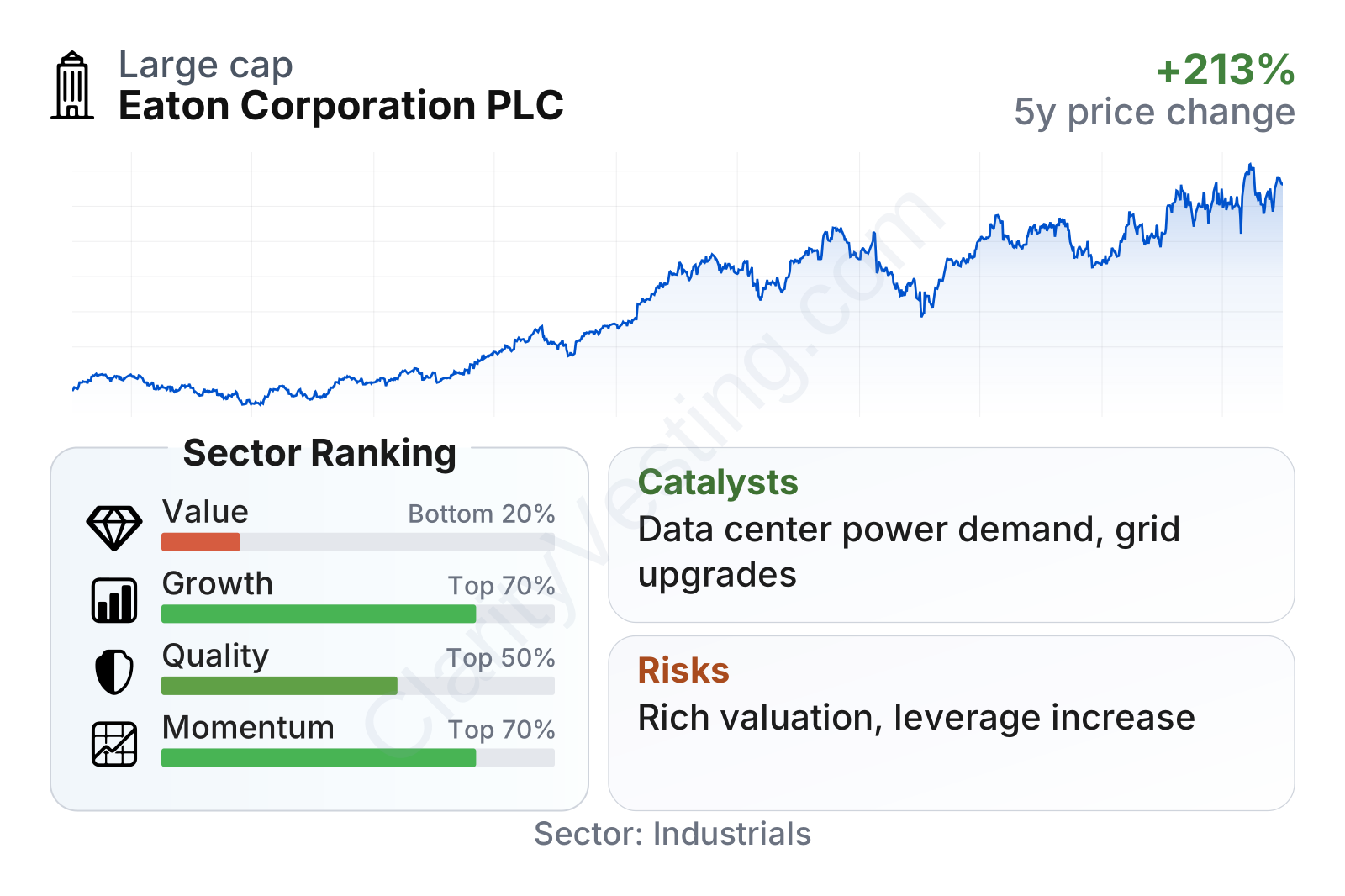
Eaton is a very large industrial company with share price performance that has been strong over multiyear periods, but the current profile is uneven across categories. Growth and market momentum rank above much of the sector, while valuation looks demanding. Profitability is clearly stronger than the sector median, but leverage has moved up, which weakens the quality picture despite solid returns on capital and strong interest coverage.
Growth
Eaton operates in markets with favorable long-term demand. The most important one is electrical infrastructure: utilities are upgrading grids, commercial buildings are becoming more power-intensive, factories need more automation, and data centers are consuming far more electricity than in the past. That last point has become especially important because AI-related computing needs more power distribution, backup systems, and protection equipment, all areas where Eaton already has a meaningful presence.
The company’s strategy broadly fits these trends. Management has spent years repositioning Eaton toward electrical businesses with better growth and margins, while keeping exposure to aerospace and selected vehicle markets. This gives the company a mix of cyclical and structural demand drivers, with the electrical platform doing most of the heavy lifting.
Revenue growth has remained positive for an extended period and appears to have accelerated again recently, reaching a pace well above the sector median. That does not remove cyclicality, but it does suggest Eaton is capturing more than just a general industrial upswing.
Cash generation has also trended higher over the last several years. Rising free cash flow is important because it gives the company more flexibility to fund factory expansion, acquisitions, debt service, dividends, and share repurchases without depending as heavily on outside financing.
Recent company updates have also pointed to heavy investment in North American manufacturing capacity for transformers, switchgear, and other electrical equipment tied to utility and data center demand. Those projects matter because order backlogs alone do not create growth unless capacity is available to deliver products. In that sense, expansion spending is a practical signal that management expects demand to remain strong.
Another useful catalyst is aerospace. Commercial aviation recovery and defense demand can support Eaton’s aerospace segment for several years, adding a second growth engine next to electrical infrastructure. eMobility is still a smaller contributor, but it gives the company exposure to higher-voltage architectures and electrified transportation if that market scales further.
Risks
This article is for informational purposes only and does not constitute financial advice. Some content is AI-generated. See Disclaimer