Stock Analysis · Essex Property Trust Inc (ESS)
Overview
Essex Property Trust is a residential real estate investment trust, or REIT. In simple terms, it owns apartment communities and makes money mainly by renting homes to residents. The company focuses on the U.S. West Coast, especially Southern California, Northern California, and the Seattle metropolitan area. This is a relatively concentrated strategy: Essex is not trying to own every kind of real estate, but to specialize in high-quality multifamily housing in supply-constrained coastal markets.
That business model is straightforward. Essex buys, develops, redevelops, and operates apartment properties, and in return collects recurring rental income. Because it is organized as a REIT, a large part of its economic appeal comes from steady property cash flow and regular dividends rather than from rapid expansion into many unrelated businesses.
The company’s revenue is dominated by property operations. Based on recent company reporting, the mix is approximately as follows:
- Rental and property revenue: about 95% to 97% — monthly apartment rents, parking, utilities reimbursements, and other property-level charges from operating communities.
- Management and other fees: about 1% to 3% — fees and ancillary income tied to services or partner-related activities.
- Property development, disposition-related, and other income: about 1% to 3% — items that can vary from year to year and are usually less recurring than rent.
Over the last several years, total revenue has continued to move upward, from roughly $1.4 billion in 2021 to about $1.9 billion in 2025. At the same time, operating profitability has remained solid, which matters for a landlord because stable margins help support dividends, property reinvestment, and debt service.
Essex is a large public apartment REIT rather than a broad real estate conglomerate. That makes the company relatively easy to understand: long-term performance largely depends on occupancy, rent growth, development discipline, balance-sheet management, and housing conditions in its core coastal markets.
The business mix has remained consistent: rent-driven revenue is expanding, while operating income and net income have been more volatile because financing costs, taxes, and property-level expenses can swing from year to year. Even so, the broad direction of revenue has been positive.
Key Figures
| Metric | Value | Sector ⓘ |
|---|---|---|
| Date | Oct 17, 2026 | |
| Context | ||
| Sector | Real Estate | |
| Industry | REIT - Residential | |
| Market Cap ⓘ | $18.57B | |
| Beta ⓘ | 0.71 | |
Value (Cheapness) | ||
| P/E Ratio ⓘ | 42.29 | 17.38 |
| P/B Ratio ⓘ | 3.39 | 0.85 |
| FCF Yield ⓘ | 5.61% | 7.38% |
| Dividend Yield ⓘ | 3.80% | 4.85% |
| EBIT / EV ⓘ | 2.86% | 3.78% |
| PEG ⓘ | 7.39 | |
Growth (Business expansion) | ||
| Revenue Growth ⓘ | 3.10% | 5.30% |
| RPS Growth (5Y CAGR) ⓘ | 7.43% | 6.02% |
| EPS Growth (5Y CAGR) ⓘ | 6.60% | -11.37% |
| BVPS Growth (5Y CAGR) ⓘ | -2.72% | 0.45% |
| Margin Growth (5Y Trend) ⓘ | -18.03% | -0.22% |
| FCF Growth (5Y CAGR) ⓘ | 4.47% | 5.40% |
| DPS Growth (5Y CAGR) ⓘ | 5.02% | 5.02% |
Quality (Business durability) | ||
| ROIC (Latest) ⓘ | 5.01% | 5.69% |
| ROE (Latest) ⓘ | 7.83% | 7.56% |
| ROA (Latest) ⓘ | 3.20% | 2.85% |
| ROIC (5Y Median) ⓘ | 7.80% | 4.22% |
| ROE (5Y Median) ⓘ | 8.10% | 6.03% |
| ROA (5Y Median) ⓘ | 3.77% | 2.44% |
| Net Debt / EBIT (Latest) ⓘ | 9.66 | 7.59 |
| Net Debt / EBIT (5Y Median) ⓘ | 7.14 | 8.40 |
| Net Debt / EBITDA (Latest) ⓘ | 5.12 | 5.27 |
| Net Debt / Assets ⓘ | 51.80% | 37.76% |
| EBITDA / Interest ⓘ | 5.02 | 4.10 |
| Operating Margin (Latest) ⓘ | 35.89% | 35.29% |
| Operating Margin (5Y Median) ⓘ | 50.26% | 37.31% |
| Debt to Equity (Latest) ⓘ | 126.77% | 88.87% |
| Profit Margin (Latest) ⓘ | 20.89% | 19.61% |
| Free Cash Flow (Latest) ⓘ | $1.04B | |
Momentum (Price trend) | ||
| 3Y Return ⓘ | +37.35% | +30.75% |
| 12M Return (excl. last month) ⓘ | +8.47% | +4.36% |
| 6M Return ⓘ | +9.11% | -2.52% |
| Price vs. 200-Day MA ⓘ | +2.06% | -2.34% |
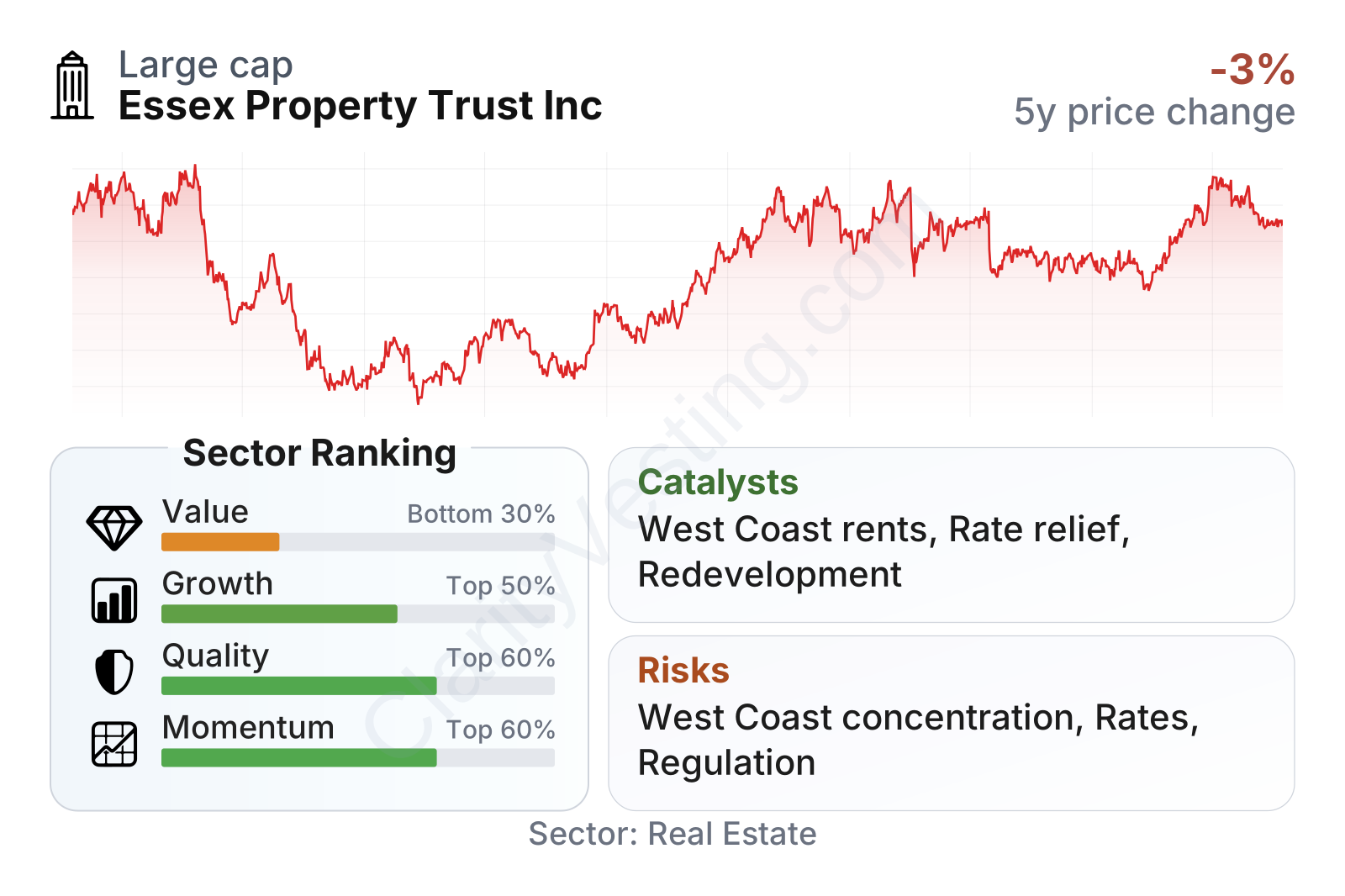
Essex stands out as a large residential REIT with relatively low share-price volatility, reflected in a beta below 1. Quality and market momentum look better than many peers, while value and recent growth rankings are less favorable. In practical terms, the market is paying a premium for a business that has historically produced solid returns on assets and equity, but that premium leaves less room for disappointment if growth stays moderate.
The share price path over the last few years also shows the typical sensitivity of apartment REITs to interest-rate expectations. Essex fell sharply during the 2022 rate reset, then recovered as operating fundamentals remained intact and sentiment toward quality residential real estate improved.
Growth
Essex operates in a sector with durable long-term demand. Apartments benefit from population concentration in major job markets, high single-family home prices that can keep people renting longer, and persistent housing undersupply in several West Coast regions. Those trends do not guarantee fast growth every year, but they do create a supportive backdrop for well-located multifamily owners.
Its strategy also makes sense for future growth. Essex focuses on markets where zoning constraints, high construction costs, and limited land availability make it harder to add new housing quickly. In theory, that can support occupancy and rent levels over time. The company also has experience in redevelopment and selective development, which can create additional value beyond simply collecting rent from existing assets.
Revenue per share has increased steadily over the last five years, which is an encouraging sign because it suggests growth has not relied only on issuing more shares. Five-year revenue-per-share growth has been stronger than the sector median, even though the latest year-over-year revenue growth rate is more modest than many peers.
Dividend per share has also moved steadily higher, with a five-year growth rate around 5%. For a REIT, that pattern matters because it points to a business that has been able to expand distributable cash flow over time rather than merely maintain it. The current dividend yield is not among the highest in the sector, but the growth record adds an element of quality.
A practical catalyst for Essex is any easing in interest-rate pressure. Lower or more stable rates can help apartment REITs in two ways: they can improve property valuations and reduce financing pressure on future borrowing or refinancing. Another catalyst is continued strength in West Coast employment centers, especially technology and knowledge-based economies that support household formation and rental demand.
Recent company updates and filings have also highlighted ongoing portfolio management, redevelopment activity, and a focus on balance-sheet discipline. None of these is dramatic on its own, but together they support the case that Essex is building growth through incremental operational gains rather than depending on aggressive expansion.
Risks
This article is for informational purposes only and does not constitute financial advice. Some content is AI-generated. See Disclaimer


