Stock Analysis · Empire State Realty Trust Inc (ESRT)
Overview
Empire State Realty Trust is a real estate investment trust, or REIT, focused mainly on owning, operating, and leasing office buildings and retail space, with a strong concentration in Manhattan. Its best-known asset is the Empire State Building, which is not only an office and retail property but also a major tourist destination through its observatories. That mix makes ESRT somewhat different from a typical office landlord: it combines recurring rental income with visitor-driven revenue.
The company’s revenue comes from three main activities, with office leasing clearly the largest contributor. Based on the latest annual company reporting, the mix is approximately:
- Office rental revenue: about 70% to 75% — rent from office tenants across Manhattan and the greater New York metropolitan area.
- Observatory revenue: about 15% to 20% — ticket sales and related spending from visitors to the Empire State Building observatories.
- Retail and other revenue: about 10% to 15% — street-level retail leases, signage, broadcast, and other property-related income.
ESRT’s business is therefore tied to two different demand drivers: the health of the New York office market and the resilience of tourism in New York City. This combination adds diversification inside the same property portfolio, but it also means results can move with both leasing conditions and visitor traffic.
The business has shown a generally stable top line over the last several years, though profitability has been less smooth than revenue. Sales have edged upward from the low $600 millions range in 2021 to the high $700 millions range more recently, while interest expense has remained meaningful. That pattern suggests a company with valuable assets and solid revenue generation, but one where financing costs and property-level economics still matter a lot.
The broad picture is that revenue has recovered and grown modestly, but earnings conversion has been uneven. That is important for a REIT like ESRT because asset quality alone does not guarantee strong shareholder returns if leverage, occupancy, or pricing power are under pressure.
Key Figures
| Metric | Value | Sector ⓘ |
|---|---|---|
| Date | Oct 17, 2026 | |
| Context | ||
| Sector | Real Estate | |
| Industry | REIT - Diversified | |
| Market Cap ⓘ | $1.46B | |
| Beta ⓘ | 1.42 | |
Value (Cheapness) | ||
| P/E Ratio ⓘ | 239.00 | 17.38 |
| P/B Ratio ⓘ | 4.41 | 0.85 |
| FCF Yield ⓘ | 7.09% | 7.38% |
| Dividend Yield ⓘ | 2.88% | 4.85% |
| EBIT / EV ⓘ | 4.10% | 3.78% |
| PEG ⓘ | 37.36 | |
Growth (Business expansion) | ||
| Revenue Growth ⓘ | 3.20% | 5.30% |
| RPS Growth (5Y CAGR) ⓘ | 6.51% | 6.02% |
| EPS Growth (5Y CAGR) ⓘ | -0.66% | -11.37% |
| BVPS Growth (5Y CAGR) ⓘ | -0.70% | 0.45% |
| Margin Growth (5Y Trend) ⓘ | 10.24% | -0.22% |
| FCF Growth (5Y CAGR) ⓘ | -30.16% | 5.40% |
| DPS Growth (5Y CAGR) ⓘ | 6.25% | 5.02% |
Quality (Business durability) | ||
| ROIC (Latest) ⓘ | 3.95% | 5.69% |
| ROE (Latest) ⓘ | 2.52% | 7.56% |
| ROA (Latest) ⓘ | 0.17% | 2.85% |
| ROIC (5Y Median) ⓘ | 5.01% | 4.22% |
| ROE (5Y Median) ⓘ | 8.79% | 6.03% |
| ROA (5Y Median) ⓘ | 1.06% | 2.44% |
| Net Debt / EBIT (Latest) ⓘ | 18.28 | 7.59 |
| Net Debt / EBIT (5Y Median) ⓘ | 12.39 | 8.40 |
| Net Debt / EBITDA (Latest) ⓘ | 6.70 | 5.27 |
| Net Debt / Assets ⓘ | 50.12% | 37.76% |
| EBITDA / Interest ⓘ | 2.99 | 4.10 |
| Operating Margin (Latest) ⓘ | 14.94% | 35.29% |
| Operating Margin (5Y Median) ⓘ | 23.34% | 37.31% |
| Debt to Equity (Latest) ⓘ | 214.38% | 88.87% |
| Profit Margin (Latest) ⓘ | 0.93% | 19.61% |
| Free Cash Flow (Latest) ⓘ | $103.84M | |
Momentum (Price trend) | ||
| 3Y Return ⓘ | -37.04% | +30.75% |
| 12M Return (excl. last month) ⓘ | -44.25% | +4.36% |
| 6M Return ⓘ | -12.09% | -2.52% |
| Price vs. 200-Day MA ⓘ | -10.91% | -2.34% |
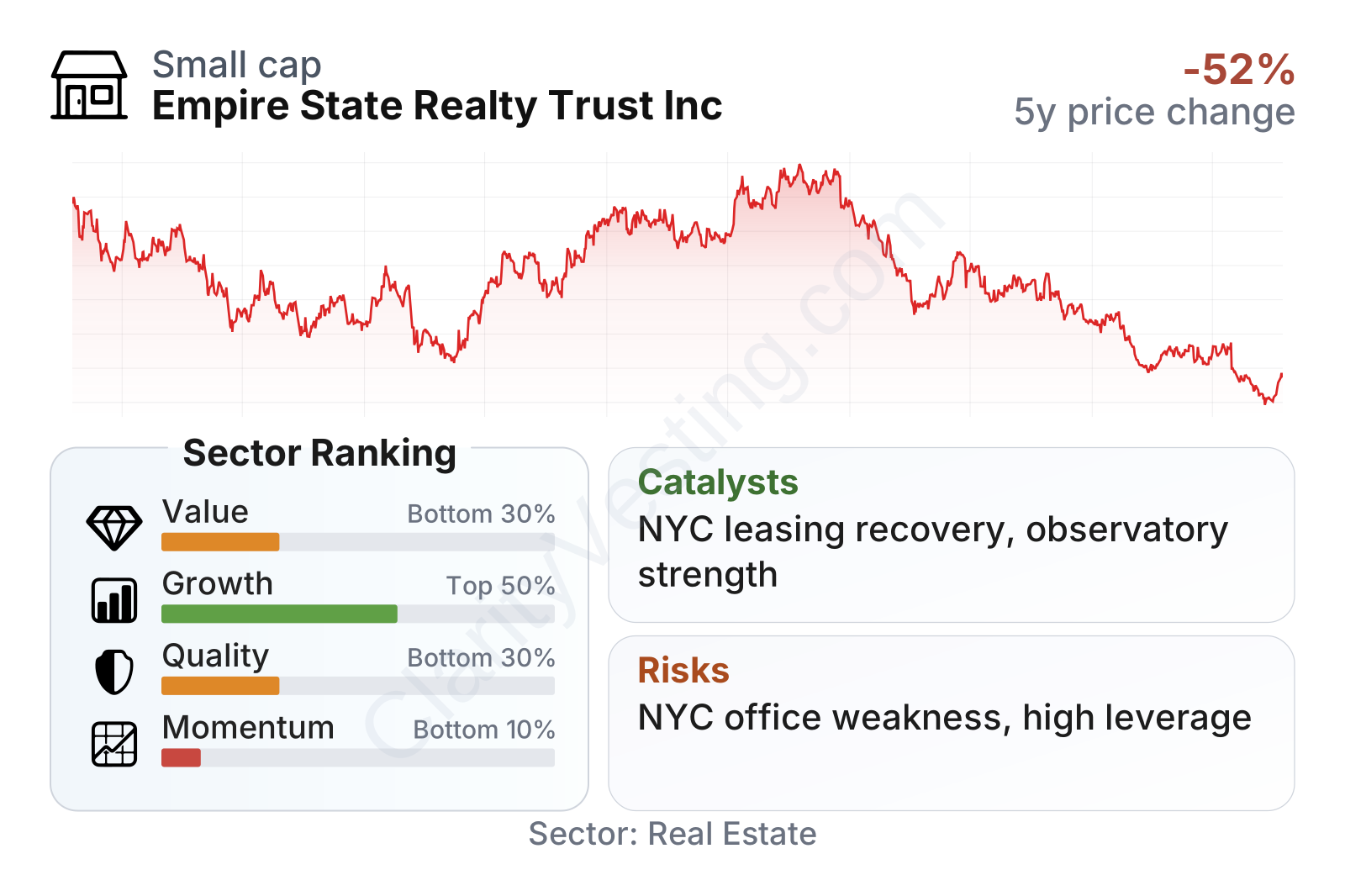
ESRT is a small-cap REIT with share-price behavior that has been more volatile than the broader market. Recent factor positioning points to a mixed profile: growth measures are around the middle of the real estate sector, while value, quality, and especially momentum rank weakly. In plain terms, the company has managed some long-term revenue growth and dividend growth, but the market has been skeptical because profitability, returns on assets, and stock performance have lagged many peers.
The stock’s recent performance has been notably weak over one year, three years, and versus its 200-day average. At the same time, free cash flow generation remains meaningful for a company of this size, and the dividend yield is moderate rather than high compared with the sector. The table also highlights an important contradiction: ESRT does not screen as cheap on common multiples such as price-to-book or price-to-earnings, even after a sharp decline in its stock price.
Growth
ESRT operates in a sector that is mature rather than fast-growing. Office real estate, especially in large urban markets, has faced a structural challenge since remote and hybrid work became more common. That makes this a selective environment where growth depends less on broad sector expansion and more on owning the right buildings in the right submarkets, keeping occupancy resilient, and upgrading assets to remain relevant for tenants.
Within that context, ESRT’s strategy has a clear logic. Management has emphasized prime locations, energy efficiency, redevelopment, and the brand value of the Empire State Building. In an office market where tenants are increasingly choosing better buildings over older, less competitive space, that positioning matters. The company also has an unusual second engine in the observatory business, which benefits from New York tourism rather than office demand. If office demand remains uneven, a strong tourism backdrop can help cushion the impact.
Revenue per share has trended upward over the last five years, but the pace has slowed more recently. That points to a company that has recovered from earlier disruption and expanded sales on a per-share basis, yet is not currently in a high-growth phase. The more encouraging element is that the trend has remained positive despite a difficult office backdrop.
The dividend per share has also moved gradually higher. The growth rate is not dramatic, but the pattern suggests a business that has rebuilt payout capacity over time. For a REIT, that steady progression is more meaningful when paired with operating stability than when driven by aggressive leverage.
Potential catalysts over the medium term are fairly specific. Better office leasing in Manhattan, higher occupancy in ESRT’s upgraded properties, and stronger observatory traffic could all improve cash flow. The company has also highlighted sustainability features and indoor environmental quality across its portfolio, which may help attract tenants looking for premium space. In a market where many older office buildings are becoming less desirable, that can create a relative advantage.
A further opportunity comes from a simple comparison effect: if the New York office market stabilizes after several years of pressure, even moderate improvement in leasing spreads or occupancy could have an outsized impact on sentiment because expectations are already low. This is not a broad secular growth narrative, but it is a plausible recovery and repositioning narrative.
Risks
This article is for informational purposes only and does not constitute financial advice. Some content is AI-generated. See Disclaimer


