Stock Analysis · Esquire Financial Holdings Inc (ESQ)
Overview
Esquire Financial Holdings Inc. is a small specialized commercial bank. Through Esquire Bank, it focuses on two main areas: business banking for the legal industry and payment processing services tied largely to litigation, settlement, and merchant relationships. Rather than trying to compete as a broad national consumer bank, the company has built a niche around law firms, plaintiffs’ firms, case-related services, and payment platforms that need tailored banking products.
This niche matters because it shapes both revenue quality and growth potential. A specialized bank can often charge better pricing and deepen client relationships if it understands a narrow customer base better than larger generalist banks. Esquire has used that approach to build a deposit base, originate commercial loans, and earn fee income from payment processing and other banking services.
Based on company filings, the business is primarily funded by the traditional banking model of gathering deposits and earning income from loans and securities, with a meaningful additional contribution from noninterest income. The broad revenue mix can be summarized as follows:
- Net interest income: approximately 75% to 80% of total revenue. This is the spread between interest earned on loans and securities and interest paid on deposits and other funding sources.
- Noninterest income: approximately 20% to 25% of total revenue. This includes payment processing-related fees, service charges, and other banking fees.
- Core lending activity: commercial and consumer lending tied largely to the company’s niche markets, including loans to law firms and related clients.
- Deposit services: operating and escrow-type deposits from law firms and payment-related relationships that support funding and liquidity.
Over the last several years, total revenue and net income have both climbed materially, and operating expenses have also risen, but at a slower pace than revenue. That pattern points to operating leverage: the company has been getting larger without losing its profitability profile.
The long-term direction here is favorable: revenue has expanded strongly since 2021, while net income has also moved higher, suggesting that growth has not come at the expense of earnings quality. Interest expense has risen as rates and funding costs increased, but the company has still widened its earnings base.
Key Figures
| Metric | Value | Sector ⓘ |
|---|---|---|
| Date | Oct 17, 2026 | |
| Context | ||
| Sector | Financial Services | |
| Industry | Banks - Regional | |
| Market Cap ⓘ | $1.44B | |
| Beta ⓘ | 0.40 | |
Value (Cheapness) | ||
| P/E Ratio ⓘ | 20.04 | 12.26 |
| P/B Ratio ⓘ | 3.30 | 1.23 |
| FCF Yield ⓘ | 4.18% | 10.40% |
| Dividend Yield ⓘ | 0.64% | 3.02% |
| EBIT / EV ⓘ | 6.38% | 8.14% |
| PEG ⓘ | N/A | |
Growth (Business expansion) | ||
| Revenue Growth ⓘ | 21.40% | 9.35% |
| RPS Growth (5Y CAGR) ⓘ | 23.01% | 12.19% |
| EPS Growth (5Y CAGR) ⓘ | -3.88% | -9.53% |
| BVPS Growth (5Y CAGR) ⓘ | 16.44% | 4.99% |
| Margin Growth (5Y Trend) ⓘ | 7.01% | -3.86% |
| FCF Growth (5Y CAGR) ⓘ | 20.22% | 4.81% |
| DPS Growth (5Y CAGR) ⓘ | 25.60% | 8.79% |
Quality (Business durability) | ||
| ROIC (Latest) ⓘ | N/A | 9.49% |
| ROE (Latest) ⓘ | 17.79% | 13.90% |
| ROA (Latest) ⓘ | 2.25% | 1.55% |
| ROIC (5Y Median) ⓘ | 31.71% | 7.86% |
| ROE (5Y Median) ⓘ | 19.31% | 12.17% |
| ROA (5Y Median) ⓘ | 2.39% | 1.30% |
| Net Debt / EBIT (Latest) ⓘ | -3.32 | 0.96 |
| Net Debt / EBIT (5Y Median) ⓘ | -3.40 | 0.73 |
| Net Debt / EBITDA (Latest) ⓘ | -3.12 | 0.92 |
| Operating Margin (Latest) ⓘ | 40.57% | 22.30% |
| Operating Margin (5Y Median) ⓘ | 42.87% | 24.63% |
| Debt to Equity (Latest) ⓘ | N/A | 58.56% |
| Profit Margin (Latest) ⓘ | 35.31% | 26.57% |
| Free Cash Flow (Latest) ⓘ | $60.20M | |
Momentum (Price trend) | ||
| 3Y Return ⓘ | +168.13% | +88.33% |
| 12M Return (excl. last month) ⓘ | +25.48% | +19.38% |
| 6M Return ⓘ | +3.78% | +4.75% |
| Price vs. 200-Day MA ⓘ | +5.12% | +3.50% |
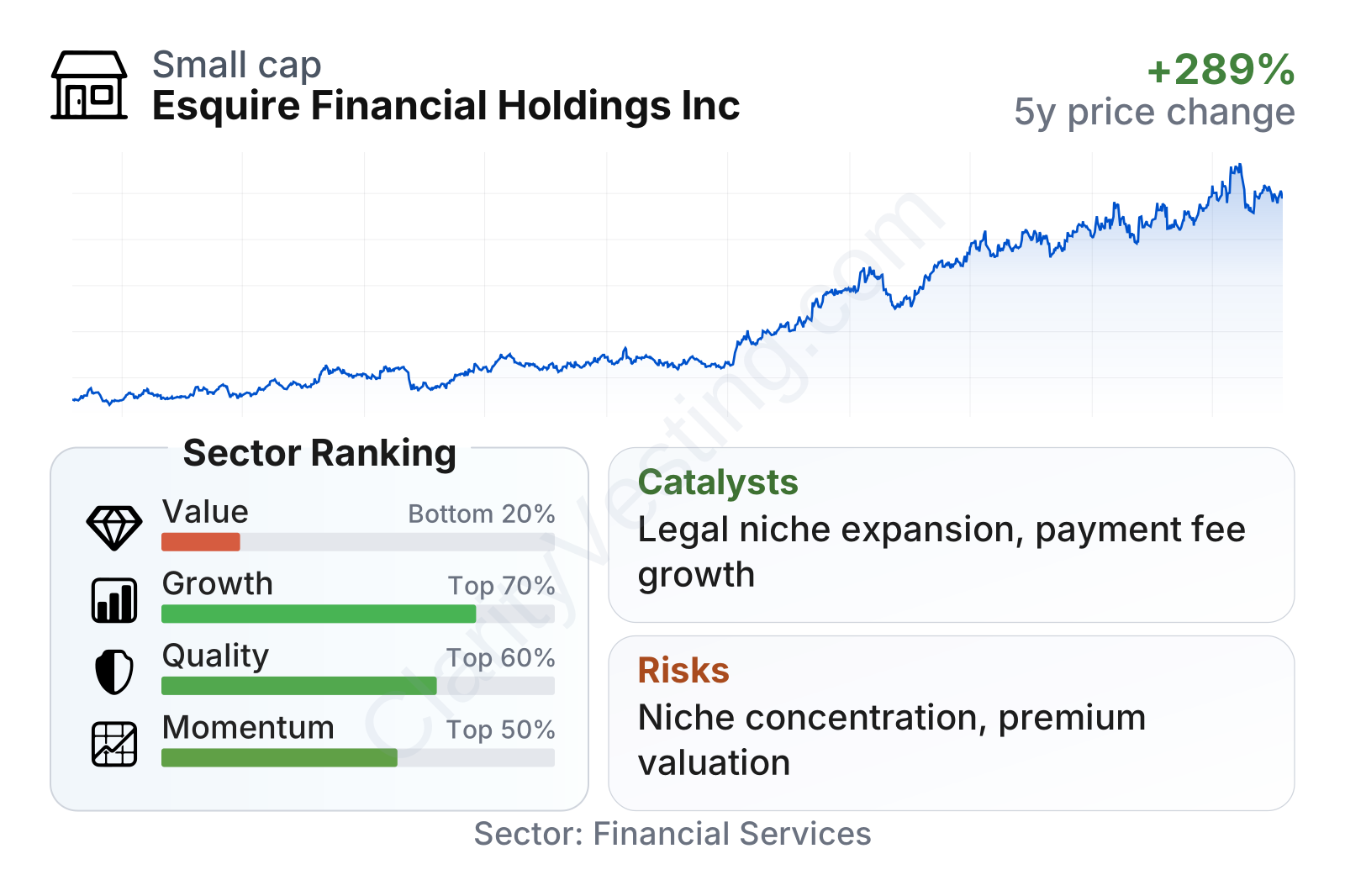
Esquire is still a relatively small public bank by market value, but it has delivered unusually strong business expansion for that size. Growth metrics are generally above the regional bank median, while profitability measures also compare well with peers. The weaker point in the table is valuation: the shares trade at higher earnings and book-value multiples than the sector median, which means the market is already recognizing the company’s stronger profile. Another notable point is the low beta, which suggests the stock has historically moved less than the broader market.
The stock chart shows a strong multiyear advance, especially from late 2024 into 2026. That kind of appreciation often reflects a combination of earnings growth, improving recognition by the market, and confidence that the company’s niche model can keep compounding.
Growth
Esquire operates in a mature industry, regional banking, but it is not trying to grow like an ordinary branch-based bank. Its growth comes from specialization. The legal industry and litigation-related banking needs are not new, yet they remain fragmented and often underserved by large banks that prefer standardized products. That gives Esquire room to keep taking share if it continues executing well.
The strategy makes sense because niche banking can create tighter relationships and more durable deposits. Law firms and related service providers may value a bank that understands trust accounts, settlement flows, and specialized lending needs. In payment processing, the company also benefits from transaction activity that can produce fee income not directly tied to loan growth.
Earnings per share have risen sharply from 2021 through 2025, moving from the low-$2 range to well above $5. Even without focusing on every quarterly movement, the overall trend shows a business that has been scaling profitably rather than merely adding assets for the sake of size.
Book value per share has also increased steadily, from about $18 in 2021 to more than $33 by 2025. For a bank, that is an important signal because it shows the company has been building shareholder equity while expanding earnings. The five-year growth rate in book value per share is far ahead of the sector median, which supports the case that growth has been real, not just cosmetic.
There are also several practical catalysts behind future expansion. First, a higher share of low-cost and operational deposits can support margins over time. Second, continued cross-selling between lending, deposits, and payments can raise revenue per client. Third, a successful niche strategy can remain scalable for longer than many expect because specialized industries often prefer expertise over branch size.
Recent company reporting has also indicated continued business momentum, with revenue growth still running ahead of many regional banks. In an industry where many banks have been dealing with slower loan demand and pressure on funding costs, Esquire’s above-median growth stands out as a meaningful opportunity indicator.
Risks
This article is for informational purposes only and does not constitute financial advice. Some content is AI-generated. See Disclaimer


