Stock Analysis · Essent Group Ltd (ESNT)
Overview
Essent Group Ltd is a private mortgage insurance company. In simple terms, it helps protect mortgage lenders when homebuyers make a small down payment and then fail to repay their loan. This type of insurance is mainly used in the U.S. housing market and is especially tied to conventional residential mortgages sold to or backed by Fannie Mae and Freddie Mac. Essent also earns income by investing the premiums it holds before claims are paid, which is typical for insurance businesses.
The business is fairly concentrated, which makes it easier to understand. Based on recent annual reporting, Essent’s revenue mainly comes from insurance activity, with investment income as a secondary contributor.
- Net premiums earned: about 70% to 75% of total revenue. This is the core business and reflects premiums from mortgage insurance policies written on residential loans.
- Net investment income: about 20% to 25% of total revenue. This comes from investing Essent’s insurance float, primarily in fixed-income securities and other investment assets.
- Other income sources: about 3% to 8%. These can include fees, underwriting-related items, and periodic gains or losses linked to investment and reinsurance activities.
Over the last several years, revenue has generally remained above $1.0 billion annually, while profitability has stayed strong even as claim patterns and interest costs moved around. That stability matters because mortgage insurance can look simple on the surface, but earnings depend heavily on underwriting discipline, home prices, unemployment, and the credit quality of insured loans.
Essent’s income structure shows an unusually high conversion of revenue into operating profit and net income for a financial company, although margins have eased from earlier peaks. Operating expenses remain relatively contained, while changes in claims, investment returns, and financing costs explain most of the year-to-year movement.
Key Figures
| Metric | Value | Sector ⓘ |
|---|---|---|
| Date | Oct 17, 2026 | |
| Context | ||
| Sector | Financial Services | |
| Industry | Insurance - Specialty | |
| Market Cap ⓘ | $5.65B | |
| Beta ⓘ | 0.76 | |
Value (Cheapness) | ||
| P/E Ratio ⓘ | 8.77 | 12.26 |
| P/B Ratio ⓘ | 1.03 | 1.23 |
| FCF Yield ⓘ | 14.62% | 10.40% |
| Dividend Yield ⓘ | 2.13% | 3.02% |
| EBIT / EV ⓘ | 13.54% | 8.14% |
| PEG ⓘ | 0.84 | |
Growth (Business expansion) | ||
| Revenue Growth ⓘ | 13.60% | 9.35% |
| RPS Growth (5Y CAGR) ⓘ | 8.14% | 12.19% |
| EPS Growth (5Y CAGR) ⓘ | -16.63% | -9.53% |
| BVPS Growth (5Y CAGR) ⓘ | 10.96% | 4.99% |
| Margin Growth (5Y Trend) ⓘ | -12.99% | -3.86% |
| FCF Growth (5Y CAGR) ⓘ | 4.68% | 4.81% |
| DPS Growth (5Y CAGR) ⓘ | 15.04% | 8.79% |
Quality (Business durability) | ||
| ROIC (Latest) ⓘ | 11.40% | 9.49% |
| ROE (Latest) ⓘ | 11.94% | 13.90% |
| ROA (Latest) ⓘ | 9.11% | 1.55% |
| ROIC (5Y Median) ⓘ | 13.87% | 7.86% |
| ROE (5Y Median) ⓘ | 14.56% | 12.17% |
| ROA (5Y Median) ⓘ | 11.46% | 1.30% |
| Net Debt / EBIT (Latest) ⓘ | 0.49 | 0.96 |
| Net Debt / EBIT (5Y Median) ⓘ | 0.41 | 0.73 |
| Net Debt / EBITDA (Latest) ⓘ | 0.49 | 0.92 |
| Operating Margin (Latest) ⓘ | 64.49% | 22.30% |
| Operating Margin (5Y Median) ⓘ | 75.43% | 24.63% |
| Debt to Equity (Latest) ⓘ | 8.76% | 58.56% |
| Profit Margin (Latest) ⓘ | 51.45% | 26.57% |
| Free Cash Flow (Latest) ⓘ | $825.89M | |
Momentum (Price trend) | ||
| 3Y Return ⓘ | +38.26% | +88.33% |
| 12M Return (excl. last month) ⓘ | +10.11% | +19.38% |
| 6M Return ⓘ | +6.03% | +4.75% |
| Price vs. 200-Day MA ⓘ | +2.43% | +3.50% |
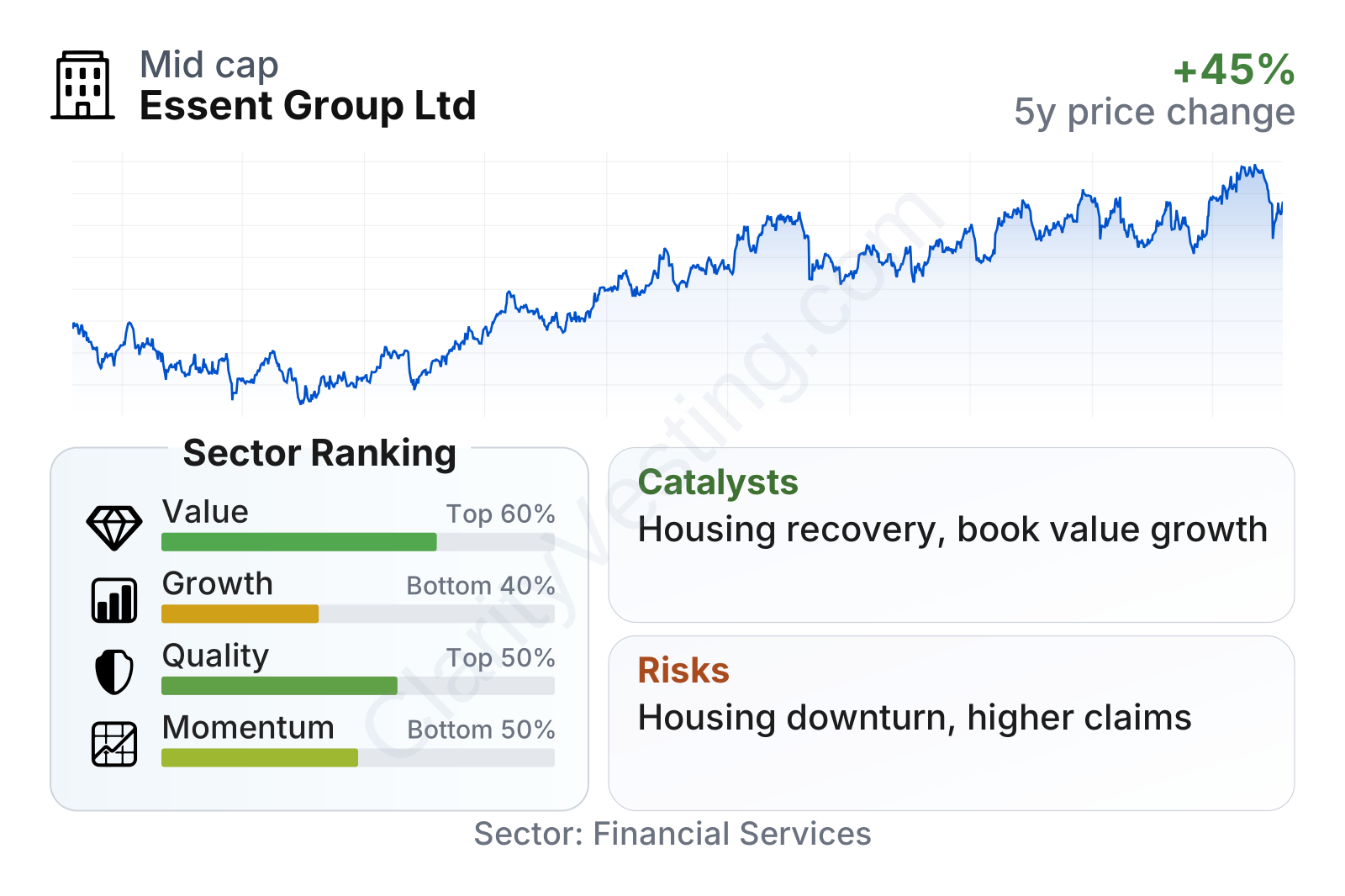
Essent currently looks stronger on profitability and balance-sheet discipline than on headline growth or share-price momentum. Valuation measures sit below sector medians in several areas, while quality indicators remain solid: profitability is high, leverage is low, and free cash flow generation is robust. The weaker spots are slower longer-term earnings growth and a stock performance trend that has lagged much of the broader financial sector.
The stock’s path over the last few years has been positive but not smooth. After dropping in 2022, shares recovered strongly through 2024, then moved through a more uneven period before reaching new highs in 2026. That pattern fits the business: mortgage insurers are closely watched for shifts in housing activity, credit conditions, and future claims.
Growth
Essent operates in a market that should remain relevant as long as home affordability stays difficult and many buyers continue to use low-down-payment mortgages. Mortgage insurance is not a high-growth technology market, but it serves a durable need in U.S. housing finance. When mortgage origination volumes recover, insurers like Essent can benefit from more new business written. Even when originations are soft, insurance-in-force can remain sizable because policies stay on the books for years.
The company’s strategy is logical for this kind of industry: stay selective on underwriting, protect capital, use reinsurance to manage risk, and let book value compound over time. Essent has also built a meaningful investment income stream, which has become more helpful as interest rates increased. That gives it a second earnings engine beyond pure premium growth.
Earnings per share surged in 2022, then pulled back and stabilized in the high-$6 range over the following years. That does not point to a straight-line growth profile, but it does show resilience. For a mortgage insurer, steadier earnings after a housing slowdown can be a positive sign because it suggests claims and pricing have remained manageable.
One of the clearest growth markers is book value per share, which has climbed consistently from roughly $38 in 2021 to nearly $58 by 2025. For an insurer, rising book value is important because it reflects retained earnings, capital strength, and the capacity to support future insurance writing or shareholder returns. Essent’s book value growth has outpaced the sector median over five years, even though revenue and earnings growth have been less impressive than some peers.
A practical catalyst for future growth is any improvement in U.S. housing transaction activity, especially if lower mortgage rates unlock refinancing or home purchases. Another catalyst is Essent’s ability to keep generating attractive returns while buying back stock, paying a growing dividend, and writing business with disciplined credit standards. Company-hosted releases in 2026 have continued to highlight capital return activity and solid operating performance, which supports the view that management is still focused on compounding value rather than chasing volume.
Risks
This article is for informational purposes only and does not constitute financial advice. Some content is AI-generated. See Disclaimer


