Stock Analysis · ESAB Corp (ESAB)
Overview
ESAB Corporation is an industrial equipment company focused on metal joining, cutting, and gas control. In simple terms, it sells the tools, consumables, and systems used to weld, cut, shape, and handle industrial gases in factories, construction sites, shipyards, energy projects, and repair shops. The company traces its roots to welding technology and today operates globally across the Americas, Europe, the Middle East, Africa, and Asia-Pacific.
Its business is organized mainly into two segments, and the larger one clearly drives the group.
- Fabrication Technology: approximately 84% of 2025 revenue. This segment includes welding consumables such as electrodes, wires, and fluxes; arc welding equipment; cutting equipment; and automated welding and cutting systems used in industrial manufacturing and infrastructure work.
- Gas Control Equipment: approximately 16% of 2025 revenue. This segment includes regulators, torches, gas equipment, and related products used in cutting, heating, and gas delivery applications for industrial and specialty markets.
That mix matters because consumables and replacement products can make revenue more resilient than a pure heavy-equipment model. ESAB also benefits from a broad installed base, which can support recurring sales of filler metals, tips, torches, and service-related demand.
Over the last several years, revenue has generally trended upward from about $2.4 billion in 2021 to roughly $2.8 billion in 2025. Gross profit also improved over that period, showing that pricing, mix, and operating discipline have helped offset a cyclical industrial backdrop. However, net income and cash generation have been less smooth, which is important for a long-term view.
The business model shows a healthy gross profit layer and solid operating income for an industrial manufacturer, but it also shows that selling and administrative costs are meaningful and that interest expense has remained noticeable. Revenue rose over time, yet earnings have not advanced in a straight line, so execution and balance-sheet management remain central to the investment case.
Key Figures
| Metric | Value | Sector ⓘ |
|---|---|---|
| Date | Oct 24, 2026 | |
| Context | ||
| Sector | Industrials | |
| Industry | Metal Fabrication | |
| Market Cap ⓘ | $4.05B | |
| Beta ⓘ | 1.14 | |
Value (Cheapness) | ||
| P/E Ratio ⓘ | 20.31 | 22.29 |
| P/B Ratio ⓘ | 1.64 | 1.98 |
| FCF Yield ⓘ | 4.85% | 6.26% |
| Dividend Yield ⓘ | 0.65% | 1.92% |
| EBIT / EV ⓘ | 5.38% | 4.83% |
| PEG ⓘ | 0.68 | |
Growth (Business expansion) | ||
| Revenue Growth ⓘ | 12.90% | 9.30% |
| RPS Growth (5Y CAGR) ⓘ | 3.63% | 7.76% |
| EPS Growth (5Y CAGR) ⓘ | -11.76% | -13.17% |
| BVPS Growth (5Y CAGR) ⓘ | -4.01% | 6.13% |
| Margin Growth (5Y Trend) ⓘ | 0.74% | 0.74% |
| FCF Growth (5Y CAGR) ⓘ | -0.22% | 10.79% |
| DPS Growth (5Y CAGR) ⓘ | 37.42% | 9.41% |
Quality (Business durability) | ||
| ROIC (Latest) ⓘ | 7.21% | 10.75% |
| ROA (Latest) ⓘ | 3.02% | 5.41% |
| ROIC (5Y Median) ⓘ | 11.59% | 9.37% |
| ROA (5Y Median) ⓘ | 6.20% | 4.95% |
| Net Debt / EBIT (Latest) ⓘ | 6.07 | 2.04 |
| Net Debt / EBIT (5Y Median) ⓘ | 2.31 | 2.27 |
| Net Debt / EBITDA (Latest) ⓘ | 4.65 | 1.39 |
| Net Debt / Assets ⓘ | 33.61% | 19.27% |
| EBITDA / Interest ⓘ | 4.85 | 9.58 |
| Operating Margin (Latest) ⓘ | 12.10% | 10.49% |
| Operating Margin (5Y Median) ⓘ | 14.34% | 10.30% |
| Debt to Equity (Latest) ⓘ | 95.46% | 64.82% |
| Profit Margin (Latest) ⓘ | 5.75% | 6.67% |
| Free Cash Flow (Latest) ⓘ | $196.61M | |
Momentum (Price trend) | ||
| 3Y Return ⓘ | +3.08% | +67.77% |
| 12M Return (excl. last month) ⓘ | -39.08% | +12.05% |
| 6M Return ⓘ | -36.97% | 0.00% |
| Price vs. 200-Day MA ⓘ | -29.96% | +0.67% |
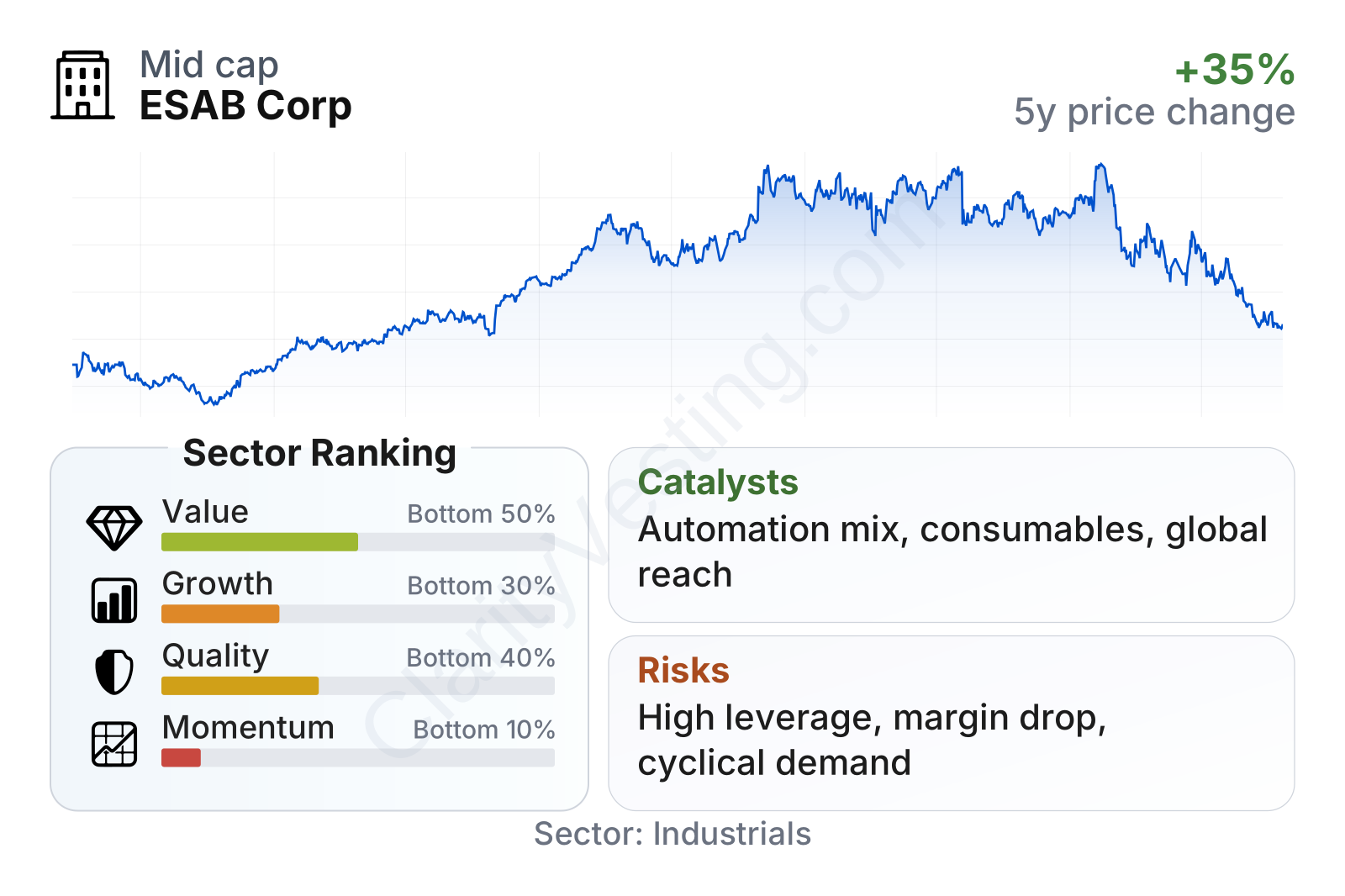
ESAB is a mid-sized industrial company with a market value around $4 billion and a share-price volatility that is slightly above the broader market. The table points to a mixed profile: valuation is near the industrial sector median on earnings, but not unusually cheap on cash flow. Growth looks uneven, with recent revenue improving but longer-term per-share expansion and free cash flow trends trailing much of the sector. Profitability remains respectable at the operating level, although leverage and weaker recent share-price momentum weigh on the overall picture.
The stock chart also highlights how much sentiment has shifted. After a strong climb through 2023, 2024, and into 2025, the shares pulled back sharply in 2026. For long-term analysis, that decline is relevant because it changes the valuation discussion, but it does not by itself solve concerns around margins, debt, or consistency.
Growth
ESAB operates in markets that have durable long-term demand drivers. Welding, cutting, and gas control are essential to construction, transportation, energy, shipbuilding, general manufacturing, and maintenance work. These are not fashionable end markets, but they are deeply embedded in the real economy. Over time, trends such as infrastructure renewal, factory automation, electrification, power-grid investment, LNG and energy projects, and reshoring of industrial production can all support demand for ESAB’s products.
The company’s strategy also makes industrial sense. It is not trying to reinvent itself around a single high-risk technology. Instead, it is building around a broad product portfolio, geographic reach, consumables exposure, productivity-focused premium equipment, and selective acquisitions. That approach can create growth from several sources at once: higher-value equipment, recurring consumables demand, cross-selling, and margin improvement through scale and operating discipline.
Recent revenue momentum has improved after a softer patch in 2024 and early 2025. Year-over-year growth turned negative for several quarters, then moved back into positive territory and has recently accelerated into the low-teens range, ahead of the sector median. That rebound suggests end-market demand and pricing are stabilizing better than they were during the prior slowdown, although it still needs to translate into stronger bottom-line consistency.
Cash generation remains one of the more important pieces to watch. Free cash flow was much stronger in 2024 and 2025 than it is now, and the trailing level has moved down from earlier highs. Even so, ESAB is still generating positive cash flow, which gives it room to fund dividends, pay interest, pursue bolt-on acquisitions, and invest in product development. For a company in industrial manufacturing, staying solidly cash generative through changing cycles is an encouraging trait, even if the recent direction is less favorable.
A notable catalyst for future growth is the company’s continued focus on higher-margin automation and workflow solutions. Manufacturers increasingly want labor-saving equipment and more efficient fabrication systems, especially in tight labor markets. If ESAB can keep moving customers toward more automated and premium offerings while retaining consumables pull-through, growth quality could improve even without a booming industrial economy.
Another helpful factor is geographic diversification. Because ESAB sells globally, it is not tied to a single country or one construction cycle. That does not remove cyclicality, but it can soften local downturns and open opportunities when capital spending recovers in different regions at different times.
Risks
This article is for informational purposes only and does not constitute financial advice. Some content is AI-generated. See Disclaimer


