Stock Analysis · Eversource Energy (ES)
Overview
Eversource Energy is a regulated utility serving customers in the Northeast, mainly across Connecticut, Massachusetts, and New Hampshire. Its core role is simple: it delivers electricity and natural gas, operates local energy networks, and earns most of its profit through state-approved rates on infrastructure such as power lines, substations, and gas distribution systems. That business model usually produces steadier demand than most industries because homes and businesses keep using energy in both strong and weak economies.
The company’s revenue mix is led by regulated electric operations, with natural gas distribution as the second-largest contributor. Based on recent company reporting, the main sources of revenue are approximately the following:
- Electric distribution and transmission: about 75% to 80% of revenue. This includes delivering electricity to retail customers and earning regulated returns on transmission assets connected to the regional grid.
- Natural gas distribution: about 20% to 25% of revenue. This covers gas delivery service to residential, commercial, and industrial customers in its service territories.
- Water and other operations: less than 5% of revenue. This is a much smaller activity and is not the main driver of the business.
Eversource has also been reshaping its business in recent years by exiting offshore wind development and narrowing its focus toward its regulated utility base. That matters for long-term analysis because regulated assets generally provide clearer earnings visibility than merchant or development-heavy energy activities.
The company’s financial flow over the last several years shows a business that remained large and cash-generative at the operating level, but with results affected by higher fuel and purchased power costs, rising interest expense, and one-time pressure tied to strategic repositioning. After a weak 2023, profitability improved materially in 2024 and strengthened further in 2025.
Key Figures
| Metric | Value | Sector ⓘ |
|---|---|---|
| Date | Nov 14, 2026 | |
| Context | ||
| Sector | Utilities | |
| Industry | Utilities - Regulated Electric | |
| Market Cap ⓘ | $26.22B | |
| Beta ⓘ | 0.66 | |
Value (Cheapness) | ||
| P/E Ratio ⓘ | 18.37 | 17.73 |
| P/B Ratio ⓘ | 1.18 | 1.95 |
| FCF Yield ⓘ | -0.20% | -0.52% |
| Dividend Yield ⓘ | 4.48% | 3.52% |
| EBIT / EV ⓘ | 6.18% | 5.78% |
| PEG ⓘ | 2.28 | |
Growth (Business expansion) | ||
| Revenue Growth ⓘ | -7.50% | 8.40% |
| RPS Growth (5Y CAGR) ⓘ | 6.26% | 3.61% |
| EPS Growth (5Y CAGR) ⓘ | -3.93% | -2.45% |
| BVPS Growth (5Y CAGR) ⓘ | 0.50% | 4.14% |
| Margin Growth (5Y Trend) ⓘ | 0.93% | 3.59% |
| FCF Growth (5Y CAGR) ⓘ | N/A | -8.59% |
| DPS Growth (5Y CAGR) ⓘ | 11.23% | 4.81% |
Quality (Business durability) | ||
| ROIC (Latest) ⓘ | N/A | 6.55% |
| ROA (Latest) ⓘ | 2.26% | 3.13% |
| ROIC (5Y Median) ⓘ | 5.03% | 5.92% |
| ROA (5Y Median) ⓘ | 2.58% | 2.74% |
| Net Debt / EBIT (Latest) ⓘ | 8.36 | 6.90 |
| Net Debt / EBIT (5Y Median) ⓘ | 9.78 | 7.25 |
| Net Debt / EBITDA (Latest) ⓘ | 5.23 | 4.25 |
| Net Debt / Assets ⓘ | 45.34% | 38.00% |
| EBITDA / Interest ⓘ | 3.88 | 4.58 |
| Operating Margin (Latest) ⓘ | 24.66% | 20.25% |
| Operating Margin (5Y Median) ⓘ | 20.70% | 19.99% |
| Debt to Equity (Latest) ⓘ | 127.05% | 137.35% |
| Profit Margin (Latest) ⓘ | 10.38% | 10.44% |
| Free Cash Flow (Latest) ⓘ | -$51.57M | |
Momentum (Price trend) | ||
| 3Y Return ⓘ | +55.37% | +54.85% |
| 12M Return (excl. last month) ⓘ | -1.19% | +6.56% |
| 6M Return ⓘ | +6.72% | +0.18% |
| Price vs. 200-Day MA ⓘ | +3.97% | +2.16% |
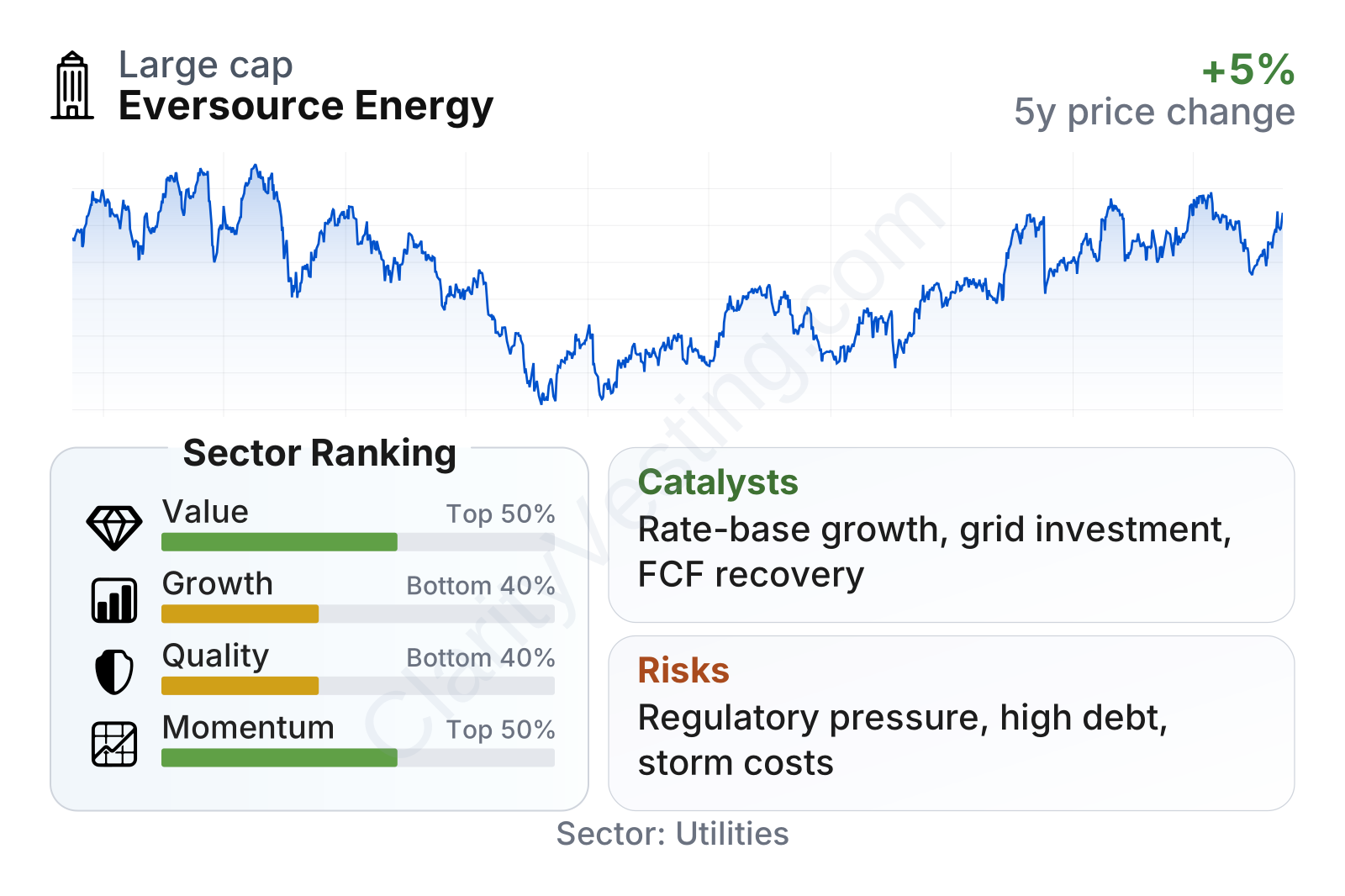
Eversource is a large utility with relatively low share-price volatility, reflected in a beta well below 1. On valuation, it sits near the sector on earnings but below the sector on book value, while the dividend yield is above the utility median. The overall profile is mixed: value metrics look broadly acceptable, but growth and quality rank weaker versus peers, mainly because earnings have been uneven and leverage remains elevated for the amount of profit the business generates.
The stock-price history also reflects that pattern. After a sharp decline through 2023, the shares recovered over 2024 through 2026, suggesting the market reassessed the company more favorably as balance-sheet concerns eased and earnings normalized.
Growth
The regulated utility sector is not a fast-growth industry, but it can still expand steadily through capital investment. Eversource’s long-term growth case depends less on customer volume and more on building and upgrading energy infrastructure that regulators allow it to earn returns on. In that sense, the sector remains supportive: grid modernization, reliability spending, storm hardening, electrification, and transmission expansion all create room for utilities to grow their asset base over time.
Eversource’s strategy makes practical sense for that environment. By concentrating on regulated electric and gas operations after stepping back from offshore wind development, the company is emphasizing areas with more predictable returns and lower execution risk. For a utility, this is often a more durable route to growth than relying on large, capital-intensive projects exposed to commodity swings or development setbacks.
Revenue per share has generally trended upward over the last five years, although not in a straight line. That suggests the company has still been expanding its business base over time, even if year-over-year revenue can fluctuate with weather, fuel pass-throughs, and regulatory timing. The recent annual decline in revenue is therefore less important than the longer-term pattern, especially in a regulated industry where earnings quality matters more than raw sales growth.
Cash generation has been a key improvement area. Free cash flow was deeply negative for several periods as capital spending ran ahead of internally generated cash, which is common in utilities during heavy investment cycles. More recently, free cash flow turned positive again, an encouraging sign because it suggests that the pressure from spending and restructuring may be easing. Even so, one positive reading does not fully erase the longer period of strain, so the direction matters more than the single point.
A notable catalyst is the company’s ongoing investment plan in transmission and distribution networks. Transmission in particular can be attractive because these assets often earn regulated returns with relatively clear cost recovery mechanisms. Another useful tailwind is the broader need to connect more renewable generation, data center demand, and electrified end uses to the grid in New England. Eversource does not need explosive demand growth to benefit; it mainly needs approval to keep investing in essential infrastructure.
Recent company updates have also emphasized execution around rate cases, capital deployment, and simplification of the business mix. For a utility, those are meaningful developments because they can improve earnings visibility and reduce the chance that non-core projects overshadow the regulated operations.
Risks
This article is for informational purposes only and does not constitute financial advice. Some content is AI-generated. See Disclaimer